
The Executive Summary of
The Fifth Discipline
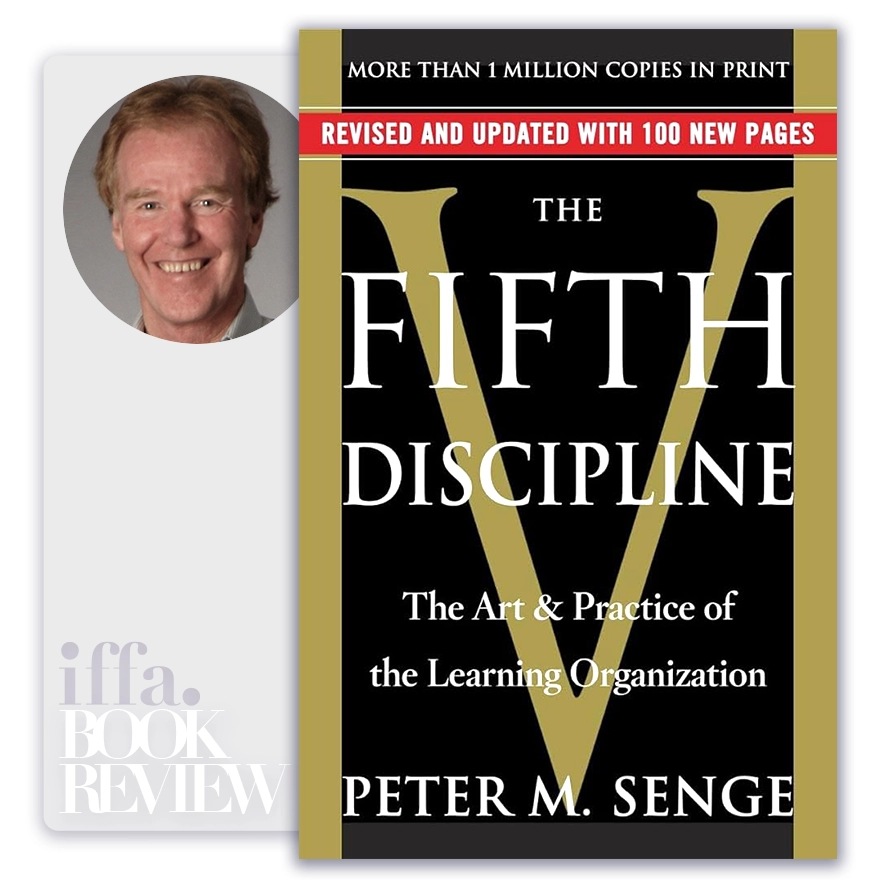
by Peter M. Senge
Summary Overview:
In complex systems, failure rarely results from isolated mistakes. It emerges from patterns embedded in structure. The Fifth Discipline reframes organizational performance through the lens of systems thinking, arguing that most challenges are systemic rather than individual. Peter M. Senge contends that sustainable advantage belongs to organizations capable of continuous learning.
For executives navigating interdependence, scale, and accelerating change, this book sharpens systems awareness, structural diagnosis, and long-term adaptive capacity. It challenges linear thinking and reactive problem-solving. In environments where unintended consequences undermine strategy, the capacity to see patterns rather than events becomes a structural advantage. Its relevance endures because complexity has only intensified since its publication.
About The Author
Peter M. Senge is a systems scientist and senior lecturer at the MIT Sloan School of Management, known for his work on organizational learning and systems thinking. His research integrates management theory, psychology, and systems dynamics to examine how institutions evolve. His distinctive contribution lies in framing organizations as living systems capable of learning and adaptation, rather than as static hierarchies focused solely on efficiency.
Core Idea:
The central thesis of The Fifth Discipline is that organizations achieve sustainable performance when they cultivate the capacity to learn collectively. Senge introduces five disciplines that together create a learning organization: systems thinking, personal mastery, mental models, shared vision, and team learning.
At its foundation, the book asserts that systems thinking integrates the other four disciplines into a coherent framework. Without understanding interdependence and feedback loops, organizations treat symptoms rather than root causes. The most powerful improvements occur when structural patterns are redesigned rather than when individuals are blamed. Learning organizations adapt not by reacting faster, but by understanding deeper.
Events are symptoms; structure drives behavior.
Key Concepts:
- Systems Thinking as Integrative Discipline
Systems thinking reveals patterns beneath events. Senge argues that problems persist when leaders focus on immediate incidents rather than structural causes.
- Linear thinking isolates variables
- Isolation obscures feedback loops
- Obscured loops perpetuate dysfunction
Understanding systemic interdependence prevents recurring crises. Structure shapes outcomes.
- Personal Mastery
Individual growth fuels institutional growth. Personal mastery emphasizes clarity of vision and disciplined self-development.
- Clarity strengthens commitment
- Commitment enhances resilience
- Resilience supports collective learning
Organizations thrive when individuals pursue continuous development. Personal discipline sustains organizational progress.
- Mental Models
Hidden assumptions shape decision-making. Senge stresses the importance of surfacing and testing ingrained beliefs.
- Unexamined beliefs distort interpretation
- Distorted interpretation limits adaptation
- Reflection improves judgment
Strategic maturity requires questioning foundational assumptions. Transparency of thought improves coherence.
- Shared Vision
Collective aspiration aligns effort. A shared vision transcends compliance and fosters engagement.
- Alignment reduces friction
- Reduced friction enhances execution
- Execution reinforces momentum
Organizations with authentic shared vision outperform those driven solely by targets. Purpose directs collective intelligence.
- Team Learning
Dialogue expands collective capability. Senge differentiates discussion from dialogue, emphasizing inquiry over debate.
- Debate defends position
- Dialogue explores possibility
- Exploration uncovers insight
Collaborative learning multiplies capacity. Collective insight exceeds individual expertise.
- Feedback Loops and Delays
Cause and effect are often separated by time. Senge highlights how delayed feedback obscures systemic consequences.
- Short-term fixes produce long-term instability
- Delays hide structural flaws
- Awareness prevents reactive escalation
Strategic patience enhances systemic correction. Timing influences sustainability.
- The Danger of Quick Fixes
Symptomatic solutions reinforce dependency. Senge describes “fixes that fail” archetypes.
- Immediate relief masks root cause
- Masking delays systemic reform
- Delay increases long-term cost
Durable solutions require structural redesign. Root cause thinking preserves stability.
- Organizational Alignment
Fragmentation weakens performance. Senge argues that siloed departments inhibit holistic understanding.
- Silo thinking limits perspective
- Limited perspective increases conflict
- Conflict undermines coordination
Integrated systems thinking fosters cohesion. Interdependence demands collaboration.
- Learning Versus Adaptation
Learning transcends reactive adjustment. Senge distinguishes between adapting to symptoms and transforming structure.
- Adaptation maintains status quo
- Structural change creates evolution
- Evolution sustains relevance
Organizations must move beyond reactive management. Learning requires redesign.
- Leadership in Learning Organizations
Leaders serve as designers, teachers, and stewards. Senge reframes leadership from control to facilitation.
- Design shapes structure
- Teaching shapes understanding
- Stewardship shapes continuity
Leadership responsibility lies in cultivating systemic clarity. Facilitative leadership sustains intelligence.
Learning requires confronting hidden assumptions.
Executive Insights:
At the executive level, The Fifth Discipline reframes performance management as structural diagnosis. Incentive systems that reward short-term fixes often reinforce systemic fragility. Sustainable value creation depends on embedding systems thinking into governance and strategy formulation.
Judgment improves when leaders analyze patterns rather than isolated metrics. Risk exposure decreases when feedback loops are anticipated rather than discovered through crisis. Long-term advantage belongs to organizations that institutionalize learning as a continuous discipline. Complexity requires integration, not simplification.
Actionable Takeaways:
Learning must become an organizational capability rather than an episodic initiative.
- Start embedding systems thinking into strategic reviews
- Stop addressing recurring problems with isolated interventions
- Reframe feedback loops as diagnostic tools
- Encourage open examination of mental models
- Align incentives with long-term structural improvement
- Reduce siloed decision-making processes
- Foster dialogue over defensive debate
- Protect time for reflective learning across teams
Final Thoughts:
The Fifth Discipline remains foundational because it reframes organizations as adaptive systems rather than mechanical hierarchies. Its enduring insight is that structure determines behavior more reliably than intention.
Long-term value creation depends on cultivating institutional learning capacity. Organizations that see patterns clearly redesign themselves deliberately. In the end, the ultimate competitive advantage belongs to those who understand the system they operate within and continuously improve it with discipline and foresight.
The ideas in this book go beyond theory, offering practical insights that shape real careers, leadership paths, and professional decisions. At IFFA, these principles are translated into executive courses, professional certifications, and curated learning events aligned with today’s industries and tomorrow’s demands. Discover more in our Courses.
Applied Programs

- Course Code : SBM-409
- Delivery : In-class / Virtual / Workshop
- Duration : 2-4 Days
- Venue: DUBAI HUB
- Course Code : PMA-613
- Delivery : In-class / Virtual / Workshop
- Duration : 3-5 Days
- Venue: DUBAI HUB

- Course Code : CIF-505
- Delivery : In-class / Virtual / Workshop
- Duration : 3-5 Days
- Venue: DUBAI HUB

- Course Code : CIF-512
- Delivery : In-class / Virtual / Workshop
- Duration : 2-4 Days
- Venue: DUBAI HUB
Related Books