
The Executive Summary of
Playing to Win
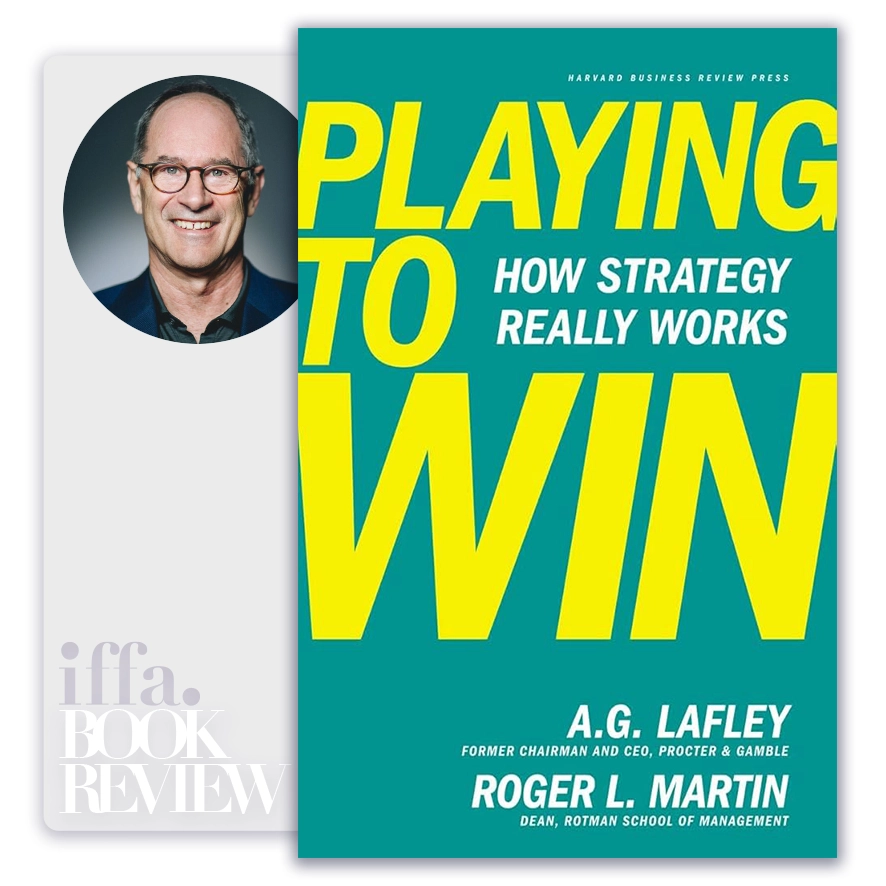
by Roger L. Martin & A.G. Lafley
Summary Overview:
In many organizations, strategy becomes an abstract exercise detached from operational reality. Playing to Win: How Strategy Really Works restores strategy to its essential function: making explicit choices about where to compete and how to win. Roger L. Martin and A.G. Lafley argue that strategy is not vision statements or financial targets; it is a coherent set of integrated decisions.
For executives navigating competitive complexity, this book sharpens choice discipline, competitive positioning, and systems alignment. It challenges the tendency to pursue growth everywhere and instead emphasizes focus. In markets defined by rapid imitation and margin pressure, clarity about where not to play becomes as critical as deciding where to compete. Its relevance endures because it treats strategy as an ongoing decision architecture rather than a periodic planning ritual.
About The Authors
Roger L. Martin is a strategy scholar and former dean of the Rotman School of Management, known for his work on integrative thinking and competitive strategy. A.G. Lafley is the former CEO of Procter & Gamble, where he led significant strategic transformation and sustained growth across global brands. Their collaboration blends academic rigor with operational execution, offering a perspective grounded in real-world competitive decision-making and disciplined organizational alignment. Their vantage point treats strategy as both intellectual framework and practical commitment.
Core Idea:
The central thesis of Playing to Win is that strategy is a cascade of integrated choices that define a path to winning. The authors argue that effective strategy answers five interrelated questions: winning aspiration, where to play, how to win, core capabilities, and management systems. Without explicit decisions in each area, organizations drift toward incoherence.
At its foundation, the book asserts that winning is not accidental; it is the result of deliberate, mutually reinforcing choices. Trade-offs are unavoidable. Attempting to serve all customers, compete in all segments, or pursue all opportunities dilutes advantage. Strategic success depends on focus, clarity, and alignment between ambition and capability.
Strategy is choice, not aspiration.
Key Concepts:
- Winning Aspiration
Winning must be clearly defined. The authors argue that vague ambitions produce vague results.
- Winning clarifies purpose
- Purpose guides resource allocation
- Allocation determines outcomes
Without a defined aspiration, organizations optimize for survival rather than leadership. Ambiguity weakens competitive intent.
- Where to Play
Strategic scope determines opportunity. Choices about geography, customer segment, channel, and product category shape competitive terrain.
- Overexpansion dilutes resources
- Undefined boundaries confuse positioning
- Clear scope concentrates effort
Focus creates leverage. Selective participation strengthens strategic clarity.
- How to Win
Competitive advantage requires a distinct approach. Winning cannot rely solely on participation; it demands differentiation.
- Differentiation may stem from cost, brand, innovation, or distribution
- Superiority must be sustainable
- Advantage must resonate with chosen customers
Competitive positioning must be explicit. Undefined advantage produces mediocrity.
- Core Capabilities
Capabilities enable strategy. The authors emphasize that ambition without supporting competencies collapses.
- Unique capabilities create barriers
- Barriers deter imitation
- Sustained investment reinforces advantage
Capabilities must be built deliberately. Execution capacity determines strategic credibility.
- Management Systems
Systems translate strategy into action. Incentives, metrics, and governance must reinforce chosen priorities.
- Misaligned incentives distort focus
- Fragmented reporting weakens coherence
- Clear accountability sustains execution
Without supportive systems, strategy remains theoretical. Alignment operationalizes intent.
- The Cascade of Choices
Strategy is interconnected, not isolated. Each decision influences and reinforces others.
- Aspiration shapes scope
- Scope defines advantage
- Advantage dictates capability needs
Disjointed decisions fragment performance. Integration ensures strategic coherence.
- Trade-Off Discipline
Trade-offs are unavoidable. Attempting to win everywhere creates diluted advantage.
- Broad focus weakens differentiation
- Excess options confuse customers
- Diffusion drains capital
Strategic restraint preserves strength. Clarity requires elimination.
- The Role of Leadership
Leadership’s responsibility is choice-making, not consensus-building. The authors argue that leaders must resolve ambiguity rather than amplify it.
- Indecision invites drift
- Drift erodes advantage
- Decisive clarity stabilizes direction
Strategic courage defines leadership maturity. Choice requires conviction.
- Testing and Learning
Strategy evolves through disciplined experimentation. The authors advocate testing hypotheses before scaling.
- Pilot initiatives reduce risk
- Feedback refines positioning
- Learning enhances resilience
Adaptive iteration sustains relevance. Strategic humility strengthens long-term advantage.
- Playing to Win Versus Playing Not to Lose
Defensive strategies rarely produce leadership. Organizations focused solely on protecting share often miss growth opportunities.
- Risk avoidance limits expansion
- Conservatism slows innovation
- Stagnation invites disruption
Winning requires proactive positioning. Offense creates momentum.
Winning requires coherence across every level of the organization.
Executive Insights:
At the executive level, Playing to Win reframes strategy as disciplined choice architecture. Incentive systems that reward incremental consensus may undermine decisive positioning. Long-term value creation depends on coherent alignment between aspiration, scope, advantage, capabilities, and systems.
Judgment strengthens when leaders regularly test whether activities reinforce chosen positioning. Risk exposure decreases when strategy is explicit rather than assumed. Organizations that institutionalize strategic clarity outperform those that pursue opportunistic expansion. Sustainable success depends on focus, conviction, and operational alignment.
Actionable Takeaways:
Strategy must be treated as a cascade of deliberate choices, not a collection of initiatives.
- Start defining winning in concrete terms
- Stop pursuing growth without clear competitive logic
- Reframe scope decisions as strategic commitments
- Embed trade-off discipline into planning processes
- Align capabilities investment with chosen positioning
- Reduce initiatives that do not reinforce strategic coherence
- Encourage hypothesis-driven experimentation before scaling
- Strengthen governance systems to reinforce strategic priorities
Final Thoughts:
Playing to Win: How Strategy Really Works restores strategy to its essence: disciplined choice in pursuit of competitive advantage. Its enduring value lies in its clarity and practical coherence.
Long-term value creation depends on leaders willing to commit to a defined path and align their organizations around it. Institutions endure when ambition, capability, and execution operate in harmony. In the end, strategy succeeds not by avoiding loss, but by committing boldly to the choices that make winning possible.
The ideas in this book go beyond theory, offering practical insights that shape real careers, leadership paths, and professional decisions. At IFFA, these principles are translated into executive courses, professional certifications, and curated learning events aligned with today’s industries and tomorrow’s demands. Discover more in our Courses.
Applied Programs

- Course Code : SBM-409
- Delivery : In-class / Virtual / Workshop
- Duration : 2-4 Days
- Venue: DUBAI HUB

- Course Code : PMA-613
- Delivery : In-class / Virtual / Workshop
- Duration : 3-5 Days
- Venue: DUBAI HUB

- Course Code : CIF-505
- Delivery : In-class / Virtual / Workshop
- Duration : 3-5 Days
- Venue: DUBAI HUB

- Course Code : CIF-512
- Delivery : In-class / Virtual / Workshop
- Duration : 2-4 Days
- Venue: DUBAI HUB
Related Books