
The Executive Summary of
Antifragile
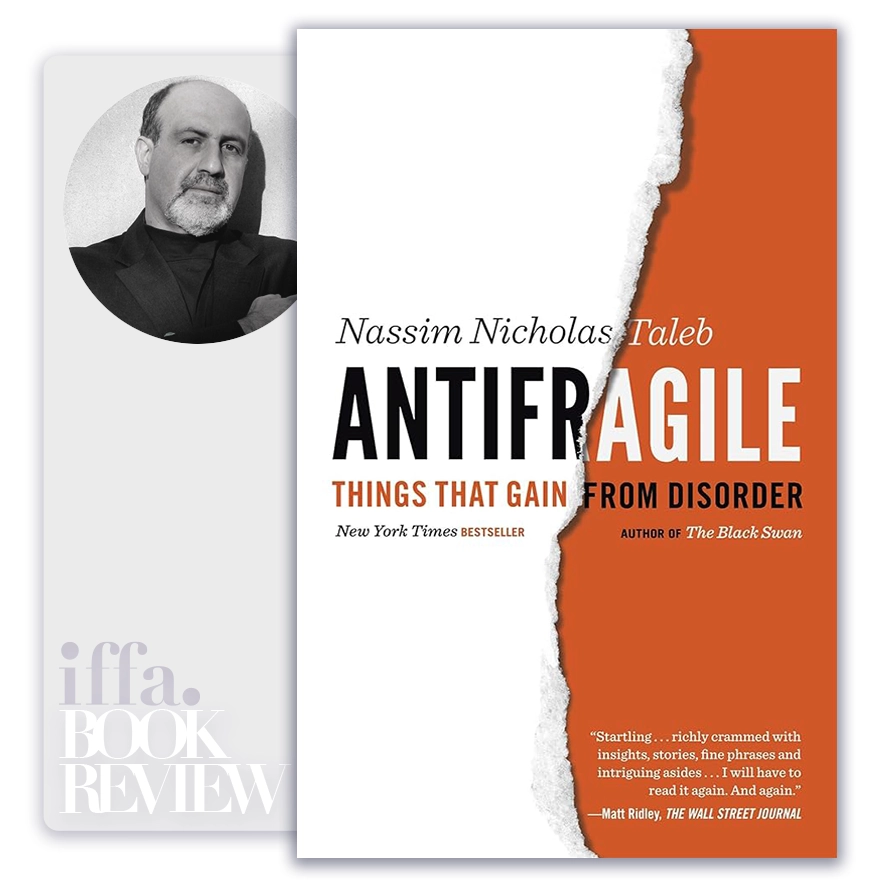
by Nassim Nicholas Taleb
Summary Overview:
In a world increasingly defined by volatility, uncertainty, complexity, and systemic shocks, Antifragile presents a fundamental shift in how leaders should think about risk, growth, and decision-making. Rather than focusing on survival or resilience alone, Nassim Nicholas Taleb introduces a more powerful concept: systems, organizations, and individuals that actively benefit from disorder, stress, and randomness. For executives, investors, policymakers, and strategists, this book provides a strategic operating philosophy for uncertainty-driven environments.
Antifragile matters because modern leadership models are built on prediction, optimization, and efficiency, all of which tend to fail catastrophically under stress. Taleb demonstrates why many institutions appear stable in calm conditions yet collapse during crises. The book challenges the illusion of control and replaces it with principles grounded in real-world exposure, evolutionary logic, and asymmetric outcomes, making it essential reading for leaders operating in high-stakes, non-linear systems.
About The Author
Nassim Nicholas Taleb is a former options trader, risk analyst, and quantitative thinker with deep, first-hand experience in financial markets and complex systems. His authority comes not from theory alone, but from decades of exposure to uncertainty, risk, and real-world consequences.
Taleb’s perspective is unique because he bridges mathematics, philosophy, history, and lived experience, challenging academic and corporate models that ignore how systems actually fail—and survive—in reality.
Core Idea:
At its heart, Antifragile advances one central, unifying idea:
Some things do not merely survive shocks—they improve because of them.
Taleb argues that the conventional framework of fragile vs. robust is incomplete. Robust systems resist shocks and remain unchanged, while antifragile systems grow stronger through volatility, randomness, and stress.
Modern organizations often believe they are becoming safer through planning, forecasting, optimization, and control. Taleb argues the opposite: these approaches frequently remove variability, feedback, and redundancy, making systems more fragile over time. Uncertainty, he explains, is not an enemy to eliminate—but a resource to harness, if systems are designed with the right asymmetries.
You do not need to predict the future, only to be prepared to benefit from it.
Key Concepts:
- Fragile, Robust, and Antifragile
Fragile systems are harmed by volatility.
They break under stress, shocks, or randomness. Examples include overleveraged institutions, rigid hierarchies, and forecast-dependent strategies.
Robust systems resist shocks but do not improve.
They endure stress but gain no upside from it.
Antifragile systems benefit from disorder.
They adapt, evolve, and strengthen when exposed to variability—like biological evolution, entrepreneurial ecosystems, and decentralized markets.
The opposite of fragile is not robust—it is antifragile.
- Optionality Over Prediction
Optionality is the ability to capture upside while limiting downside. Taleb argues that success does not depend on accurate forecasts, but on positioning oneself to benefit from favorable uncertainty.
Forecast-heavy strategies often create false confidence and hidden fragility. Optionality allows leaders to experiment, fail safely, and benefit disproportionately from success.
You do not need to predict the future—only to be prepared to benefit from it.
- The Barbell Strategy
The barbell strategy avoids moderate risk and instead combines extreme safety with selective, high-upside exposure.
- One side: maximum protection, redundancy, and capital preservation
- The other side: small, controlled risks with large upside
- The middle: continuous, moderate risk—the most dangerous zone
This strategy applies to investments, careers, innovation, and organizational design.
- Skin in the Game
Systems work better when decision-makers bear the consequences of their actions. Taleb criticizes structures where leaders collect rewards while transferring risk to others.
When there is skin in the game:
- Risks are assessed more realistically
- Fragility is exposed earlier
- Ethics and incentives align with survival
Those who take risks must also take losses.
- Via Negativa: Progress Through Subtraction
Taleb emphasizes via negativa—improvement through removal rather than addition. Complex systems often fail because of over-intervention and excess complexity.
Examples include:
- Removing debt instead of chasing returns
- Eliminating toxic processes rather than adding controls
- Reducing exposure instead of increasing prediction
- Small Failures, Big Survival
Antifragile systems allow frequent, small failures to prevent rare, catastrophic ones. Suppressing volatility may create short-term calm but leads to long-term collapse.
Healthy systems:
- Fail locally, not globally
- Learn through stress
- Adapt continuously
The opposite of fragile is not robust, it is antifragile.
Executive Insights:
Antifragile forces leaders to rethink success not as stability, but as adaptive strength under pressure. The book provides a lens for evaluating systems based on how they behave during stress—not calm.
Strategic Implications for Executives:
- Over-optimization increases fragility
- Forecast-driven planning creates blind spots
- Redundancy is a strategic asset, not inefficiency
- Decentralization improves resilience
- Long-term survival requires exposure to feedback and stress
Actionable Takeaways:
The principles of antifragility are immediately applicable across leadership, finance, operations, innovation, and governance.
Key Actions Leaders Can Take:
- Design systems that fail locally without collapsing globally
- Replace prediction-heavy plans with optionality-based strategies
- Encourage experimentation with capped downside and unlimited upside
- Remove hidden fragilities before pursuing growth
- Align incentives so risk-takers share both rewards and losses
- Favor simplicity, redundancy, and adaptability over efficiency
Final Thoughts:
Antifragile is not a traditional business or management book—it is a strategic survival manual for an unpredictable world. Taleb’s message is clear and uncompromising: disorder is not a threat to be avoided, but a force to be leveraged.
In an era of constant shocks, the most valuable competitive advantage is not prediction—but antifragility.
The ideas in this book go beyond theory, offering practical insights that shape real careers, leadership paths, and professional decisions. At IFFA, these principles are translated into executive courses, professional certifications, and curated learning events aligned with today’s industries and tomorrow’s demands. Discover more in our Courses.
Applied Programs

- Course Code : SBM-409
- Delivery : In-class / Virtual / Workshop
- Duration : 2-4 Days
- Venue: DUBAI HUB

- Course Code : PMA-613
- Delivery : In-class / Virtual / Workshop
- Duration : 3-5 Days
- Venue: DUBAI HUB

- Course Code : CIF-505
- Delivery : In-class / Virtual / Workshop
- Duration : 3-5 Days
- Venue: DUBAI HUB

- Course Code : CIF-512
- Delivery : In-class / Virtual / Workshop
- Duration : 2-4 Days
- Venue: DUBAI HUB
Related Books