
The Executive Summary of
All In on AI
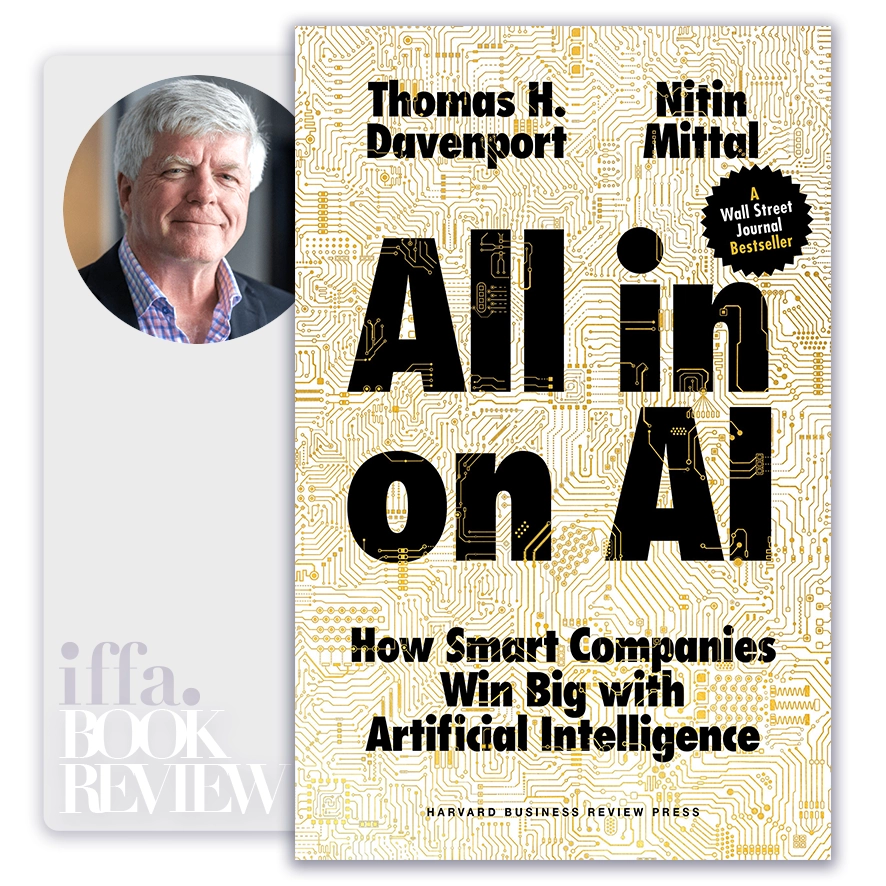
by Thomas H. Davenport
Summary Overview:
Artificial intelligence has shifted from experimental technology to competitive infrastructure. All-In on AI examines what differentiates organizations that extract strategic value from AI from those that treat it as incremental automation. Thomas H. Davenport argues that advantage does not come from isolated pilots, but from institutional commitment.
For executives navigating digital transformation, this book sharpens capital allocation discipline, organizational redesign, and capability alignment. It challenges superficial adoption and emphasizes systemic integration. In environments where AI investments are rising rapidly yet returns remain uneven, clarity about governance, talent, and operating model becomes decisive. The book remains relevant because it addresses not what AI can do, but how organizations must evolve to benefit from it.
About The Author
Thomas H. Davenport is a professor, researcher, and consultant specializing in analytics, digital innovation, and knowledge work transformation. With decades of advisory experience across global enterprises, he has examined how organizations convert data and emerging technologies into competitive advantage. His perspective is grounded in empirical case studies and managerial observation, focusing on institutional capability rather than technological novelty. He approaches AI not as abstraction, but as operational strategy.
Core Idea:
The central thesis of All-In on AI is that AI creates meaningful advantage only when it becomes embedded in strategy, processes, and culture. Davenport argues that scattered experiments generate learning but rarely transformation. Organizations that achieve outsized returns treat AI as core infrastructure rather than auxiliary tool.
At its foundation, the book asserts that AI success depends less on algorithms and more on organizational commitment. Leadership alignment, data governance, talent development, and process redesign determine outcomes. Companies that go “all-in” integrate AI into decision flows, operational workflows, and value propositions. Strategic clarity, not technological enthusiasm, separates leaders from followers.
Without leadership alignment, AI remains experimentation.
Key Concepts:
- From Experimentation to Enterprise Integration
Isolated pilots rarely transform performance. Davenport emphasizes that AI initiatives often stall when confined to departments.
- Pilots validate feasibility
- Integration delivers scale
- Scale creates economic impact
Strategic value emerges when AI becomes embedded in enterprise processes. Fragmentation limits return on investment.
- Leadership Commitment
Executive sponsorship determines AI trajectory. Davenport notes that organizations succeeding with AI have visible leadership endorsement.
- Clear strategic intent aligns resources
- Ambiguity diffuses investment
- Diffusion reduces momentum
Leadership must articulate how AI supports competitive positioning. Direction anchors transformation.
- Data as Strategic Asset
AI performance is constrained by data quality and governance. Without reliable data infrastructure, AI outputs lack credibility.
- Inconsistent data undermines trust
- Poor governance increases risk
- Robust architecture enables scalability
Data discipline becomes foundational to competitive differentiation. Infrastructure precedes intelligence.
- Talent and Capability Development
AI requires new skill architectures. Davenport highlights the need for data scientists, engineers, translators, and domain experts.
- Technical expertise enables modeling
- Business translators align AI with objectives
- Cross-functional collaboration enhances deployment
Talent strategy must evolve with technological ambition. Capability alignment sustains advantage.
- Process Redesign
AI does not simply automate existing workflows; it reshapes them. Davenport argues that organizations must rethink processes to extract value.
- Automation without redesign limits efficiency gains
- Redesign unlocks productivity and insight
- Insight enhances strategic agility
Transformation requires structural change, not surface optimization. Workflow evolution drives impact.
- AI in Decision-Making
AI augments judgment rather than replaces it. Successful organizations integrate machine recommendations with human oversight.
- Algorithms identify patterns
- Humans interpret context
- Combined judgment improves accuracy
Balanced integration reduces bias and enhances reliability. Collaboration between human and machine strengthens governance.
- Risk and Ethics
AI adoption introduces governance and ethical considerations. Davenport stresses the importance of transparency and accountability.
- Bias can erode trust
- Opaque systems increase liability
- Ethical frameworks sustain legitimacy
Strategic resilience requires anticipatory risk management. Responsible AI safeguards long-term credibility.
- Scaling AI Across the Enterprise
Scaling requires standardized platforms and shared learning. Davenport notes that successful firms create reusable models and common infrastructures.
- Shared platforms reduce duplication
- Reuse accelerates deployment
- Deployment compounds value
Economies of scale amplify return. Institutionalization multiplies innovation.
- Competitive Differentiation Through AI
AI creates advantage when embedded in customer value propositions. Davenport highlights examples where AI enhances personalization, efficiency, or predictive capability.
- Enhanced insight improves service
- Improved service strengthens loyalty
- Loyalty reinforces market position
Strategic positioning depends on integrating AI into offerings. Technology must translate into customer value.
- Cultural Transformation
AI transformation is cultural as much as technical. Davenport emphasizes learning orientation and openness to experimentation.
- Resistance slows adoption
- Curiosity accelerates adaptation
- Adaptation sustains relevance
Organizational mindset shapes technological success. Culture determines digital maturity.
AI advantage is organizational, not merely technical.
Executive Insights:
At the executive level, All-In on AI reframes artificial intelligence as enterprise strategy rather than innovation initiative. Incentive systems that isolate AI within IT departments limit impact. Sustainable advantage requires aligning governance, infrastructure, talent, and leadership around AI-enabled transformation.
Judgment improves when leaders evaluate AI not by novelty but by contribution to core objectives. Risk exposure decreases when data governance and ethical oversight are embedded early. Long-term value creation depends on disciplined integration and cultural alignment. Organizations that institutionalize AI capability outperform those that treat it as experimental enhancement.
Actionable Takeaways:
AI must be embedded as strategic infrastructure rather than discretionary innovation.
- Start aligning AI initiatives with explicit competitive objectives
- Stop limiting AI to pilot programs without scaling pathways
- Reframe data governance as core strategic priority
- Embed cross-functional collaboration in AI deployment
- Align talent development with long-term digital capability needs
- Reduce siloed experimentation that lacks enterprise integration
- Encourage executive-level accountability for AI outcomes
- Protect ethical oversight and transparency frameworks
Final Thoughts:
All-In on AI underscores that technological sophistication alone does not guarantee competitive advantage. The decisive variable is organizational commitment and integration.
Long-term value creation in the AI era depends on leadership clarity, disciplined governance, and cultural readiness. Institutions that embed AI into their strategic architecture will define their industries rather than react to them. In the end, the true advantage of artificial intelligence lies not in algorithms, but in the institutions capable of deploying them with clarity and purpose.
The ideas in this book go beyond theory, offering practical insights that shape real careers, leadership paths, and professional decisions. At IFFA, these principles are translated into executive courses, professional certifications, and curated learning events aligned with today’s industries and tomorrow’s demands. Discover more in our Courses.
Applied Programs

- Course Code : SBM-409
- Delivery : In-class / Virtual / Workshop
- Duration : 2-4 Days
- Venue: DUBAI HUB

- Course Code : PMA-613
- Delivery : In-class / Virtual / Workshop
- Duration : 3-5 Days
- Venue: DUBAI HUB

- Course Code : CIF-505
- Delivery : In-class / Virtual / Workshop
- Duration : 3-5 Days
- Venue: DUBAI HUB

- Course Code : CIF-512
- Delivery : In-class / Virtual / Workshop
- Duration : 2-4 Days
- Venue: DUBAI HUB
Related Books