
The Executive Summary of
Liar’s Poker
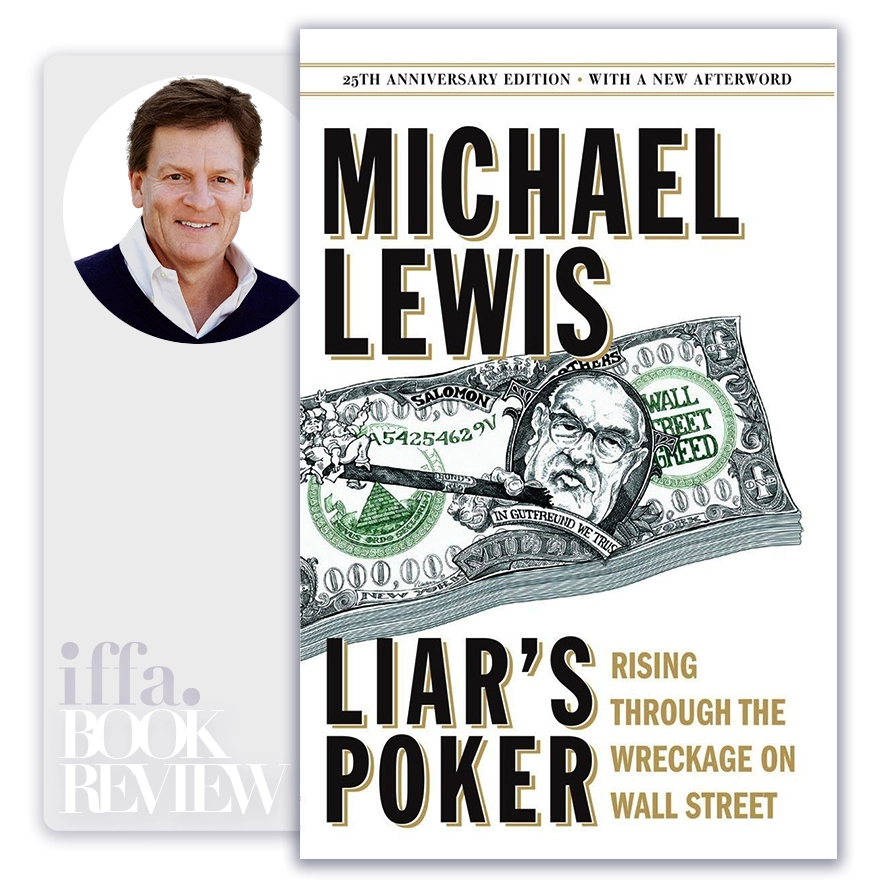
by Michael Lewis
Summary Overview:
Liar’s Poker is not just a memoir of Wall Street in the 1980s—it is a cultural autopsy of modern finance at the moment it learned to reward arrogance, speed, and short-term gain over judgment, ethics, and long-term value. Michael Lewis’s firsthand account of his time at Salomon Brothers exposes the psychological DNA of financial markets that would later fuel repeated crises.
This book matters because it explains how incentives shape behavior long before disasters occur. Long before the 2008 crisis, Liar’s Poker revealed the cultural mechanics of risk: the glorification of bravado, the marginalization of skepticism, and the transformation of markets into competitive games detached from real economic value. For executives, board members, and leaders across industries, this book is a case study in how culture becomes strategy—and how toxic cultures scale risk invisibly.
About The Author
Michael Lewis is one of the most influential writers on finance, institutions, and power. Liar’s Poker was his first book, written after working as a bond salesman at Salomon Brothers during Wall Street’s boom years.
Lewis’s credibility lies in his insider-outsider perspective. He was young enough to be swept up by the system, but observant enough to recognize its absurdities. His narrative captures not only what Wall Street did—but how it thought, spoke, rewarded, and justified itself.
Core Idea:
The central thesis of Liar’s Poker is deceptively simple:
Wall Street is not driven by rational markets alone—it is driven by culture, incentives, ego, and gamesmanship.
Lewis shows that financial markets are shaped as much by human psychology and internal hierarchies as by models or fundamentals. At Salomon Brothers, success was measured not by long-term value creation, but by:
- Short-term profit
- Aggression
- Status
- Fear induced in others
- Ability to dominate information asymmetry
This culture did not merely tolerate excess—it celebrated it.
When markets become games, risk becomes entertainment rather than responsibility.
Key Concepts:
- Wall Street as a Game, Not a Market
One of the book’s most enduring insights is that trading floors often behave less like economic institutions and more like competitive games.
“Liar’s Poker” itself—a bluffing game played with bonds—symbolizes this mindset:
- Winning mattered more than truth
- Bluffing was admired
- Intimidation was strategy
- Losses were externalized
When markets become games, risk becomes entertainment rather than responsibility.
This mentality detaches decision-makers from real-world consequences.
- Incentives Over Judgment
Lewis demonstrates that traders and salespeople were not rewarded for:
- Sound judgment
- Risk awareness
- Client outcomes
- Long-term thinking
They were rewarded for:
- Volume
- Short-term profit
- Aggressiveness
- Internal status
People don’t rise by being right—they rise by making money fast. This incentive structure created systematic recklessness, even among intelligent individuals.
- Information Asymmetry as Power
At Salomon Brothers, success depended on:
- Knowing more than clients
- Knowing before others
- Exploiting complexity
Clients—often pension funds, municipalities, or institutions—were frequently outmatched by traders who understood products better and used that advantage ruthlessly.
When one side doesn’t understand the product, the transaction isn’t a trade—it’s a transfer. This dynamic eroded trust and embedded fragility into the system.
- Arrogance as a Career Asset
Lewis portrays a culture where arrogance was not a flaw—it was a credential.
Traits rewarded included:
- Loud confidence
- Disdain for caution
- Public humiliation of weaker players
- Zero-sum thinking
Humility, nuance, and doubt were interpreted as weakness. Confidence signaled competence—even when it was unfounded. This pattern recurs in many high-pressure industries beyond finance.
- The Illusion of Intelligence
Many Wall Street stars were undeniably smart—but Lewis reveals how intelligence was often misapplied.
Problems included:
- Overreliance on cleverness
- Disregard for systemic consequences
- Treating complexity as superiority
- Confusing winning trades with understanding risk
Being smart in a bad system does not make the system smart.
- Short-Termism as Organizational Norm
Careers were built quarter by quarter, trade by trade. Long-term outcomes were:
- Someone else’s problem
- Tomorrow’s issue
- Irrelevant to bonus cycles
This created organizations that were hyper-efficient in the short term and catastrophically blind in the long term.
- Cultural Contagion and Groupthink
Lewis shows how new hires quickly absorbed:
- The language
- The values
- The cynicism
- The justifications
Even those initially skeptical were socialized into the culture, illustrating how institutions overwrite individual ethics over time.
Callout Insight:
Culture trains people faster than rules ever can.
- Moral Distance from Consequences
Most traders were insulated from the downstream impact of their actions. Losses were abstract; clients were faceless; risk was theoretical.
This moral distance allowed:
- Ethical numbness
- Rationalization of harm
- Detachment from accountability
- A Warning Disguised as a Memoir
Although written with humor and irony, Liar’s Poker functions as an early warning system.
Nearly every structural issue described would later reappear:
- Excessive leverage
- Misaligned incentives
- Complexity masking risk
- Cultural glorification of aggression
- Suppression of dissent
The book reads today less like satire—and more like prophecy.
People don’t rise by being right—they rise by making money fast.
Executive Insights:
Liar’s Poker is ultimately a book about how culture determines outcomes. It reveals that catastrophic risk rarely starts with bad intentions—it starts with bad incentives and unchecked norms.
Strategic Implications for Leaders and Boards:
- Culture is a risk factor
- Incentives drive behavior more reliably than values
- Arrogance scales faster than wisdom
- Short-term rewards create long-term fragility
- Information asymmetry invites abuse
- Unchecked competition erodes ethics
- Groupthink amplifies systemic blind spots
Actionable Takeaways:
The lessons of Liar’s Poker extend far beyond Wall Street—to technology firms, startups, governments, and any high-performance organization.
Practical Actions for Executives and Governance Leaders:
- Audit incentive systems for unintended behavior
- Reward long-term outcomes, not just short-term wins
- Institutionalize dissent and skepticism
- Reduce complexity that obscures risk
- Align power with accountability
- Measure cultural signals, not just KPIs
- Train leaders to recognize arrogance as a risk
- Design systems assuming people respond to incentives—not ideals
Final Thoughts:
Liar’s Poker endures because it captures a truth many organizations still resist: systems fail not because people are evil, but because cultures reward the wrong behaviors.
Michael Lewis does not present villains—he presents a mirror. The excesses of Wall Street were not anomalies; they were logical outcomes of the rules, rewards, and narratives in place.
The book’s ultimate lesson is timeless:
If you want to understand where an organization is headed, don’t study its strategy—study what it rewards, what it mocks, and what it ignores.
For leaders today, Liar’s Poker is both a cautionary tale and a diagnostic tool. It reminds us that before markets crash, cultures rot quietly—and profitably.
The ideas in this book go beyond theory, offering practical insights that shape real careers, leadership paths, and professional decisions. At IFFA, these principles are translated into executive courses, professional certifications, and curated learning events aligned with today’s industries and tomorrow’s demands. Discover more in our Courses.
Applied Programs

- Course Code : SBM-409
- Delivery : In-class / Virtual / Workshop
- Duration : 2-4 Days
- Venue: DUBAI HUB

- Course Code : PMA-613
- Delivery : In-class / Virtual / Workshop
- Duration : 3-5 Days
- Venue: DUBAI HUB

- Course Code : CIF-505
- Delivery : In-class / Virtual / Workshop
- Duration : 3-5 Days
- Venue: DUBAI HUB

- Course Code : CIF-512
- Delivery : In-class / Virtual / Workshop
- Duration : 2-4 Days
- Venue: DUBAI HUB
Related Books