
The Executive Summary of
Future Money
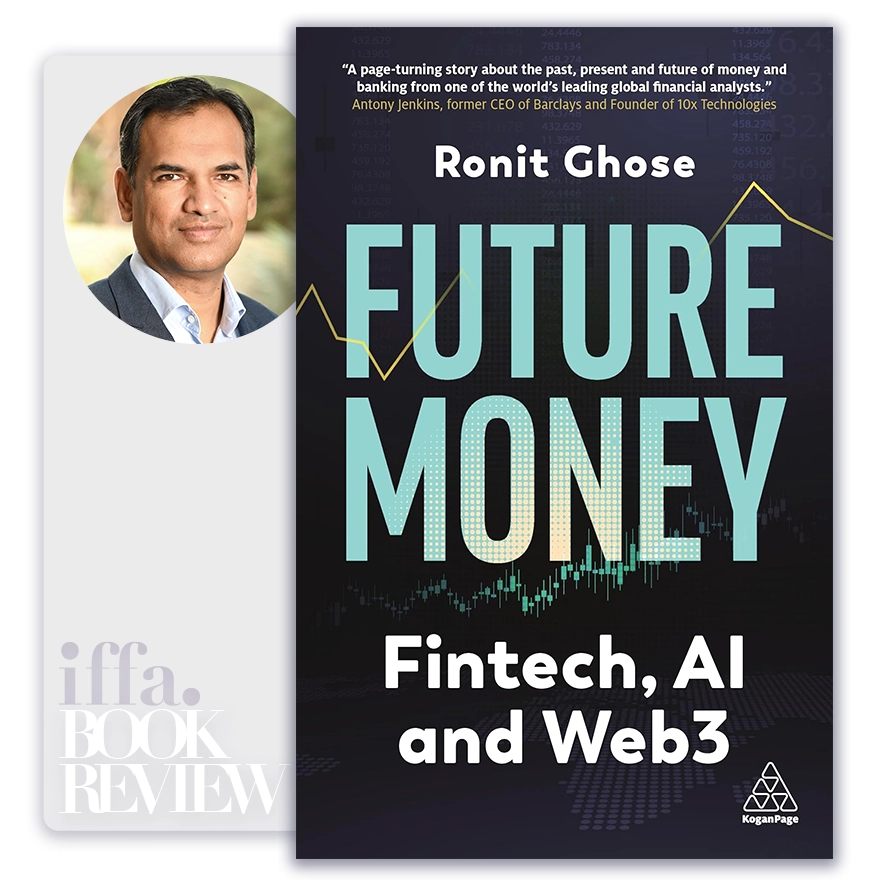
by Ronit Ghose
Summary Overview:
Money is undergoing its most consequential redesign since the creation of modern banking. Future Money remains essential because it explains this shift not as a series of disconnected innovations—apps, blockchains, or algorithms—but as a systemic re-architecture of financial infrastructure, incentives, and control. For CEOs, board members, policymakers, and long-term investors, the book matters because it clarifies why incremental digitization is no longer sufficient. FinTech, AI, and Web3 are converging to challenge who controls money, how trust is created, and where value accrues. The relevance today lies in understanding that finance is moving from institution-centric to network-centric, with profound implications for regulation, competition, and monetary sovereignty.
About The Author
Ronit Ghose is a senior banking strategist and advisor focused on financial innovation, digital assets, and the intersection of technology and regulation. His work draws on direct engagement with global banks, regulators, technology firms, and investors navigating rapid financial change.
What distinguishes Ghose’s perspective is his balanced, institution-literate approach. He neither evangelizes disruption nor defends incumbency by default. Instead, he examines how legacy finance adapts—or fails—when technology reshapes incentives faster than governance structures can respond.
Core Idea:
The core idea of Future Money is that the future of finance will be defined by the interaction of three forces: FinTech’s re-engineering of distribution and user experience, AI’s transformation of decision-making and risk assessment, and Web3’s challenge to centralized trust through programmable, decentralized networks.
Ghose frames this transformation as a shift from product innovation to infrastructure competition. Payments, lending, custody, and asset management are no longer differentiated primarily by brand or balance sheet, but by data, intelligence, interoperability, and protocol design. Leaders who treat FinTech, AI, or Web3 in isolation misunderstand the scale of change; advantage accrues to those who grasp how these technologies reinforce each other.
The future of money is not about faster payments; it is about who controls financial networks.
Key Concepts:
- Money as Infrastructure, Not Product
Ghose emphasizes that money functions as shared infrastructure. Control over rails, data, and standards increasingly matters more than ownership of individual financial products. - FinTech’s Real Disruption: Distribution and Cost
FinTech succeeds by unbundling services and reducing friction. Its strategic threat lies not in innovation alone, but in resetting customer expectations and margins across finance. - AI as a Decision Engine
AI reshapes credit, fraud detection, trading, and compliance by standardizing judgment at scale. The real value is consistency and learning, not prediction perfection. - Data as the New Balance Sheet
Access to high-quality data increasingly substitutes for traditional capital advantages. Firms with superior data governance gain compounding informational edge. - Web3 and the Re-Design of Trust
Blockchains and smart contracts challenge centralized trust models. Ghose treats Web3 not as anti-institutional, but as a new trust architecture that institutions must either integrate or compete against. - Digital Assets Beyond Speculation
Tokenization of assets—bonds, funds, real estate—represents a structural shift. Liquidity, settlement speed, and programmability redefine how assets are issued and managed. - Central Bank Digital Currencies (CBDCs)
CBDCs reflect state response to private innovation. They raise questions of privacy, control, and competition that will reshape monetary policy and banking models. - Regulation as Strategic Differentiator
Regulation does not disappear; it evolves. Jurisdictions that balance innovation and oversight attract capital and talent, while others export competitiveness. - Incumbents Versus Platforms
Traditional banks face platform competition from Big Tech and Web3 ecosystems. Survival depends on ecosystem participation, not standalone dominance. - Fragmentation Versus Interoperability
The future of money risks fragmentation across networks and standards. Strategic leaders invest in interoperability, avoiding technological lock-in and systemic brittleness.
Technology does not remove intermediaries; it replaces weak ones with stronger systems.
Executive Insights:
Future Money reframes financial transformation as a contest for architectural control, not customer features. Institutions with similar capital bases diverge sharply based on how they integrate AI, data, and decentralized infrastructure into core operations.
For boards and senior leadership, the implication is clear: technology strategy is now monetary strategy. Delegating it to innovation units without governance integration exposes firms to structural erosion.
- Infrastructure control outweighs product innovation
- AI reshapes risk and margin structure
- Web3 challenges centralized trust models
- Regulation determines competitive geography
- Interoperability preserves long-term optionality
Actionable Takeaways:
Senior leaders should translate Ghose’s insights into enterprise-level commitments:
- Reframe FinTech, AI, and Web3 as one convergent strategy, not separate initiatives
- Identify which financial rails and data layers you must control or access
- Embed AI into core decision systems, not advisory dashboards
- Engage regulators early as partners in infrastructure evolution
- Invest in interoperability to avoid platform dependence
Final Thoughts:
Future Money is ultimately a book about power, trust, and institutional adaptation. It strips away hype and fear to reveal a financial system being re-written at the protocol level. The winners will not be those who adopt the most technology, but those who govern it with clarity, restraint, and strategic intent.
Its enduring contribution lies in showing that finance’s future is neither purely decentralized nor centrally controlled, but hybrid—combining institutional strength with network intelligence.
The closing insight is decisive and forward-looking: the future of money will belong to organizations and states that understand finance as programmable infrastructure—and that design governance, intelligence, and trust into that infrastructure from the start.
The ideas in this book go beyond theory, offering practical insights that shape real careers, leadership paths, and professional decisions. At IFFA, these principles are translated into executive courses, professional certifications, and curated learning events aligned with today’s industries and tomorrow’s demands. Discover more in our Courses.
Applied Programs

- Course Code : SBM-409
- Delivery : In-class / Virtual / Workshop
- Duration : 2-4 Days
- Venue: DUBAI HUB

- Course Code : PMA-613
- Delivery : In-class / Virtual / Workshop
- Duration : 3-5 Days
- Venue: DUBAI HUB

- Course Code : CIF-505
- Delivery : In-class / Virtual / Workshop
- Duration : 3-5 Days
- Venue: DUBAI HUB

- Course Code : CIF-512
- Delivery : In-class / Virtual / Workshop
- Duration : 2-4 Days
- Venue: DUBAI HUB
Related Books