The Executive Summary of
Blind Spot
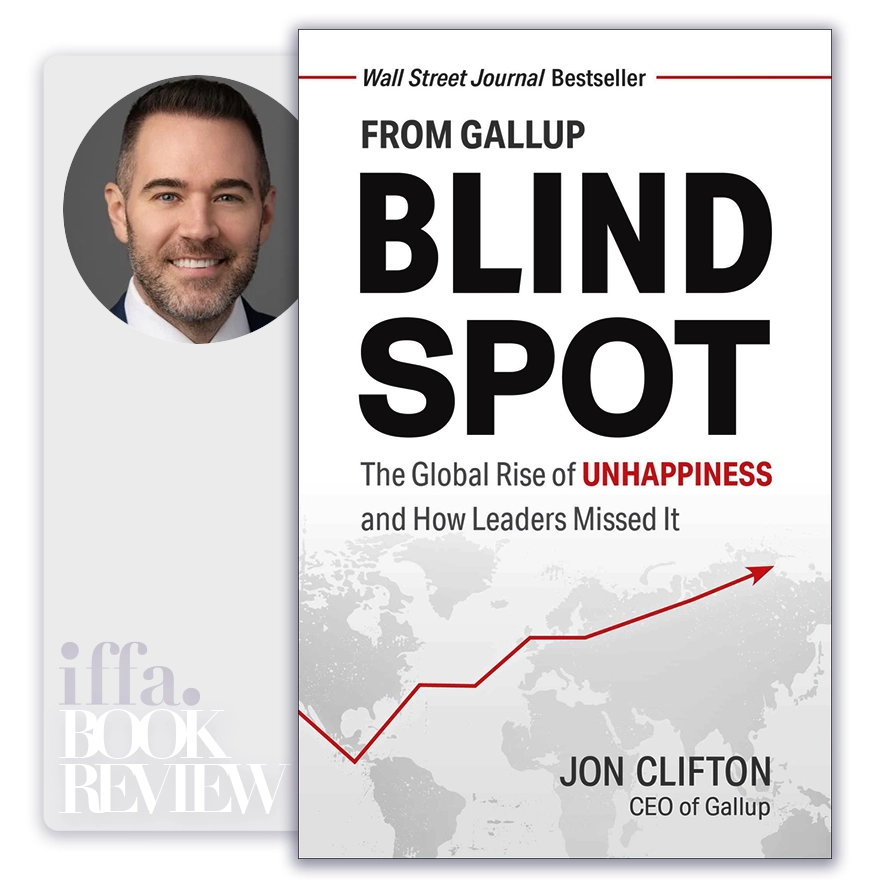
by Jon Clifton
Summary Overview:
Blind Spot confronts a leadership failure that is both widespread and largely invisible: the systematic misunderstanding of human well-being at scale. Jon Clifton argues that governments, corporations, and institutions increasingly rely on economic indicators, productivity metrics, and sentiment proxies while overlooking what people actually experience in their daily lives. The book remains urgent because rising disengagement, distrust, and dissatisfaction are often treated as secondary issues—when in fact they are leading indicators of instability, underperformance, and social fracture.
For CEOs, board members, policymakers, and long-term investors, the book matters because well-being is no longer a soft or peripheral concern. It shapes workforce resilience, consumer behavior, political risk, and institutional legitimacy. Clifton shows that leaders frequently believe they understand how people are doing, yet operate with incomplete or misleading data. This blind spot distorts judgment, weakens strategy, and produces decisions that appear rational but fail in practice because they misread the human system they depend on.
About The Author
Jon Clifton is the CEO of Gallup and a global authority on workforce analytics, public opinion, and well-being measurement. His work draws on decades of large-scale data collected across countries, industries, and institutions.
Clifton’s perspective is distinctive because it is grounded not in anecdote or ideology, but in longitudinal, global evidence. He has direct visibility into how people actually feel about their lives, work, and leaders—and how those feelings translate into performance, stability, and risk over time.
Core Idea:
The central thesis of Blind Spot is that leaders consistently misjudge human well-being, and that misjudgment carries strategic consequences. Clifton argues that traditional success indicators—GDP, profits, growth, engagement scores—often fail to capture whether people feel secure, hopeful, respected, and capable of shaping their future.
At a deeper level, the book presents a worldview in which well-being is infrastructure. It underpins productivity, social cohesion, and long-term value creation. When leaders ignore or misunderstand it, they unintentionally erode trust and resilience. Effective leadership, in this framing, requires seeing what standard metrics hide and governing accordingly.
What leaders fail to measure accurately is often what eventually destabilizes their institutions.
Key Concepts:
- Economic Metrics Mask Human Reality
Clifton shows that economic growth can coexist with rising unhappiness.
- Prosperity does not guarantee well-being.
- Lagging indicators conceal early warning signs.
- Leaders Overestimate Understanding
Decision-makers often assume they know how people are doing.
- Perception diverges from lived experience.
- Confidence without evidence creates blind spots.
- Well-Being Predicts Performance
Data consistently links well-being to productivity, retention, and engagement.
- Poor well-being increases hidden costs.
- Healthy systems outperform over time.
- Stress and Anxiety Are Rising Globally
The book highlights global increases in daily stress and worry.
- Chronic stress weakens judgment.
- Anxiety erodes long-term planning capacity.
- Work Is a Central Driver of Life Satisfaction
Employment quality affects identity, dignity, and security.
- Bad jobs damage well-being disproportionately.
- Leadership behavior shapes daily experience.
- Measurement Shapes Attention
What leaders measure determines what they manage.
- Incomplete metrics distort priorities.
- Better data improves governance accuracy.
- Well-Being Is Unevenly Distributed
Averages obscure inequality of experience within organizations and societies.
- Concentrated distress creates systemic risk.
- Outliers matter more than means.
- Disengagement Signals Deeper Issues
Low engagement is often a symptom, not a cause.
- Surface fixes fail without diagnosis.
- Root causes are emotional and structural.
- Ignored Well-Being Fuels Distrust
When people feel unseen, institutional trust erodes.
- Distrust precedes resistance.
- Legitimacy depends on recognition.
- Leadership Sets the Emotional Climate
Leaders influence how safe, hopeful, and valued people feel.
- Tone travels downward.
- Behavior outweighs messaging.
Well-being is not a moral add-on; it is a strategic foundation.
Executive Insights:
Blind Spot reframes well-being as a strategic intelligence problem. Leaders who lack accurate insight into how people experience work, life, and change operate with incomplete information—no different from making capital decisions without reliable financial data. Clifton’s work suggests that many shocks attributed to politics, labor markets, or culture are actually predictable outcomes of ignored human signals.
At the board and governance level, the implication is clear: institutions that fail to measure and manage well-being systematically increase long-term risk. Strategy, talent, and reputation all depend on understanding the human conditions that sustain them.
- Decision quality improves with well-being visibility.
- Organizational risk rises when human signals are ignored.
- Culture and performance are inseparable.
- Trust is built through recognition, not rhetoric.
- Long-term value depends on emotional as well as financial capital.
Actionable Takeaways:
Effective leadership begins with clearer human insight.
- Treat well-being data as strategic intelligence.
- Question assumptions about how people are doing.
- Look beyond averages to identify concentrated risk.
- Integrate human experience into decision frameworks.
- Hold leaders accountable for emotional as well as operational outcomes.
Final Thoughts:
Blind Spot is a warning delivered calmly and backed by evidence: leaders cannot manage what they refuse to see clearly. Clifton’s work shows that ignoring human well-being does not preserve efficiency; it quietly undermines it. Institutions that overlook lived experience may appear strong—until trust collapses, engagement fades, or resistance erupts.
For executives and boards tasked with long-term stewardship, the book offers a durable insight: the health of any system depends on the well-being of the people inside it. Seeing that reality clearly is not compassion alone—it is competence.
In the long run, leadership failures are rarely sudden; they are the predictable result of blind spots left unexamined.
The ideas in this book go beyond theory, offering practical insights that shape real careers, leadership paths, and professional decisions. At IFFA, these principles are translated into executive courses, professional certifications, and curated learning events aligned with today’s industries and tomorrow’s demands. Discover more in our Courses.
Applied Programs

- Course Code : SBM-409
- Delivery : In-class / Virtual / Workshop
- Duration : 2-4 Days
- Venue: DUBAI HUB

- Course Code : PMA-613
- Delivery : In-class / Virtual / Workshop
- Duration : 3-5 Days
- Venue: DUBAI HUB
- Course Code : CIF-505
- Delivery : In-class / Virtual / Workshop
- Duration : 3-5 Days
- Venue: DUBAI HUB

- Course Code : CIF-512
- Delivery : In-class / Virtual / Workshop
- Duration : 2-4 Days
- Venue: DUBAI HUB
Related Books