The Executive Summary of
Winning
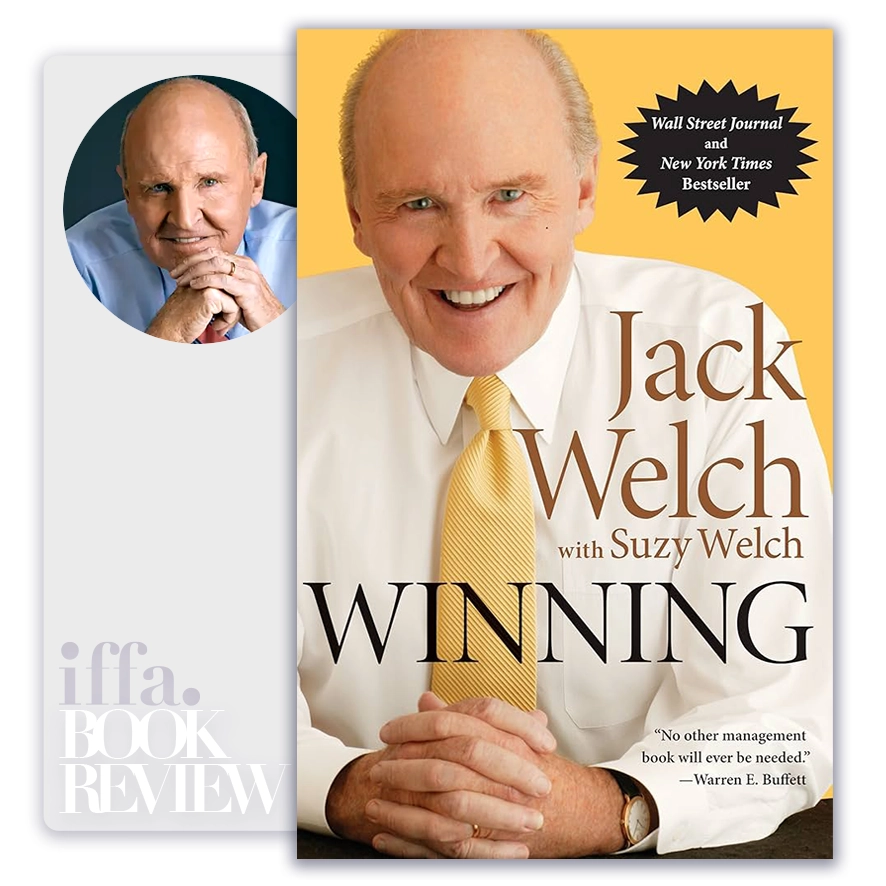
by Jack Welch
Summary Overview:
Winning remains one of the most influential leadership books of the modern corporate era not because it offers subtlety, but because it offers clarity. In a business environment where leaders are often encouraged to balance competing narratives—purpose, culture, empathy, growth, and risk—Jack Welch insists on something more fundamental: organizations exist to win, and leadership exists to make winning possible. The book speaks directly to senior executives who must reconcile ideals with outcomes and vision with execution.
For boards, CEOs, and long-term investors, Winning addresses a perennial leadership problem: the avoidance of tough calls in the name of harmony or complexity. Welch argues that ambiguity, politeness, and delay are not neutral behaviors; they actively destroy performance and morale. The book remains relevant because it reframes leadership as a series of explicit choices about people, priorities, and accountability, reminding decision-makers that culture, strategy, and results are inseparable. Winning, in Welch’s view, is not about ego or short-term gains, but about building organizations that are honest, energized, and relentlessly clear about what matters.
About The Author
Jack Welch served as Chairman and CEO of General Electric for two decades, transforming it into one of the most valuable and influential companies in the world during his tenure. His leadership style and management philosophy reshaped how corporations think about performance, talent, and execution.
Welch’s authority comes not from theory but from operating at scale under sustained scrutiny. His ideas reflect the realities of managing complex global organizations, capital markets expectations, and internal politics. Whether one agrees with all his conclusions or not, his perspective is distinctive for its directness, operational grounding, and intolerance for ambiguity.
Core Idea:
The central thesis of Winning is that great organizations are built on clarity, candor, and differentiation. Welch argues that leaders must be explicit about where the organization is going, who belongs on the journey, and how success is measured. Ambivalence, in his view, is leadership failure.
At a deeper level, the book presents a worldview in which execution is the ultimate test of strategy. Vision without follow-through is meaningless, and culture without accountability is performative. Welch frames leadership as the responsibility to make reality visible, even when that reality is uncomfortable.
Leadership succeeds when priorities are unmistakable and accountability is unavoidable.
Key Concepts:
- Candor as an Organizational Accelerator
Welch treats candor not as a soft value but as a hard performance driver. When people speak openly, decisions improve and execution speeds up.
- Lack of candor inflates politics and slows action.
- Honest dialogue reduces hidden costs.
- Differentiation Is a Leadership Obligation
One of Welch’s most controversial ideas is differentiation—recognizing that not all people or businesses perform equally.
- Treating everyone the same erodes meritocracy.
- Clear differentiation clarifies expectations and rewards excellence.
- Strategy Must Be Simple and Actionable
Welch rejects complex strategy frameworks. He argues that if strategy cannot be explained clearly, it cannot be executed.
- Simplicity aligns large organizations.
- Complexity often masks indecision.
- People Decisions Define the Organization
According to Welch, nothing shapes outcomes more than who is hired, promoted, or removed.
- Leaders signal values through talent decisions.
- Avoiding people decisions corrodes credibility.
- Culture Is Built Through Behavior, Not Statements
Culture, in Winning, is not aspirational language but observable leadership behavior.
- What leaders tolerate becomes the culture.
- Values without enforcement lose meaning.
- Execution Is a Daily Discipline
Welch emphasizes that execution is not a phase but a continuous management rhythm.
- Follow-through distinguishes intent from impact.
- Leaders must inspect what they expect.
- Leadership Requires Emotional Energy
Welch places unusual emphasis on energy—the ability to energize oneself and others.
- Energy drives momentum.
- Low-energy leadership stalls even strong strategies.
- Facing Reality Enables Speed
The book repeatedly stresses the importance of confronting facts early.
- Delayed recognition compounds problems.
- Speed comes from realism, not optimism.
- Winning Creates Organizational Confidence
Welch argues that winning is self-reinforcing. Success builds belief, which improves performance further.
- Confidence reduces resistance to change.
- Momentum strengthens culture.
- Leadership Is Not Consensus Management
While listening is essential, Welch insists leaders must ultimately decide.
- Excessive consensus dilutes accountability.
- Authority exists to resolve uncertainty.
Organizations stagnate not from lack of ideas, but from leaders unwilling to confront reality.
Executive Insights:
Winning is a manifesto for decisive, performance-oriented leadership. It challenges leaders to examine where they may be avoiding clarity under the guise of complexity or empathy. The book’s enduring contribution is its insistence that results and culture are not trade-offs, but mutually reinforcing outcomes of disciplined leadership.
For boards and investors, the book highlights that leadership quality is revealed in how organizations handle underperformance, conflict, and truth-telling. Sustainable value creation depends less on visionary language and more on consistent execution and honest differentiation.
Strategic implications include:
- Evaluate leaders on clarity and follow-through.
- Treat candor as a governance priority.
- Recognize talent differentiation as a strategic tool.
- Simplify strategy communication.
- Align culture with enforcement, not slogans.
Actionable Takeaways:
Strong leadership begins with eliminating ambiguity at the top.
- Start doing: Making priorities explicit and non-negotiable.
- Stop doing: Avoiding difficult people decisions.
- Reframe: Candor as a performance advantage, not a risk.
- Build into systems: Clear metrics, ownership, and consequences.
- Embed culturally: Respect for results and honest dialogue.
Final Thoughts:
Winning is unapologetically direct, and that is precisely its value. While some of its ideas invite debate in today’s evolving leadership landscape, the book endures because it confronts a reality many organizations prefer to soften: clarity is kind, and avoidance is costly.
Welch’s ultimate lesson is not about aggressiveness or ego, but about responsibility. Leaders owe their organizations truth, direction, and accountability. When those elements are present, winning becomes a natural outcome rather than an obsession.
In the end, organizations do not win by trying to please everyone, but by committing fully to clarity, execution, and results.
The ideas in this book go beyond theory, offering practical insights that shape real careers, leadership paths, and professional decisions. At IFFA, these principles are translated into executive courses, professional certifications, and curated learning events aligned with today’s industries and tomorrow’s demands. Discover more in our Courses.
Applied Programs

- Course Code : SBM-409
- Delivery : In-class / Virtual / Workshop
- Duration : 2-4 Days
- Venue: DUBAI HUB

- Course Code : PMA-613
- Delivery : In-class / Virtual / Workshop
- Duration : 3-5 Days
- Venue: DUBAI HUB
- Course Code : CIF-505
- Delivery : In-class / Virtual / Workshop
- Duration : 3-5 Days
- Venue: DUBAI HUB

- Course Code : CIF-512
- Delivery : In-class / Virtual / Workshop
- Duration : 2-4 Days
- Venue: DUBAI HUB
Related Books