The Executive Summary of
The Black Swan
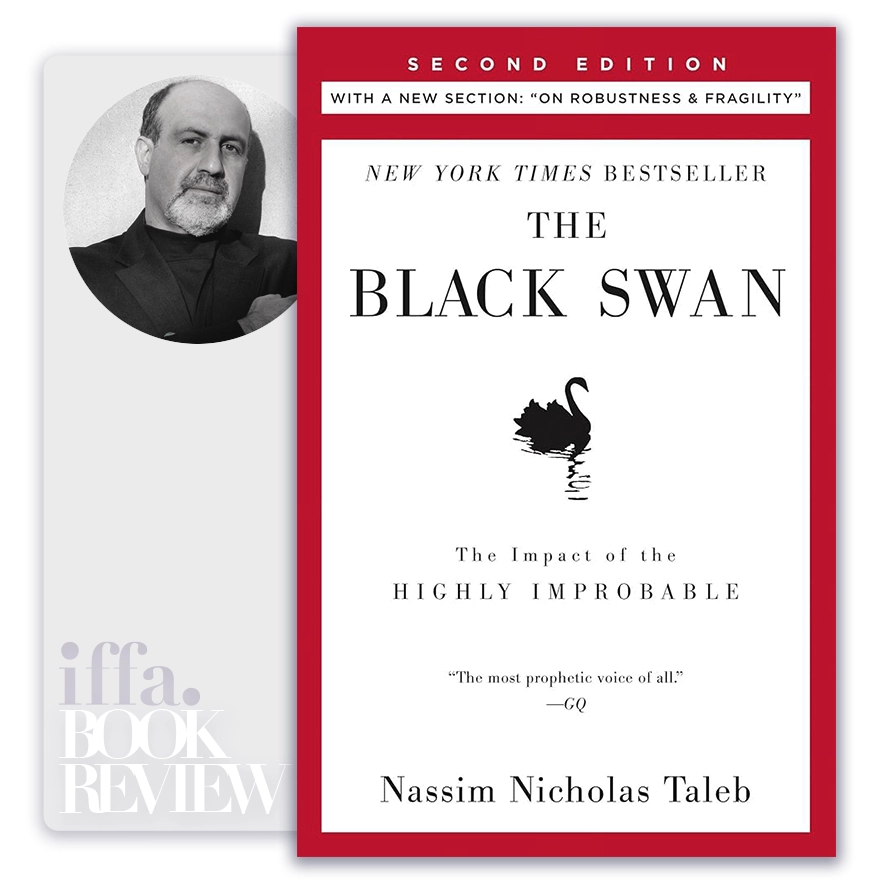
by Nassim Nicholas Taleb
Summary Overview:
In a world shaped by financial shocks, geopolitical disruptions, technological leaps, pandemics, and climate volatility, few books explain reality as powerfully as The Black Swan. First published in 2007—just before the global financial crisis—this seminal work reframed how leaders, investors, policymakers, and executives understand risk, uncertainty, and decision-making.
Rather than focusing on what is predictable, the book exposes how rare, extreme, and unforeseen events drive history, markets, and human progress. For executive audiences, The Black Swan is not merely a philosophical text; it is a strategic wake-up call against overconfidence, fragile systems, and blind faith in forecasts.
About The Author
Nassim Nicholas Taleb is a Lebanese–American essayist, former trader, and philosopher best known for reshaping how the world thinks about uncertainty, risk, and decision-making. With a background spanning mathematics, philosophy, and finance, he challenges conventional forecasting and expert-driven models, especially in economics and public policy.
Taleb’s work argues that rare, extreme events shape history far more than predictable trends, and that modern systems often underestimate fragility. His ideas have influenced leaders across finance, technology, risk management, and strategy by emphasizing robustness, humility, and respect for uncertainty.
Core Idea:
A Black Swan event is defined by three essential attributes, The most important events in history which are rare, unpredictable, and retrospectively rationalized—but not foreseeable:
- Extreme rarity – It lies outside normal expectations and standard models
- Massive impact – It reshapes systems, institutions, or beliefs
- Retrospective rationalization – After it occurs, people invent explanations that make it seem predictable
Modern societies mistakenly believe that more data, better models, and smarter experts reduce uncertainty. Taleb argues the opposite: complex systems are dominated by extreme events, not averages. The real danger lies not in randomness itself, but in our blindness to it—what Taleb calls epistemic arrogance.
History is driven by a few extreme events, not by the steady accumulation of the ordinary.
Key Concepts:
- The Black Swan Event
A Black Swan is an event that is rare, carries massive impact, and is explained away after the fact. The danger lies not only in the event itself, but in our blindness to its possibility.
- Rarity does not imply insignificance
- Impact overwhelms averages
- Narratives create false confidence
- Mediocristan vs. Extremistan
Taleb contrasts two worlds. In Mediocristan, outcomes cluster around averages. In Extremistan, a single event can dominate totals. Most social, financial, and technological domains belong to Extremistan.
- Averages mislead in Extremistan
- Scale amplifies inequality
- Prediction becomes fragile
- The Narrative Fallacy
Humans crave coherent stories. After extreme events, we create explanations that make randomness appear ordered. This illusion of understanding encourages overconfidence and poor risk assessment.
- Stories replace probabilities
- Clarity is often fabricated
- Confidence grows after the fact
- The Limits of Prediction
Forecasting models rely on historical data and assumptions of normality. Taleb argues these models systematically underestimate extremes, giving decision-makers a false sense of control.
- Models simplify reality
- Past data hides tail risk
- Precision masks error
- Silent Evidence and Survivorship Bias
We learn from visible successes and ignore invisible failures. This skews perception of probability and performance, leading to flawed conclusions about strategy and skill.
- Winners distort learning
- Failures disappear from data
- Success is over-attributed to talent
- Fragility and Exposure to Tails
Systems are fragile when small shocks cause disproportionate damage. Taleb emphasizes identifying asymmetry—situations where downside is large and upside is limited.
- Fragility hides in calm periods
- Small stress reveals weakness
- Exposure matters more than probability
- Robustness Over Optimization
Optimized systems perform well under expected conditions but fail under stress. Robust systems may seem inefficient but survive volatility. Taleb favors redundancy, slack, and simplicity.
- Efficiency increases fragility
- Redundancy absorbs shocks
- Survival precedes optimization
- The Problem with Expertise
In domains dominated by randomness, expert predictions often perform no better than chance. Authority and credentials can obscure uncertainty rather than reduce it.
- Confidence is not accuracy
- Expertise fails in noisy domains
- Humility improves judgment
- Scalability and Winner-Take-All Effects
Modern technologies enable extreme concentration of outcomes. A single product, idea, or firm can dominate globally, increasing inequality and tail risk.
- Scale magnifies extremes
- Success concentrates rapidly
- Risk becomes systemic
- Optionality as a Strategy
Rather than predicting outcomes, Taleb advocates creating options—limited downside with large potential upside. This approach benefits from positive Black Swans while minimizing harm from negative ones.
- Upside without commitment
- Losses are capped
- Uncertainty becomes an ally
What we think we know about the future is dwarfed by what we do not know.
Executive Insights:
The Black Swan reframes leadership as a risk stewardship function, not a forecasting exercise. Its central implication is that many failures stem not from bad luck, but from overconfidence in models, metrics, and narratives that ignore tail risk.
For executives and boards, the book highlights that stability often masks accumulating fragility. Long periods without crisis do not imply safety; they increase exposure by encouraging leverage, optimization, and complacency. Strategic advantage lies in recognizing where outcomes are dominated by extremes—and acting accordingly.
The book also challenges incentive structures that reward short-term gains while externalizing tail risk. When decision-makers benefit from upside but do not bear downside, fragility becomes systemic.
Key strategic implications include:
- Tail risks dominate long-term outcomes
- Optimization increases vulnerability
- Prediction is weaker than preparation
- Incentives shape systemic fragility
- Robustness outperforms precision
Actionable Takeaways:
The book offers principles for navigating uncertainty rather than eliminating it.
- Identify where your domain lies in Extremistan
- Reduce exposure to catastrophic downside
- Favor robustness over maximum efficiency
- Avoid reliance on precise forecasts
- Build redundancy and flexibility into systems
- Create options with asymmetric payoff
- Question narratives that appear too coherent
Final Thoughts:
The Black Swan is ultimately a book about intellectual humility in a world of uncertainty. Nassim Nicholas Taleb reminds readers that the most consequential forces shaping outcomes are often invisible, unpredictable, and misunderstood—yet repeatedly ignored by institutions that prize certainty.
The enduring insight is both unsettling and liberating: we cannot predict the future reliably, but we can design ourselves to survive—and even benefit from—its unpredictability. Leaders who internalize this lesson shift from forecasting what will happen to preparing for what might, building organizations that endure not because they are clever, but because they are resilient.
The ideas in this book go beyond theory, offering practical insights that shape real careers, leadership paths, and professional decisions. At IFFA, these principles are translated into executive courses, professional certifications, and curated learning events aligned with today’s industries and tomorrow’s demands. Discover more in our Courses.
Applied Programs

- Course Code : SBM-409
- Delivery : In-class / Virtual / Workshop
- Duration : 2-4 Days
- Venue: DUBAI HUB

- Course Code : PMA-613
- Delivery : In-class / Virtual / Workshop
- Duration : 3-5 Days
- Venue: DUBAI HUB
- Course Code : CIF-505
- Delivery : In-class / Virtual / Workshop
- Duration : 3-5 Days
- Venue: DUBAI HUB

- Course Code : CIF-512
- Delivery : In-class / Virtual / Workshop
- Duration : 2-4 Days
- Venue: DUBAI HUB
Related Books