The Executive Summary of
Leadership: Six Studies in World Strategy
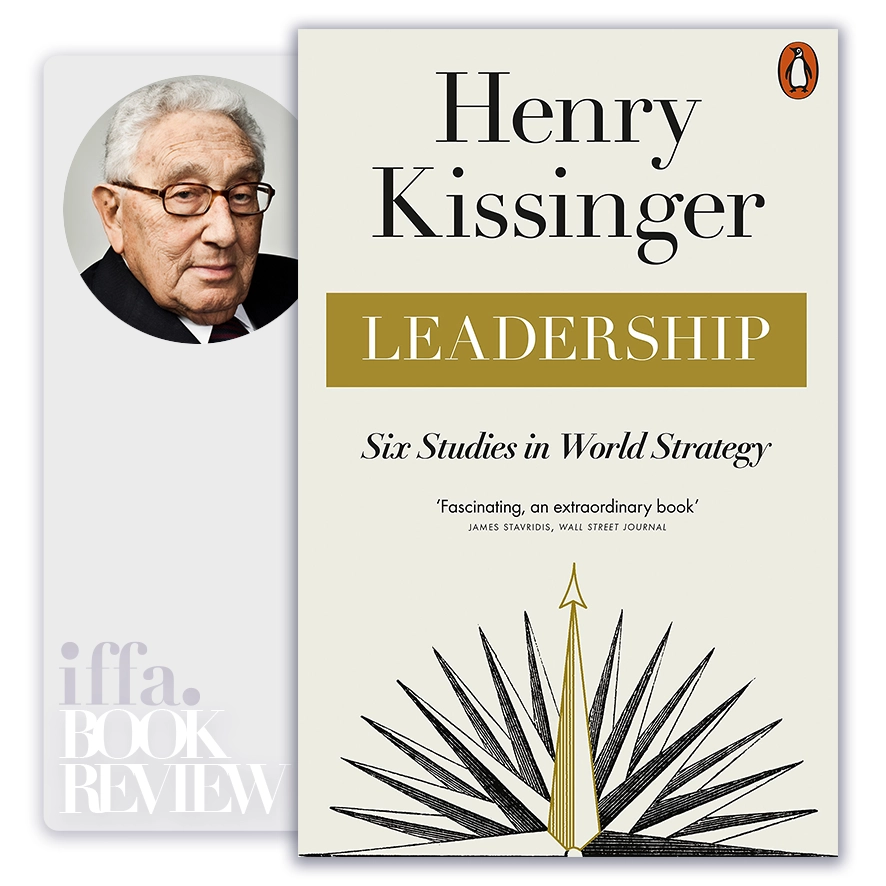
by Henry Kissinger
Summary Overview:
Leadership is often discussed in the language of inspiration, charisma, and vision. Leadership by Henry Kissinger confronts a harder truth: in moments that shape history, leadership is less about popularity and more about judgment under pressure. It is exercised in ambiguity, constrained by reality, and tested by irreversible consequences.
This book matters because today’s executives, policymakers, and institutional leaders face conditions strikingly similar to those confronted by statesmen: geopolitical instability, systemic risk, moral trade-offs, fragmented consensus, and accelerating change. Kissinger argues that leadership cannot be reduced to management technique or motivational rhetoric. It is the art of aligning vision with power, ideals with constraints, and long-term order with short-term necessity.
For senior leaders, Leadership offers something rare: a sober, experience-driven framework for making decisions when no option is clean, time is limited, and failure carries systemic cost.
About The Author
Henry Kissinger was one of the most influential strategists and diplomats of the 20th century, serving as U.S. National Security Advisor and Secretary of State. He played a central role in reshaping global order through détente, Cold War diplomacy, and the rebalancing of power among nations.
Kissinger’s authority does not come from theory alone, but from direct engagement with history-making decisions. His perspective reflects decades of navigating power, ideology, crisis, and statecraft—making this book especially relevant for leaders operating at scale, where decisions affect institutions, societies, and systems beyond immediate stakeholders.
Core Idea:
At the heart of Leadership lies a demanding and unsentimental thesis:
Leadership is the capacity to translate vision into reality while operating within the limits of power, history, and human nature.
Kissinger rejects the idea that leadership is about moral purity or consensus-building alone. Instead, he argues that effective leaders must:
- Understand the structure of the world as it is
- Act within constraints rather than deny them
- Balance ideals with order
- Accept responsibility for tragic trade-offs
Leadership is not the pursuit of perfection, it is the management of unavoidable imperfection.
Key Concepts:
The Six Leadership Archetypes (Strategic Lessons)
Kissinger examines six leaders not to celebrate them, but to extract enduring leadership principles.
- Konrad Adenauer — Leadership Through Restraint and Reconstruction
Adenauer rebuilt post-war Germany by:
- Accepting historical limits
- Choosing integration over revenge
- Prioritizing legitimacy and trust
Sometimes leadership means narrowing options deliberately to rebuild credibility. For executives, this reflects turnaround leadership grounded in realism rather than ambition.
- Charles de Gaulle — Leadership as National Identity
De Gaulle led by:
- Defining a clear national narrative
- Standing apart from alliances when necessary
- Embodying symbolic authority
Identity can be a strategic asset when institutions are fragile. In organizations, this mirrors leaders who stabilize culture through strong vision—but risk isolation if symbolism replaces adaptability.
- Richard Nixon — Leadership Through Strategic Calculation
Nixon reshaped global power through:
- Cold realism
- Opening relations with adversaries
- Long-term balance-of-power thinking
Effective leadership sometimes requires engaging rivals pragmatically, not ideologically. For executives, this applies to competitive strategy, mergers, and ecosystem diplomacy.
- Anwar Sadat — Leadership Through Personal Risk
Sadat transformed the Middle East by:
- Breaking taboos
- Taking unilateral risks
- Betting legitimacy on bold moves
Transformational change often requires leaders to stake personal credibility. This parallels founders or CEOs who initiate radical shifts knowing resistance is inevitable.
- Lee Kuan Yew — Leadership Through Institutional Design
Lee focused on:
- Long-term societal engineering
- Meritocracy and discipline
- Stability over popularity
Great leaders build systems that outlast them. For organizations, this highlights governance, talent systems, and institutional continuity.
- Margaret Thatcher — Leadership Through Conviction
Thatcher governed by:
- Ideological clarity
- Willingness to confront entrenched interests
- Moral certainty in economic reform
Conviction provides momentum—but must be tempered by context. In corporate leadership, this reflects the power—and risk—of uncompromising transformation agendas.
Key Strategic Leadership Themes
- Leadership Operates Under Constraint
Kissinger emphasizes that leaders never act freely. They are constrained by:
- History
- Institutions
- Culture
- Power structures
Ignoring constraints is not visionary—it is reckless. Effective leaders work with reality, not against it.
- Vision Without Power Is Rhetoric
Vision matters—but only when paired with execution capacity.
Leadership is the ability to move institutions, not just inspire people. This distinguishes leaders from commentators.
- Order Precedes Progress
Kissinger argues that chaos destroys the possibility of reform.
Stability is not stagnation—it is the precondition for change. In organizations, psychological and structural order enables innovation.
- Moral Leadership Requires Responsibility, Not Purity
Leaders must choose between imperfect options.
Ethical leadership accepts responsibility for outcomes, not just intentions. Avoiding decisions is itself a moral failure.
- Time Horizons Define Leadership Quality
Great leaders think in decades, not quarters.
Short-term wins that undermine long-term order are leadership failures. This is especially relevant for boards and executive governance.
- Leadership Is Lonely by Nature
Kissinger stresses that ultimate decisions cannot be delegated.
Consensus dilutes responsibility; leadership concentrates it. True leadership requires psychological resilience and solitude.
Effective leadership sometimes requires engaging rivals pragmatically, not ideologically.
Executive Insights:
Leadership reframes executive authority as stewardship of order under uncertainty.
Strategic Implications for Senior Leaders:
- Judgment matters more than charisma
- Institutions must be protected, not exploited
- Trade-offs are unavoidable—own them
- Vision must align with execution capacity
- Long-term stability outweighs short-term approval
- Leadership requires moral courage, not applause
Organizations that confuse leadership with popularity mortgage their future for comfort.
Actionable Takeaways:
For CEOs and Senior Leaders
- Distinguish vision from aspiration
- Assess constraints honestly
- Think in long-term equilibria
- Accept responsibility for trade-offs
- Build institutions, not personal legacies
For Leadership Development
- Teach historical case thinking
- Train leaders to manage ambiguity
- Build resilience for isolation
- Develop moral seriousness, not slogans
Final Thoughts:
Leadership is not an inspirational manual—it is a reckoning. Henry Kissinger strips leadership of sentimentality and replaces it with responsibility, restraint, and realism. His message is demanding but essential:
Leadership is the burden of making decisions that history will judge—often without knowing whether you were right.
In an era obsessed with visibility, speed, and consensus, Kissinger reminds us that the leaders who shape the future are those who:
- Understand power
- Respect limits
- Think long-term
- Accept responsibility
- Act decisively in uncertainty
Leadership, ultimately, is not about being admired.
It is about preserving order, enabling progress, and bearing the weight of consequence.
The ideas in this book go beyond theory, offering practical insights that shape real careers, leadership paths, and professional decisions. At IFFA, these principles are translated into executive courses, professional certifications, and curated learning events aligned with today’s industries and tomorrow’s demands. Discover more in our Courses.
Applied Programs

- Course Code : SBM-409
- Delivery : In-class / Virtual / Workshop
- Duration : 2-4 Days
- Venue: DUBAI HUB

- Course Code : PMA-613
- Delivery : In-class / Virtual / Workshop
- Duration : 3-5 Days
- Venue: DUBAI HUB
- Course Code : CIF-505
- Delivery : In-class / Virtual / Workshop
- Duration : 3-5 Days
- Venue: DUBAI HUB

- Course Code : CIF-512
- Delivery : In-class / Virtual / Workshop
- Duration : 2-4 Days
- Venue: DUBAI HUB
Related Books