The Executive Summary of
Thinking, Fast and Slow
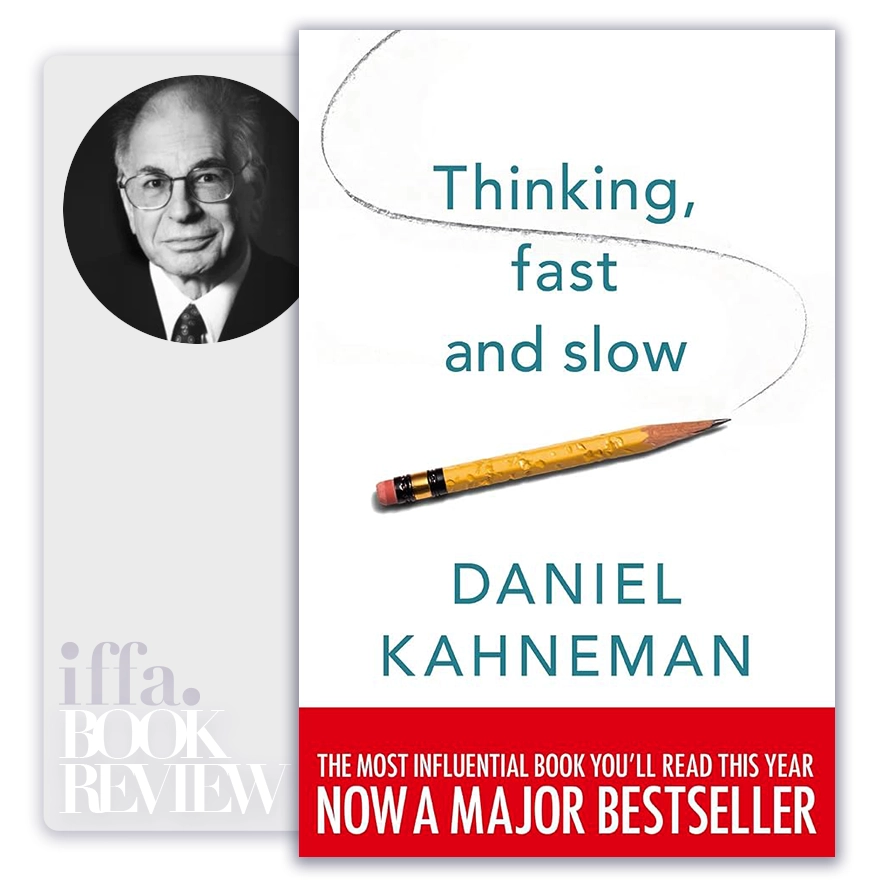
by Daniel Kahneman
Summary Overview:
Every strategic decision—investment, hiring, negotiation, policy choice, or leadership judgment—depends not just on information, but on how the human mind processes that information. Thinking, Fast and Slow exposes a critical reality most leaders underestimate: even highly intelligent, experienced decision-makers are systematically biased. Errors in judgment are not exceptions; they are predictable outcomes of how our brains are wired.
This book matters because modern organizations operate under speed, complexity, and uncertainty, precisely the conditions where cognitive biases are most dangerous. Daniel Kahneman reveals why confidence often exceeds accuracy, why intuition can be both powerful and misleading, and why many sophisticated models fail when they collide with human psychology. For executives, policymakers, investors, and strategists, Thinking, Fast and Slow is not an academic text—it is a survival guide for decision-making in the real world.
About The Author
Daniel Kahneman is a pioneering psychologist and Nobel Prize–winning economist whose research reshaped economics, finance, psychology, and public policy. He is best known for founding behavioral economics, demonstrating that humans do not behave as rational agents assumed by classical theory.
Kahneman’s authority comes from decades of empirical research, much of it conducted with Amos Tversky, showing that judgment errors are systematic, measurable, and universal. His work is foundational to risk management, behavioral finance, policy design, and executive decision science.
Core Idea:
At the heart of Thinking, Fast and Slow lies a deceptively simple but profound insight:
The human mind operates using two systems—and they often work against each other.
Kahneman introduces two modes of thinking:
- System 1 (Fast Thinking) – automatic, intuitive, emotional, and effortless
- System 2 (Slow Thinking) – deliberate, analytical, effortful, and logical
System 1 drives most of our daily judgments. System 2 monitors and corrects—but it is lazy, slow, and easily overridden. Most decision errors occur not because people are irrational, but because System 1 dominates when System 2 should be in charge.
Understanding this dual-system architecture allows leaders to predict, diagnose, and mitigate decision failures—in themselves and in organizations.
What feels true is not necessarily true, it is merely easy to process.
Key Concepts:
- System 1 vs. System 2
System 1:
- Operates automatically and quickly
- Uses heuristics (mental shortcuts)
- Generates impressions and feelings
- Is highly efficient—but error-prone
System 2:
- Requires effort and attention
- Performs calculations and logic
- Monitors behavior
- Is reliable—but easily fatigued
Most decisions feel deliberate—but are made by System 1.
System 2 often endorses System 1’s conclusions without sufficient scrutiny, especially under time pressure.
- Cognitive Ease and the Illusion of Truth
The brain prefers information that is:
- Familiar
- Repeated
- Clear
- Emotionally coherent
This creates cognitive ease, which System 1 interprets as truth.
As a result:
- Repetition increases belief
- Simple narratives feel more accurate
- Confidence is mistaken for correctness
What feels true is not necessarily true—it is merely easy to process. This explains why strong narratives often outperform strong data.
- Heuristics: Useful Shortcuts, Dangerous Defaults
Heuristics are mental shortcuts that save time—but introduce bias.
Common heuristics include:
- Availability heuristic – judging probability by how easily examples come to mind
- Representativeness heuristic – judging likelihood by similarity rather than statistics
These shortcuts are adaptive—but become dangerous in complex, probabilistic environments such as finance, strategy, and policy.
- Overconfidence and the Illusion of Skill
One of the book’s most consequential findings is that humans are systematically overconfident, especially experts.
Kahneman shows that:
- Confidence correlates weakly with accuracy
- Experts often cannot predict better than simple models
- Past success creates false narratives of skill
Confidence is a feeling—not a measurement of truth. This has direct implications for leadership selection, forecasting, and performance evaluation.
- The Planning Fallacy
The planning fallacy explains why projects routinely exceed time and budget—even when planners know this happens.
Causes include:
- Optimism bias
- Inside-view thinking
- Ignoring historical data
Kahneman advocates using the outside view—examining similar past projects—to counteract this bias.
- Anchoring: The First Number Controls the Conversation
Anchoring occurs when:
- Initial information (even irrelevant) shapes subsequent judgment
Examples include:
- Opening offers in negotiations
- Initial forecasts in budgeting
- First impressions in interviews
Callout Insight:
The mind clings to anchors—even when they are arbitrary. Anchors are powerful precisely because they operate below conscious awareness.
- Loss Aversion: Why Losses Hurt More Than Gains Feel Good
Kahneman shows that humans are loss-averse: losses feel roughly twice as painful as equivalent gains feel pleasurable.
This leads to:
- Excessive risk avoidance
- Holding onto failing projects
- Resistance to change
Loss aversion explains why organizations protect the status quo—even when change is rational.
- Prospect Theory: How People Actually Evaluate Risk
Contrary to classical economics, people do not evaluate outcomes based on final wealth. Instead, they evaluate:
- Gains and losses relative to a reference point
- Probabilities subjectively
Key implications:
- People are risk-averse in gains
- Risk-seeking in losses
- Highly sensitive to framing
How a choice is framed often matters more than the choice itself.
- The Focusing Illusion
Kahneman introduces the focusing illusion:
“Nothing in life is as important as you think it is while you are thinking about it.”
This explains why people:
- Overestimate the impact of specific outcomes
- Misjudge happiness and satisfaction
- Make distorted life and career decisions
Leaders often overweight visible issues while neglecting systemic or long-term drivers.
- Intuition: When It Works—and When It Fails
Kahneman does not dismiss intuition entirely. He clarifies that intuition is reliable only when:
- The environment is regular
- Feedback is fast and accurate
- Expertise has been built through long practice
Chess masters and firefighters may rely on intuition successfully—but strategic business and policy environments rarely meet these conditions.
How a choice is framed often matters more than the choice itself.
Executive Insights:
Thinking, Fast and Slow reframes leadership effectiveness as bias management, not intelligence.
Strategic Implications for Leaders:
- Most errors are predictable and preventable
- Overconfidence is the most dangerous bias
- Narratives distort judgment
- Data does not override psychology
- Good processes matter more than brilliant individuals
Organizations that ignore cognitive bias institutionalize error at scale.
Actionable Takeaways:
Kahneman emphasizes decision hygiene—designing processes that protect against bias.
Practical Actions for Leaders and Executives:
- Slow down high-stakes decisions deliberately
- Separate idea generation from evaluation
- Use reference-class forecasting
- Challenge confident forecasts
- Design premortems to surface hidden risks
- Measure accuracy, not confidence
- Standardize decision frameworks
For Organizations and Boards:
- Build systems that reduce bias, not rely on hero judgment
- Reward calibration over bravado
- Institutionalize dissent
- Audit decisions, not just outcomes
Final Thoughts:
Thinking, Fast and Slow is one of the most important books ever written about how humans actually decide. Daniel Kahneman delivers a humbling but empowering message: we are not as rational as we believe—but we can become better decision-makers through awareness and design.
In a world of complexity and speed, the greatest advantage belongs not to the fastest thinker—but to the one who knows when to slow down.
The ideas in this book go beyond theory, offering practical insights that shape real careers, leadership paths, and professional decisions. At IFFA, these principles are translated into executive courses, professional certifications, and curated learning events aligned with today’s industries and tomorrow’s demands. Discover more in our Courses.
Applied Programs

- Course Code : SBM-409
- Delivery : In-class / Virtual / Workshop
- Duration : 2-4 Days
- Venue: DUBAI HUB

- Course Code : PMA-613
- Delivery : In-class / Virtual / Workshop
- Duration : 3-5 Days
- Venue: DUBAI HUB
- Course Code : CIF-505
- Delivery : In-class / Virtual / Workshop
- Duration : 3-5 Days
- Venue: DUBAI HUB

- Course Code : CIF-512
- Delivery : In-class / Virtual / Workshop
- Duration : 2-4 Days
- Venue: DUBAI HUB
Related Books