The Executive Summary of
The Culture Map
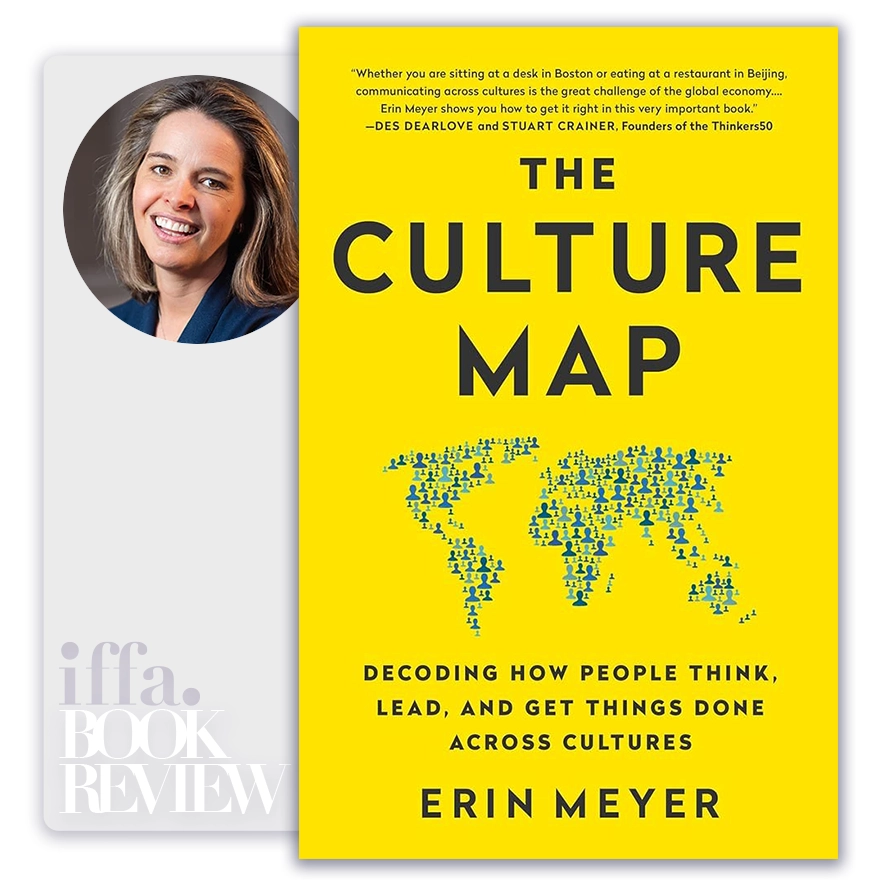
by Erin Meyer
Summary Overview:
As organizations expand across borders, cultures, and time zones, technical expertise alone is no longer sufficient for effective leadership. The Culture Map addresses one of the most underestimated risks in global business: cultural misunderstanding. Erin Meyer demonstrates that many corporate failures, team conflicts, and leadership breakdowns are not caused by incompetence or poor strategy—but by unexamined cultural assumptions.
The Culture Map matters because globalization has outpaced cultural literacy. Executives routinely manage multicultural teams, negotiate across continents, and lead diverse organizations—often assuming that “professionalism” is universal. Meyer reveals why this assumption is flawed. The book provides leaders with a practical, structured framework for decoding cultural differences and turning them into strategic advantages rather than hidden liabilities.
About The Author
Erin Meyer is a globally recognized expert in cross-cultural management and organizational behavior, and a professor at INSEAD, one of the world’s leading business schools. She has worked with multinational corporations across Europe, Asia, the Middle East, and the Americas.
Her credibility comes from deep field research combined with real executive case studies, offering leaders practical tools rather than abstract cultural theory. Meyer’s strength lies in translating complex cultural dynamics into clear, actionable frameworks.
Core Idea:
At the heart of The Culture Map is a powerful and clarifying insight:
Culture is not about nationality—it is about patterns of behavior that shape how people communicate, decide, disagree, and trust.
Meyer argues that cultural differences are systematic and predictable, not random. Problems arise when leaders interpret other cultures through their own cultural lens, assuming intent where only difference exists.
Rather than categorizing cultures as “good” or “bad,” the book provides a comparative framework—a map—that allows leaders to locate cultures relative to one another across key dimensions of workplace behavior. This enables executives to adapt their leadership style without compromising authenticity.
What feels “normal” to you may feel rude, vague, or chaotic to someone else.
Key Concepts:
- Culture Is Relative, Not Absolute
One of the book’s foundational ideas is that culture only makes sense in comparison. No behavior is inherently polite, direct, hierarchical, or egalitarian—it is perceived that way only relative to another norm.
Misunderstandings occur when leaders:
- Assume their style is neutral or universal
- Attribute cultural behavior to personality or competence
- Fail to adjust expectations across contexts
What feels “normal” to you may feel rude, vague, or chaotic to someone else.
- The Eight Cultural Dimensions
Meyer introduces eight practical dimensions that define how cultures operate in professional environments. These dimensions form the “map” leaders can use to navigate global interactions.
- Communicating: Low-Context vs. High-Context
Low-context cultures (e.g., U.S., Germany, Netherlands) value:
- Explicit communication
- Clear, direct messages
- Written clarity
High-context cultures (e.g., Japan, China, Arab cultures) rely on:
- Implicit meaning
- Shared understanding
- Reading between the lines
Executives who communicate too directly may be perceived as rude; those who communicate indirectly may be seen as unclear or evasive.
- Evaluating: Direct vs. Indirect Feedback
Some cultures give frank, explicit negative feedback, while others soften criticism through nuance, context, or positive framing.
Common leadership mistakes include:
- Believing indirect feedback means approval
- Assuming direct criticism implies hostility
- Failing to decode subtle signals
The same feedback can sound respectful in one culture and brutal in another.
- Leading: Egalitarian vs. Hierarchical
In egalitarian cultures, leaders:
- Encourage open debate
- Minimize status differences
- Expect informal interaction
In hierarchical cultures, leaders:
- Are expected to give clear direction
- Maintain authority and distance
- Make decisions at the top
Misalignment here can lead to confusion, disengagement, or perceived weakness.
- Deciding: Consensus vs. Top-Down
Some cultures value broad consensus before action, even if it takes time. Others expect quick, authoritative decisions.
Executives often misinterpret:
- Consensus-building as inefficiency
- Top-down decisions as autocracy
Understanding this dimension helps align expectations on speed, buy-in, and accountability.
- Trusting: Task-Based vs. Relationship-Based
Task-based trust is built through:
- Reliability
- Expertise
- Performance
Relationship-based trust is built through:
- Personal connection
- Shared experiences
- Long-term rapport
Deals fail not because of bad terms—but because leaders misjudge how trust is established.
- Disagreeing: Confrontational vs. Avoids Confrontation
In some cultures, open disagreement is healthy and expected. In others, it is avoided to preserve harmony and face.
Leaders who push for debate may:
- Encourage innovation in some cultures
- Create discomfort or silence in others
- Scheduling: Linear-Time vs. Flexible-Time
Linear-time cultures value:
- Punctuality
- Structured agendas
- Sequential planning
Flexible-time cultures prioritize:
- Adaptability
- Relationships over schedules
- Parallel activities
Misalignment leads to frustration, not incompetence.
The same feedback can sound respectful in one culture and brutal in another.
Executive Insights:
The Culture Map provides leaders with a competitive advantage in global execution. Cultural intelligence is no longer a soft skill—it is a core leadership competency.
Strategic Implications for Executives:
- Global alignment requires cultural adaptation, not standardization
- Miscommunication is often cultural, not personal
- One leadership style does not scale globally
- Cultural fluency reduces friction, risk, and failure
- Respect increases when leaders adapt intentionally
Organizations that master cultural dynamics move faster, negotiate better, and retain global talent more effectively.
Actionable Takeaways:
The book offers immediately applicable tools for leaders managing across borders.
Practical Actions for Leaders:
- Map your own cultural preferences before judging others
- Adjust communication style based on cultural context
- Clarify expectations around feedback, authority, and decision-making
- Invest time in building the right type of trust
- Avoid assuming intent—seek understanding instead
- Train teams in cultural literacy, not just diversity awareness
For Organizations:
- Embed cultural intelligence into leadership development
- Localize leadership behaviors, not just policies
- Use cultural differences as strategic assets
- Prevent conflict by design, not damage control
Final Thoughts:
The Culture Map is an essential guide for leaders operating in a globally connected world. Erin Meyer’s core message is clear: culture does not disappear in professional settings—it becomes more powerful.
The most effective global leaders are not those who impose their style, but those who adapt with intelligence, respect, and intent.
The ideas in this book go beyond theory, offering practical insights that shape real careers, leadership paths, and professional decisions. At IFFA, these principles are translated into executive courses, professional certifications, and curated learning events aligned with today’s industries and tomorrow’s demands. Discover more in our Courses.
Applied Programs

- Course Code : SBM-409
- Delivery : In-class / Virtual / Workshop
- Duration : 2-4 Days
- Venue: DUBAI HUB

- Course Code : PMA-613
- Delivery : In-class / Virtual / Workshop
- Duration : 3-5 Days
- Venue: DUBAI HUB
- Course Code : CIF-505
- Delivery : In-class / Virtual / Workshop
- Duration : 3-5 Days
- Venue: DUBAI HUB

- Course Code : CIF-512
- Delivery : In-class / Virtual / Workshop
- Duration : 2-4 Days
- Venue: DUBAI HUB
Related Books