The Executive Summary of
So Good They Can’t Ignore You
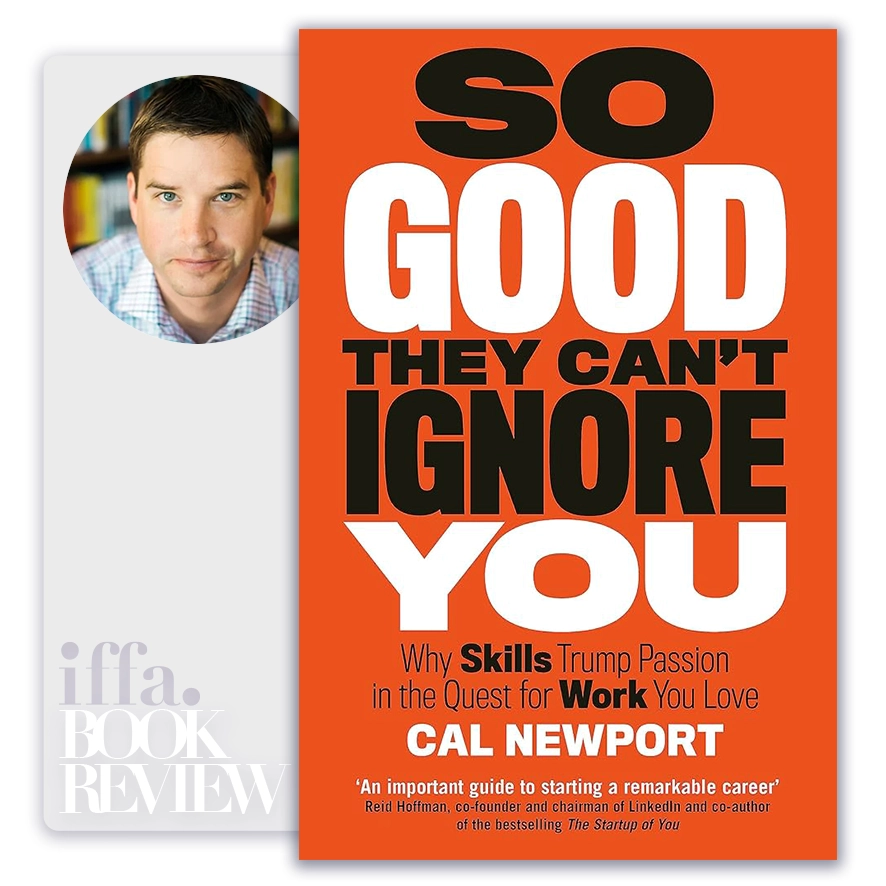
by Cal Newport
Summary Overview:
Modern career advice—and increasingly, talent strategy—centers on a seductive idea: follow your passion. Organizations design roles around “purpose,” individuals search for meaningful work, and leaders attempt to inspire through vision alone. Yet despite these efforts, disengagement, career volatility, and shallow skill development persist. So Good They Can’t Ignore You challenges this narrative at its core.
This book matters because it replaces romanticized career thinking with a performance-driven, evidence-based framework for professional excellence. Cal Newport argues that passion is not a prerequisite for great work—it is a byproduct of mastery. From a leadership and management perspective, this insight is transformative: sustainable engagement, retention, and innovation come not from slogans or perks, but from deliberate skill-building, autonomy earned through competence, and reputational capital. For leaders responsible for building exceptional teams and cultures, this book offers a practical blueprint for cultivating excellence that compounds over time.
About The Author
Cal Newport is a professor of computer science and a leading thinker on focus, skill development, and meaningful work. His work combines academic rigor, case studies, and practical frameworks drawn from high performers across fields.
Newport’s credibility lies in his refusal to rely on motivational rhetoric. Instead, he studies how people actually build rare and valuable skills—and how those skills translate into autonomy, satisfaction, and influence. His perspective resonates strongly with leadership, because it addresses how excellence is produced, not merely how it is described.
Core Idea:
The central thesis of So Good They Can’t Ignore You can be translated into leadership language as follows:
Career satisfaction, influence, and autonomy are earned through mastery—not granted through passion alone.
Newport introduces the concept of career capital—the accumulation of rare and valuable skills that give professionals leverage in the marketplace and inside organizations. In leadership terms:
- High performers gain autonomy because they deliver value
- Experts shape roles because they are hard to replace
- Meaning follows competence, not the other way around
For organizations, this reframes talent strategy from motivation-first to capability-first.
The craftsman mindset creates value; the passion mindset demands it.
Key Concepts:
- The Passion Hypothesis Is a Leadership Trap
Newport dismantles the idea that people must first discover their passion to do great work.
Passion is unreliable as a strategy; skill is dependable.
From a management perspective:
- Passion-based hiring often overlooks capability
- Passion without skill leads to frustration
- Passion rhetoric creates entitlement without excellence
Leaders who overemphasize passion risk building cultures that expect fulfillment before contribution.
- Career Capital: The Currency of Influence
At the heart of the book is the concept of career capital—skills that are:
- Rare
- Valuable
- Difficult to replicate
Autonomy, purpose, and flexibility are rewards for excellence—not starting conditions.
In organizations:
- High career capital earns trust
- High career capital enables negotiation
- High career capital drives resilience
Leadership development should therefore focus on systematic capability accumulation, not abstract inspiration.
- Why Autonomy Must Be Earned
Newport warns that autonomy pursued too early often backfires.
Autonomy without value creation collapses under pressure.
From a leadership lens:
- Flexibility works when performance is proven
- Freedom is sustainable when results are consistent
- Authority grows from contribution
Great leaders grant autonomy progressively, aligned with demonstrated mastery.
- Deliberate Practice as a Management Discipline
Newport emphasizes deliberate practice—focused, feedback-driven skill development.
Key characteristics:
- Stretching beyond comfort
- Immediate feedback
- Clear performance metrics
Busy work feels productive; deliberate practice produces results.
Organizations that fail to distinguish the two stall talent growth.
Leaders must:
- Design roles that develop skills
- Allocate time for deep improvement
- Reward learning velocity, not just output
- The Craftsman Mindset vs. The Passion Mindset
Newport contrasts two orientations:
- Passion mindset: “What can this job do for me?”
- Craftsman mindset: “How can I become excellent at this work?”
The craftsman mindset creates value; the passion mindset demands it.
From a leadership perspective, the craftsman mindset:
- Builds pride in execution
- Encourages ownership
- Produces consistent quality
High-performance cultures prioritize craft over entitlement.
- Meaning Emerges from Mastery
One of the book’s most important leadership insights is that meaning follows competence.
People love what they become good at.
In practice:
- Skill creates confidence
- Confidence creates agency
- Agency creates satisfaction
This reverses conventional engagement strategies and suggests leaders should invest in mastery first.
- Control Traps and Leadership Responsibility
Newport identifies “control traps”—situations where people pursue autonomy without adequate career capital.
Not all change is progress; some change is escape.
Leaders must help employees:
- Avoid premature role changes
- Build depth before breadth
- Recognize when persistence beats pivoting
This is especially relevant in volatile, opportunity-rich environments.
- Reputation as a Strategic Asset
Newport shows that exceptional professionals become known for specific, reliable excellence.
Reputation is built quietly, then compounds suddenly.
From a management perspective:
- Teams with strong reputations attract opportunity
- Individuals with reputational capital influence direction
- Organizations known for excellence gain strategic leverage
Leadership must protect and reinforce standards that sustain reputation.
- Mission Requires Capital
Newport argues that meaningful missions require leverage.
You need capital before you can change the rules.
In organizations:
- Vision without capability fails
- Strategy without execution erodes credibility
- Purpose without competence becomes rhetoric
Leaders must align mission ambition with skill maturity.
- Excellence as a Long-Term Strategy
The book ultimately frames excellence as a career-long strategy, not a quick win.
Being exceptional is the most reliable form of job security.
For leaders, this means:
- Long-term talent investment
- Patience with learning curves
- Resistance to shallow optimization
Reputation is built quietly, then compounds suddenly.
Executive Insights:
From a leadership and management lens, So Good They Can’t Ignore You offers powerful implications:
- Engagement follows mastery
- Autonomy must be earned
- Skill beats passion as a strategy
- Craftsmanship creates meaning
- Reputation compounds value
- Deliberate practice drives excellence
- Capability enables purpose
- Leaders shape mastery pathways
- Standards outperform slogans
- Excellence is a defensible advantage
Actionable Takeaways:
Practical Leadership Actions Inspired by Newport:
- Shift engagement strategies toward skill-building
- Design roles with clear mastery ladders
- Reward learning depth, not just activity
- Encourage craftsman mindset in performance reviews
- Delay autonomy until competence is proven
- Create feedback-rich environments
- Protect time for deep work and improvement
- Promote based on skill scarcity, not enthusiasm
- Build reputational capital at team level
- Align purpose narratives with capability reality
Final Thoughts:
So Good They Can’t Ignore You offers leaders a grounded, empowering message: great work is built, not discovered. Cal Newport dismantles the myth that fulfillment precedes excellence and replaces it with a far more reliable truth—excellence creates freedom, meaning, and influence.
The book’s ultimate leadership insight is both demanding and liberating:
If you want people to love their work, help them become exceptional at it.
For executives responsible for talent, culture, and long-term performance, this book delivers a timeless principle:
Organizations that invest in mastery will never struggle to motivate.
The ideas in this book go beyond theory, offering practical insights that shape real careers, leadership paths, and professional decisions. At IFFA, these principles are translated into executive courses, professional certifications, and curated learning events aligned with today’s industries and tomorrow’s demands. Discover more in our Courses.
Applied Programs

- Course Code : SBM-409
- Delivery : In-class / Virtual / Workshop
- Duration : 2-4 Days
- Venue: DUBAI HUB

- Course Code : PMA-613
- Delivery : In-class / Virtual / Workshop
- Duration : 3-5 Days
- Venue: DUBAI HUB
- Course Code : CIF-505
- Delivery : In-class / Virtual / Workshop
- Duration : 3-5 Days
- Venue: DUBAI HUB

- Course Code : CIF-512
- Delivery : In-class / Virtual / Workshop
- Duration : 2-4 Days
- Venue: DUBAI HUB
Related Books