The Executive Summary of
Superforecasting
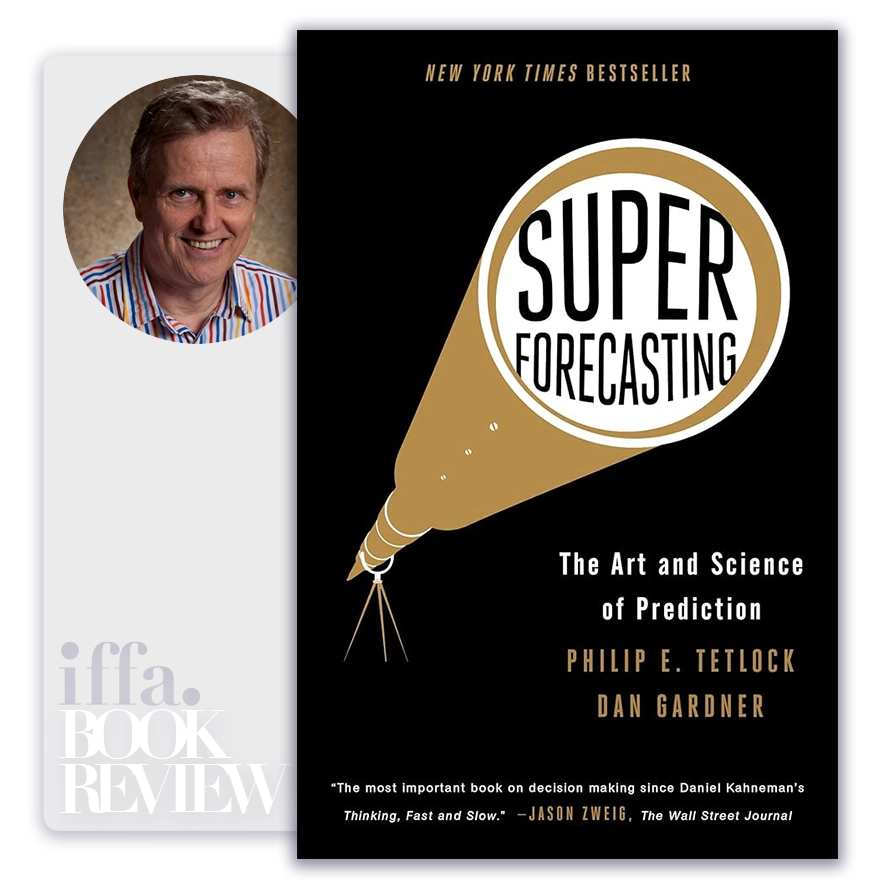
by Philip E. Tetlock & Dan Gardner
Summary Overview:
In volatile environments, strategic decisions depend on judgments about uncertain futures. Superforecasting: The Art and Science of Prediction challenges the assumption that forecasting is either intuitive guesswork or reserved for elite experts. Philip E. Tetlock and Dan Gardner demonstrate that forecasting accuracy can be improved systematically through disciplined thinking habits.
For executives navigating geopolitical risk, technological disruption, and capital allocation, this book sharpens probabilistic reasoning, bias control, and adaptive judgment. It reframes forecasting not as prophecy, but as a measurable skill. In contexts where overconfidence and ideological rigidity distort strategy, calibrated probability thinking becomes a structural advantage. The book remains relevant because uncertainty has become the defining condition of leadership.
About The Authors
Philip E. Tetlock is a psychologist and professor known for his decades-long research on political judgment and forecasting accuracy. Dan Gardner is a journalist and author specializing in decision-making and risk analysis. Together, they analyze data from large-scale forecasting tournaments, including projects sponsored by the U.S. intelligence community. Their distinctive contribution lies in demonstrating empirically that forecasting skill varies significantly and can be cultivated through disciplined cognitive habits.
Core Idea:
The central thesis of Superforecasting is that accurate prediction is less about intelligence or access to information and more about cognitive discipline and probabilistic thinking. The authors identify “superforecasters” as individuals who consistently outperform peers by updating beliefs, decomposing problems, and avoiding cognitive bias.
At its foundation, the book asserts that forecasts should be expressed in probabilities, revised continuously, and grounded in evidence rather than ideology. Superforecasters are neither reckless optimists nor cynical skeptics. They are intellectually humble, detail-oriented, and willing to change their minds. Judgment improves when certainty is replaced with calibrated likelihood.
Forecasting improves when confidence decreases.
Key Concepts:
- The Limits of Expert Intuition
Expert status does not guarantee forecasting accuracy. Tetlock’s research reveals that traditional authorities often perform no better than chance.
- Domain expertise may foster overconfidence
- Overconfidence reduces flexibility
- Reduced flexibility lowers accuracy
Skepticism toward authority enhances judgment. Evidence must outweigh credentials.
- Probabilistic Thinking
Predictions should be expressed in degrees of likelihood. Superforecasters avoid binary thinking.
- Certainty distorts risk assessment
- Probability clarifies exposure
- Calibration refines strategy
Quantifying uncertainty improves planning. Precision in probability reduces strategic error.
- Decomposition of Complex Problems
Breaking large questions into smaller components increases clarity. Superforecasters analyze underlying drivers rather than surface outcomes.
- Complexity obscures causation
- Decomposition reveals variables
- Variables refine estimates
Structured analysis enhances accuracy. Clarity emerges from disciplined breakdown.
- Updating Beliefs
Frequent revision improves forecasts. Superforecasters update probabilities as new data emerges.
- Static beliefs fossilize error
- Dynamic updating preserves accuracy
- Adaptability sustains advantage
Strategic agility depends on continuous reassessment. Flexibility strengthens resilience.
- Avoiding Cognitive Bias
Bias undermines prediction. The authors highlight common distortions such as confirmation bias and anchoring.
- Selective evidence reinforces error
- Anchoring narrows perspective
- Reflection reduces distortion
Bias awareness enhances objectivity. Self-correction refines judgment.
- Intellectual Humility
Confidence must coexist with openness. Superforecasters exhibit strong opinions lightly held.
- Dogmatism blocks learning
- Openness invites refinement
- Refinement improves accuracy
Humility is a predictive advantage. Learning outruns ego.
- The Role of Data and Base Rates
Historical patterns inform probability estimates. Superforecasters consult base rates before considering unique narratives.
- Anecdotes mislead
- Base rates anchor realism
- Realism strengthens planning
Data grounds intuition. Context precedes speculation.
- Team-Based Forecasting
Collaborative forecasting improves performance. Diverse perspectives reduce blind spots.
- Diversity broadens insight
- Structured debate surfaces assumptions
- Aggregation increases reliability
Collective intelligence enhances precision. Well-managed teams outperform individuals.
- Measuring Accuracy
Forecasting must be evaluated quantitatively. Tetlock uses scoring systems to track predictive performance.
- Measurement reveals bias
- Feedback refines skill
- Accountability strengthens discipline
Performance improves when tracked systematically. Metrics sharpen foresight.
- The Mindset of a Superforecaster
Superforecasters combine curiosity, discipline, and patience. They are methodical rather than dramatic.
- Curiosity drives inquiry
- Discipline structures reasoning
- Patience supports revision
Temperament influences accuracy. Steady cognition outperforms bold prediction.
Probability is a language of uncertainty, not a hedge against responsibility.
Executive Insights:
At the executive level, Superforecasting reframes strategic planning as probabilistic discipline rather than deterministic projection. Incentive systems that reward certainty may inadvertently encourage overconfidence. Sustainable performance requires embedding calibrated probability into decision frameworks.
Judgment strengthens when leaders articulate risk in quantitative terms. Risk exposure decreases when forecasts are updated continuously rather than defended rigidly. Long-term value creation depends on institutionalizing humility, feedback loops, and evidence-based adjustment. Organizations that measure predictive accuracy improve foresight over time.
Actionable Takeaways:
Forecasting must be treated as a skill to cultivate rather than a function to outsource.
- Start expressing strategic assumptions in probabilistic terms
- Stop rewarding overconfident certainty
- Reframe forecasts as evolving estimates rather than commitments
- Embed regular review and updating into planning cycles
- Encourage structured dissent in forecasting discussions
- Reduce reliance on anecdotal reasoning
- Align performance metrics with forecasting accuracy
- Protect intellectual humility at senior levels
Final Thoughts:
Superforecasting: The Art and Science of Prediction demonstrates that foresight is neither mystical nor purely intuitive. It is disciplined cognition applied consistently over time.
Long-term value creation depends on leaders who acknowledge uncertainty and manage it with structured reasoning. Institutions endure when prediction becomes calibrated rather than categorical. In the end, the strongest strategic advantage belongs to those who think in probabilities, revise without ego, and decide with disciplined humility.
The ideas in this book go beyond theory, offering practical insights that shape real careers, leadership paths, and professional decisions. At IFFA, these principles are translated into executive courses, professional certifications, and curated learning events aligned with today’s industries and tomorrow’s demands. Discover more in our Courses.
Applied Programs

- Course Code : SBM-409
- Delivery : In-class / Virtual / Workshop
- Duration : 2-4 Days
- Venue: DUBAI HUB

- Course Code : PMA-613
- Delivery : In-class / Virtual / Workshop
- Duration : 3-5 Days
- Venue: DUBAI HUB
- Course Code : CIF-505
- Delivery : In-class / Virtual / Workshop
- Duration : 3-5 Days
- Venue: DUBAI HUB

- Course Code : CIF-512
- Delivery : In-class / Virtual / Workshop
- Duration : 2-4 Days
- Venue: DUBAI HUB
Related Books