
The Executive Summary of
Blue Ocean Strategy
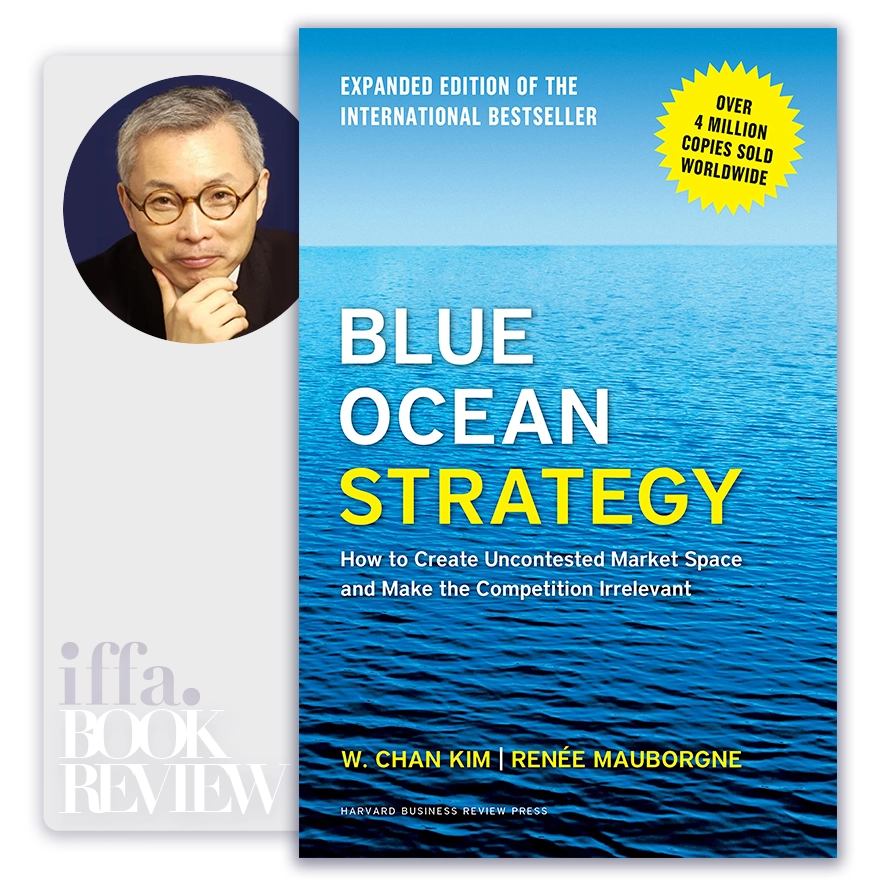
by W. Chan Kim & Renée Mauborgne
Summary Overview:
In saturated markets where competition intensifies and margins compress, Blue Ocean Strategy reframes the central strategic question. Instead of asking how to outperform rivals, it asks how to redefine the game entirely. W. Chan Kim and Renée Mauborgne argue that lasting growth does not come from fighting harder in crowded industries, but from creating new market space where competition is irrelevant.
This book sharpens strategic positioning, value innovation, and long-term growth thinking. It challenges zero-sum assumptions embedded in competitive strategy and replaces them with a disciplined framework for expanding demand. In volatile economies where differentiation erodes quickly, the ability to reconstruct market boundaries becomes a structural advantage. Its relevance endures because it shifts leadership from reactive rivalry to proactive creation.
About The Authors
Chan Kim and Renée Mauborgne are strategy scholars and professors at INSEAD who have spent decades studying corporate growth across industries and geographies. Their research-based approach analyzes how organizations systematically achieve high growth while avoiding direct competition. Their distinctive contribution lies in articulating value innovation as a repeatable strategic discipline, grounded in empirical study rather than abstract theory. They frame strategy not as confrontation, but as market creation.
Core Idea:
The central thesis of Blue Ocean Strategy is that sustainable growth comes from creating uncontested market space rather than competing within existing boundaries. Traditional competition, described as “red ocean,” focuses on outperforming rivals in known markets. Blue ocean strategy shifts focus to reconstructing value propositions in ways that simultaneously increase buyer value and reduce cost.
At its foundation, the book argues that value innovation aligns differentiation with low cost, breaking the conventional trade-off between the two. Rather than choosing between premium positioning or operational efficiency, companies can redesign offerings to eliminate and reduce factors that add cost while raising and creating elements customers truly value. Strategy, therefore, becomes a creative act of market design rather than competitive defense.
Competing harder in crowded markets rarely produces lasting advantage.
Key Concepts:
- Red Oceans Versus Blue Oceans
Red oceans represent existing industries defined by rivalry. In these markets, boundaries are accepted and competitors fight over incremental share.
- Competition reduces margins
- Imitation accelerates commoditization
- Price pressure erodes profitability
Blue oceans, by contrast, are defined by untapped demand. Strategic growth emerges when companies redefine boundaries rather than defend positions.
- Value Innovation
Value innovation is the cornerstone of blue ocean strategy. It integrates differentiation and cost reduction simultaneously.
- Eliminate factors that add little value
- Reduce over-engineered features
- Raise elements customers truly care about
- Create new sources of demand
This disciplined redesign enables companies to deliver compelling offerings at lower cost. Alignment of utility and efficiency drives scalable growth.
- Reconstructing Market Boundaries
Industry boundaries are not fixed; they are constructed. The authors outline methods for reimagining markets across alternatives, strategic groups, buyer groups, complementary offerings, functional-emotional orientation, and time.
Strategically, this broadens perspective beyond conventional competitor analysis. Opportunity expands when assumptions about industry structure are challenged.
- Focus, Divergence, and Compelling Tagline
A strong blue ocean strategy demonstrates focus and divergence. Rather than matching competitors across multiple dimensions, companies concentrate on distinctive value curves.
- Focus prevents dilution
- Divergence signals originality
- Clarity enhances communication
Strategic coherence strengthens internal alignment and external positioning. Simplicity enhances strategic impact.
- The Strategy Canvas
The strategy canvas visualizes competitive positioning. It maps key factors of competition and compares value curves.
- Reveals industry conformity
- Highlights overinvestment
- Exposes opportunities for differentiation
Visualization clarifies where strategic shifts are required. Clarity of landscape precedes transformation.
- Noncustomers as Opportunity
Growth lies in converting noncustomers. The authors emphasize looking beyond existing buyers.
- Soon-to-be noncustomers
- Refusing noncustomers
- Unexplored noncustomers
Focusing on nonconsumption expands demand rather than redistributes it. Market creation enlarges the economic pie.
- Sequencing Strategy
Strategic ideas must pass a sequence of tests. Utility, price, cost, and adoption barriers must align.
- Exceptional utility attracts demand
- Strategic pricing enables accessibility
- Cost structure supports profitability
- Adoption hurdles require proactive management
Execution risk decreases when sequencing is disciplined. Alignment converts concept into scalable reality.
- Organizational Alignment
Strategy fails without internal alignment. The authors stress fair process and engagement.
- Transparency builds trust
- Involvement increases commitment
- Clarity reduces resistance
Organizational buy-in sustains transformation. Strategy is cultural as much as analytical.
- Overcoming Organizational Hurdles
Cognitive, resource, motivational, and political hurdles obstruct innovation. Blue ocean execution requires concentrated effort to overcome these barriers.
- Concentration on critical influencers
- Visible quick wins
- Strategic resource reallocation
Momentum reinforces change. Focused effort overcomes inertia.
- Sustainability of Blue Oceans
Blue oceans attract imitation over time. The authors argue that early mover advantage must be protected through continued innovation.
- Brand strength builds loyalty
- Economies of scale deter entrants
- Continuous reinvention preserves differentiation
Sustainability requires vigilance. Creation must be ongoing, not episodic.
The most profitable growth often lies beyond industry boundaries.
Executive Insights:
At the executive level, Blue Ocean Strategy reframes competitive positioning as market design. Incentive systems focused exclusively on market share within existing industries reinforce red ocean behavior. Sustainable growth depends on questioning industry orthodoxy and realigning resources toward opportunity creation.
Judgment improves when leaders evaluate whether initiatives shift demand or merely redistribute it. Risk exposure decreases when strategic sequencing is disciplined and organizational alignment is deliberate. Long-term value creation emerges from expanding the frontier of demand rather than intensifying rivalry. Institutions that embed value innovation into governance processes sustain strategic renewal.
Actionable Takeaways:
Blue ocean thinking must become an institutional discipline rather than a one-time initiative.
- Start challenging industry assumptions during strategic planning
- Stop allocating disproportionate resources to incremental competitive battles
- Reframe differentiation and cost as complementary rather than opposing goals
- Embed value innovation into product and service design processes
- Encourage cross-functional analysis to reconstruct market boundaries
- Align pricing strategy with broad accessibility rather than exclusivity alone
- Reduce overinvestment in features customers undervalue
- Protect early advantage through continuous innovation and scale
Final Thoughts:
Blue Ocean Strategy reorients leadership from competition to creation. Its enduring relevance lies in redefining strategy as an act of imaginative discipline rather than defensive positioning.
Long-term value creation depends on expanding demand and aligning cost with innovation. Organizations that systematically seek uncontested space avoid destructive rivalry and unlock sustainable growth. In the end, the most enduring strategic advantage is not defeating competitors, but rendering them irrelevant through purposeful innovation.
The ideas in this book go beyond theory, offering practical insights that shape real careers, leadership paths, and professional decisions. At IFFA, these principles are translated into executive courses, professional certifications, and curated learning events aligned with today’s industries and tomorrow’s demands. Discover more in our Courses.
Applied Programs

- Course Code : SBM-409
- Delivery : In-class / Virtual / Workshop
- Duration : 2-4 Days
- Venue: DUBAI HUB

- Course Code : PMA-613
- Delivery : In-class / Virtual / Workshop
- Duration : 3-5 Days
- Venue: DUBAI HUB
- Course Code : CIF-505
- Delivery : In-class / Virtual / Workshop
- Duration : 3-5 Days
- Venue: DUBAI HUB

- Course Code : CIF-512
- Delivery : In-class / Virtual / Workshop
- Duration : 2-4 Days
- Venue: DUBAI HUB
Related Books