The Executive Summary of
The Effective Executive
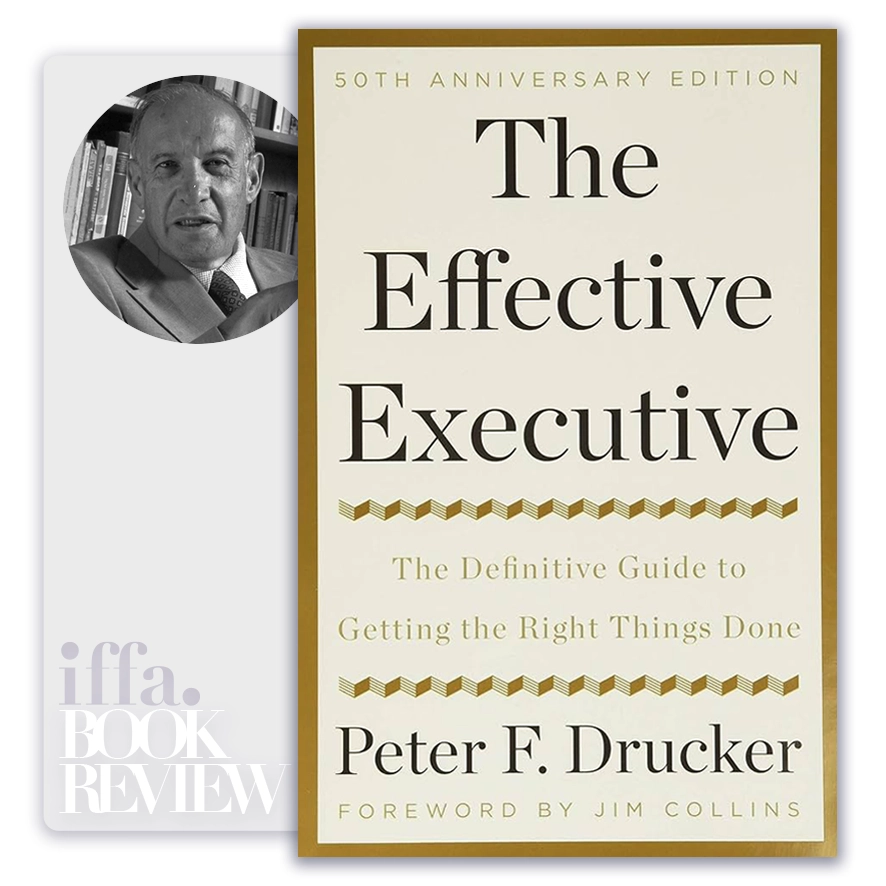
by Peter F. Drucker
Summary Overview:
In a landscape saturated with productivity systems and performance metrics, The Effective Executive remains a foundational text because it shifts the focus from efficiency to effectiveness. Peter F. Drucker argues that intelligence, talent, and ambition are insufficient without disciplined judgment about what truly matters. For senior leaders operating under constant demand, this distinction is decisive.
The book sharpens prioritization, responsibility, time governance, and decision discipline. It challenges the assumption that executives are paid to be busy; they are paid to be effective. In complex organizations where noise overwhelms signal, the ability to identify and act on the few truly consequential priorities becomes a structural advantage. Its relevance endures because it addresses the central constraint of leadership: limited time and unlimited demands.
About The Author
Peter F. Drucker is widely regarded as the father of modern management. His influence spans strategy, leadership, innovation, and organizational design, shaping how executives think about responsibility and results.
Drucker’s authority comes from decades of observation across corporations, governments, and non-profits, combined with an unmatched ability to distill management into clear, actionable principles that endure across eras.
Core Idea:
The central thesis of The Effective Executive is that effectiveness is a learned discipline, not a personality trait. Drucker rejects the myth of the naturally gifted leader and instead argues that executives become effective through systematic habits.
At its foundation, the book asserts that the executive’s primary responsibility is to achieve meaningful results through disciplined choices. Time must be managed, priorities must be defined, strengths must be leveraged, and decisions must be executed with clarity. Effectiveness is not about doing more; it is about doing what truly matters. Without disciplined focus, authority and intelligence produce limited impact.
Efficiency improves processes; effectiveness determines outcomes.
Key Concepts:
- Time as the Scarce Resource
Time is the executive’s most constrained asset. Drucker emphasizes that time cannot be stored, replaced, or expanded.
- Most time is consumed reactively
- Interruptions distort priorities
- Unexamined schedules erode strategic focus
Effective executives audit their time to understand where it truly goes. Without disciplined time governance, strategy remains aspirational.
- Contribution Over Activity
Executives are judged by results, not effort. Drucker shifts the focus from tasks to contribution.
- Activity may satisfy internal metrics
- Contribution advances organizational mission
- Mission alignment drives long-term value
Leaders must ask what meaningful impact they are responsible for. Output without relevance weakens strategic coherence.
- Leveraging Strengths
Results come from strengths, not from fixing weaknesses. Drucker argues that focusing on strengths multiplies value.
- Strengths accelerate performance
- Weakness-fixation diffuses energy
- Alignment enhances morale
Organizations that place individuals where they excel outperform those that attempt universal competence. Strategic positioning maximizes capability.
- The Discipline of Prioritization
Few priorities matter; many distract. Drucker insists that executives must concentrate on what produces disproportionate results.
- Multiple priorities dilute execution
- Diffusion reduces accountability
- Focus clarifies direction
Strategic concentration creates leverage. Clarity of priority defines leadership maturity.
- Decision Effectiveness
A decision is only as strong as its execution. Drucker emphasizes that decisions require clear communication and follow-through.
- Undefined responsibility weakens action
- Ambiguity invites delay
- Delay erodes momentum
Effective executives translate decisions into structured implementation. Clarity converts intent into outcome.
- Building on Opportunities
Energy should be directed toward opportunity, not merely problem-solving. Drucker observes that organizations often overemphasize crisis management.
- Problems require containment
- Opportunities generate growth
- Growth sustains relevance
While problems must be addressed, opportunity defines trajectory. Forward focus sustains competitive advantage.
- The Importance of Self-Development
Executives must manage themselves before managing others. Drucker stresses self-discipline as foundational.
- Self-awareness enhances judgment
- Personal discipline stabilizes influence
- Clarity strengthens credibility
Leadership begins with internal order. Personal effectiveness precedes institutional effectiveness.
- Organizational Communication
Clarity in communication prevents strategic drift. Drucker highlights the cost of misaligned expectations.
- Vague directives create confusion
- Confusion delays execution
- Delay compounds inefficiency
Clear communication aligns action across layers. Alignment accelerates results.
- Concentration on the Few
Effectiveness demands elimination. Drucker advises reducing low-impact activities.
- Elimination creates capacity
- Capacity enables focus
- Focus improves quality
The ability to say no is central to strategic clarity. Selective commitment preserves excellence.
- Institutional Responsibility
Executives are accountable for the performance of the whole. Drucker frames leadership as stewardship rather than status.
- Authority entails responsibility
- Responsibility demands discipline
- Discipline sustains results
Organizations succeed when leaders prioritize institutional health over personal recognition. Stewardship defines enduring leadership.
Strengths create results; weaknesses consume attention.
Executive Insights:
At the executive level, The Effective Executive reframes leadership as disciplined allocation of scarce attention. Incentive systems that reward busyness rather than results create illusionary productivity. Long-term value creation depends on concentration, clarity, and structured decision-making.
Judgment improves when executives regularly reassess time use and priority alignment. Risk exposure decreases when decisions are communicated clearly and executed deliberately. Organizations that cultivate effectiveness as a cultural discipline develop sustainable performance advantages. Over time, effectiveness compounds, while distraction compounds fragility.
Actionable Takeaways:
Effectiveness must be embedded as a systemic discipline, not left to personality.
- Start auditing executive time allocation regularly
- Stop equating motion with meaningful progress
- Reframe performance reviews around contribution to mission
- Embed prioritization frameworks into governance processes
- Align roles with demonstrated strengths
- Reduce low-impact initiatives that dilute focus
- Clarify decision ownership before execution
- Encourage leaders to manage themselves with the same rigor applied to teams
Final Thoughts:
The Effective Executive remains a cornerstone of management thought because it addresses the enduring constraint of leadership: limited time and expanding responsibility. Its wisdom lies in recognizing that effectiveness is cultivated through disciplined habits rather than charisma.
Long-term value creation depends on executives who can concentrate on the vital few and eliminate the trivial many. Sustainable institutions are built by leaders who measure themselves not by activity, but by contribution. In the end, the most powerful executive advantage is the disciplined habit of doing the right things with clarity and consistency.
The ideas in this book go beyond theory, offering practical insights that shape real careers, leadership paths, and professional decisions. At IFFA, these principles are translated into executive courses, professional certifications, and curated learning events aligned with today’s industries and tomorrow’s demands. Discover more in our Courses.
Applied Programs

- Course Code : SBM-409
- Delivery : In-class / Virtual / Workshop
- Duration : 2-4 Days
- Venue: DUBAI HUB

- Course Code : PMA-613
- Delivery : In-class / Virtual / Workshop
- Duration : 3-5 Days
- Venue: DUBAI HUB
- Course Code : CIF-505
- Delivery : In-class / Virtual / Workshop
- Duration : 3-5 Days
- Venue: DUBAI HUB

- Course Code : CIF-512
- Delivery : In-class / Virtual / Workshop
- Duration : 2-4 Days
- Venue: DUBAI HUB
Related Books