The Executive Summary of
Age of Agency
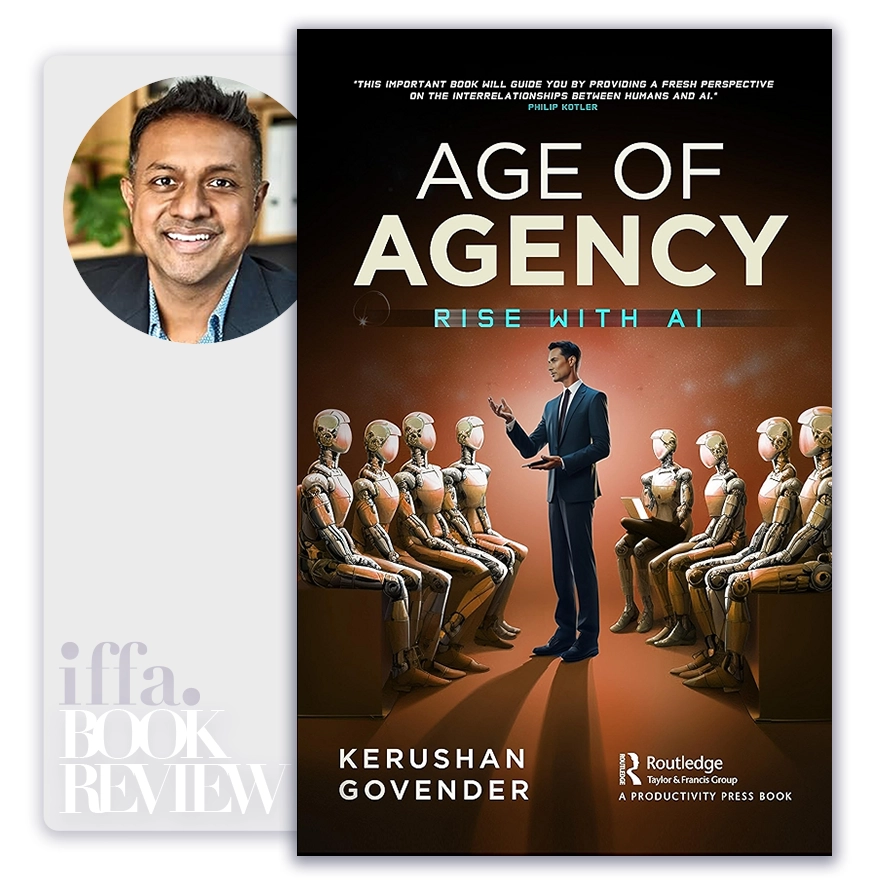
by Kerushan Govender
Summary Overview:
As artificial intelligence accelerates, many leaders frame the moment as a threat to jobs, judgment, and human relevance. Age of Agency matters because it rejects that framing and replaces it with a more demanding one: AI does not diminish human agency; it exposes whether leaders are willing to exercise it. The book is relevant today because the core risk of AI adoption is not automation, but abdication—the quiet transfer of judgment, responsibility, and purpose to systems optimized for efficiency rather than meaning. For CEOs, board members, policymakers, and senior executives, the book offers a strategic reframing: the winners of the AI era will not be those who deploy the most technology, but those who reassert human agency in how decisions are framed, delegated, and governed.
About The Author
Kerushan Govender is a leadership advisor and transformation practitioner working at the intersection of AI, organizational change, and human capability. His perspective is shaped by hands-on engagement with executives navigating real-world AI adoption rather than theoretical futures.
What distinguishes Govender’s viewpoint is his emphasis on agency as a leadership discipline. He treats AI not as a replacement for human capability, but as a force that amplifies intent—revealing whether organizations are designed for ownership, learning, and responsibility, or for compliance and deferral.
Core Idea:
The core idea of Age of Agency is that AI shifts the locus of value from execution to choice. As machines handle more routine analysis, pattern recognition, and optimization, human advantage moves upstream—to framing problems, setting direction, defining values, and taking responsibility for consequences. AI does not remove agency; it raises the cost of not using it deliberately.
Govender frames agency as the capacity to choose consciously under uncertainty. In the AI era, leaders face a temptation to defer judgment to systems that appear objective and efficient. The book argues that this is a strategic error. Organizations that thrive will be those that use AI to augment human judgment, while explicitly retaining accountability for decisions that shape people, culture, and long-term outcomes.
The future belongs to leaders who choose, not those who defer.
Key Concepts:
- Agency as a Strategic Asset
Agency—the ability to choose, adapt, and take responsibility—becomes more valuable as automation increases. It differentiates leaders from operators and organizations from commodities. - From Task Execution to Decision Framing
As AI executes tasks, humans must excel at framing the right problems. Poor framing scales failure faster than poor execution. - Delegation Without Abdication
AI enables delegation of analysis and execution, but not of accountability. Leaders remain responsible for outcomes, regardless of automation. - Judgment Under Uncertainty
AI improves prediction, not wisdom. Human judgment is required where values conflict, data is incomplete, or consequences are irreversible. - The Risk of Passive Automation
Uncritical adoption of AI embeds hidden assumptions and biases. Passive automation erodes agency by normalizing deference to outputs. - Human–AI Partnership by Design
Effective organizations design explicit roles for humans and machines. Ambiguity about decision ownership creates cultural and ethical risk. - Learning Velocity Over Efficiency
AI accelerates feedback loops. Leaders who prioritize learning over short-term efficiency compound advantage; those who optimize prematurely lock in error. - Culture as the Hidden Constraint
Agency flourishes in cultures that reward curiosity, dissent, and ownership. Command-and-control cultures misuse AI as a surveillance or enforcement tool. - Leadership Identity in the AI Era
Leaders shift from being decision-makers by authority to sense-makers by responsibility, guiding interpretation rather than issuing instructions. - Agency as a Moral Choice
Ultimately, exercising agency is an ethical stance. Choosing not to decide is itself a decision—one that transfers power to systems not designed for moral judgment.
Kaizen works not because it is simple, but because it is sustained.
Executive Insights:
Age of Agency reframes AI adoption as a leadership maturity test. Organizations with identical technologies will diverge sharply based on whether leaders consciously redesign decision rights, accountability, and culture—or allow automation to default into control by convenience.
For boards and senior executives, the implication is clear: AI governance is inseparable from human governance. Delegating too much erodes trust and purpose; delegating too little wastes potential.
- Agency determines strategic relevance
- Framing quality outweighs execution speed
- Accountability cannot be automated
- Culture shapes AI outcomes more than code
- Leadership absence scales faster with AI
Actionable Takeaways:
Senior leaders should translate Govender’s ideas into executive-level posture and systems:
- Reframe AI as an agency amplifier, not a decision replacement
- Redesign decision frameworks to clarify where humans must lead
- Explicitly assign accountability for AI-assisted outcomes
- Reward learning, not blind efficiency, in AI-enabled workflows
- Invest in leadership judgment and sense-making, not only technical skill
Final Thoughts:
Age of Agency is ultimately a book about choosing to remain human in systems that reward automation. It does not argue against AI; it argues against passivity. The danger is not that machines become more capable, but that leaders become less engaged, less responsible, and less willing to choose.
Its enduring value lies in its insistence that agency is not preserved by default. It must be exercised, protected, and institutionalized—especially when technology makes abdication comfortable and defensible.
The closing insight is calm and resolute: in the age of AI, the organizations that rise will not be those that automate fastest, but those whose leaders consciously reclaim agency—choosing direction, owning consequences, and ensuring that intelligence, however powerful, remains in service of human purpose.
The ideas in this book go beyond theory, offering practical insights that shape real careers, leadership paths, and professional decisions. At IFFA, these principles are translated into executive courses, professional certifications, and curated learning events aligned with today’s industries and tomorrow’s demands. Discover more in our Courses.
Applied Programs

- Course Code : SBM-409
- Delivery : In-class / Virtual / Workshop
- Duration : 2-4 Days
- Venue: DUBAI HUB

- Course Code : PMA-613
- Delivery : In-class / Virtual / Workshop
- Duration : 3-5 Days
- Venue: DUBAI HUB
- Course Code : CIF-505
- Delivery : In-class / Virtual / Workshop
- Duration : 3-5 Days
- Venue: DUBAI HUB

- Course Code : CIF-512
- Delivery : In-class / Virtual / Workshop
- Duration : 2-4 Days
- Venue: DUBAI HUB
Related Books