
The Executive Summary of
The War Below
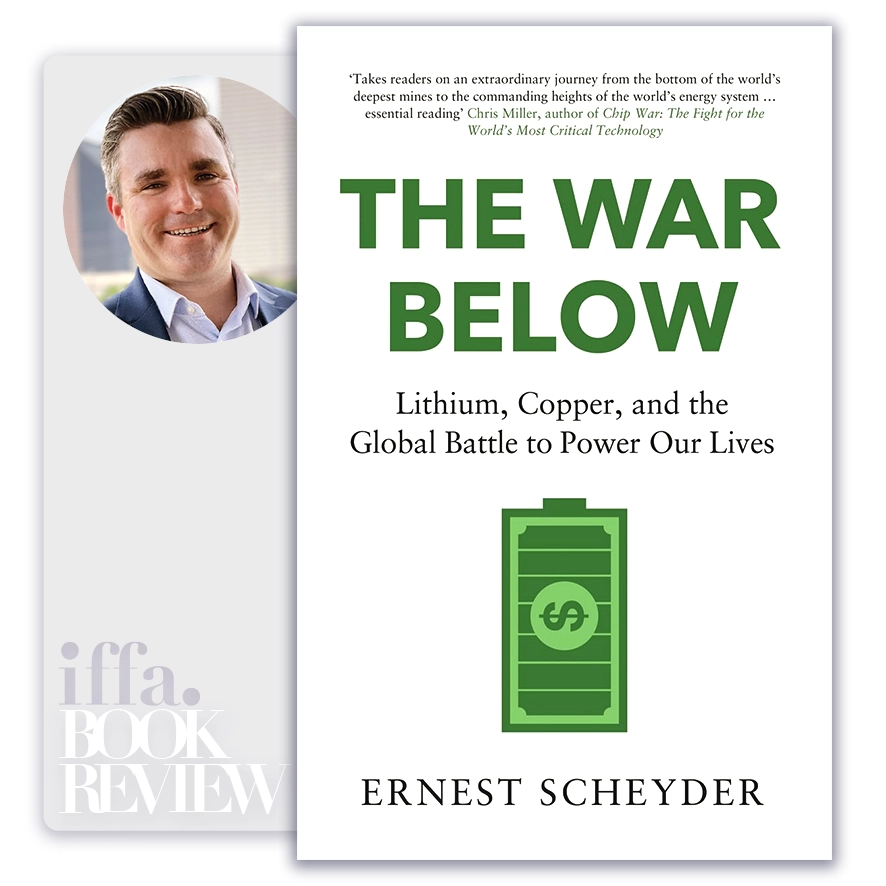
by Ernest Scheyder
Summary Overview:
The global energy transition is commonly framed as a race to deploy renewables, electrify transport, and digitize infrastructure. The War Below remains essential because it exposes the subsurface reality that determines whether those ambitions succeed or fail. Lithium, copper, and other critical minerals are not peripheral inputs; they are the physical foundation of electrification, and their scarcity, geography, and politics increasingly dictate the pace of transition. For CEOs, policymakers, investors, and national security leaders, the book matters because it reframes climate strategy as a mining, permitting, and social legitimacy challenge—one where timelines stretch across decades and public resistance collides with geopolitical urgency. Its relevance lies in showing that the clean-energy future will be decided not in laboratories or boardrooms alone, but underground and in contested communities.
About The Author
Ernest Scheyder is a senior energy journalist with extensive experience covering mining, commodities, and the energy transition, particularly through on-the-ground reporting. His authority stems from direct engagement with miners, regulators, indigenous groups, executives, and policymakers across multiple continents.
What distinguishes Scheyder’s perspective is his focus on implementation friction. Rather than treating critical minerals as abstract shortages, he documents how projects are delayed or derailed by permitting battles, environmental opposition, labor constraints, and capital risk—revealing the human and institutional bottlenecks behind supply forecasts.
Core Idea:
The core idea of The War Below is that the energy transition is constrained not by ambition or technology, but by society’s unwillingness and inability to extract the materials it requires. Electrification dramatically increases demand for lithium, copper, nickel, and other metals, yet mining remains politically unpopular, environmentally contentious, and procedurally slow—especially in advanced economies.
Scheyder presents the critical minerals challenge as a conflict between speed and consent. Governments demand rapid decarbonization, while communities resist the mines necessary to enable it. This tension creates strategic vulnerability, pushing supply chains toward jurisdictions willing to accept environmental and social costs. Leaders who ignore this reality risk building transition strategies on material assumptions that cannot be fulfilled at scale.
The clean-energy transition is limited not by innovation, but by what societies are willing to dig up.
Key Concepts:
- Explosive Demand for Electrification Metals
Electric vehicles, grids, and renewables require multiples more copper and lithium than fossil systems. Demand growth is structural, not cyclical, making supply adequacy a strategic question. - Mining Timelines Versus Climate Timelines
New mines take a decade or more to permit and build. This mismatch creates structural scarcity, regardless of geological abundance. - Community Opposition and Social License
Mining projects increasingly face resistance from local and indigenous communities. Social license has become as decisive as ore quality or capital availability. - Environmental Paradox of Clean Energy
Clean technologies rely on environmentally disruptive extraction. Societies externalize damage while demanding purity at home, creating moral and political contradiction. - Concentration of Supply Chains
Processing and refining capacity is geographically concentrated, amplifying geopolitical risk. Control of midstream capacity often matters more than mining itself. - The Illusion of Recycling as a Near-Term Solution
Recycling is necessary but insufficient. Scale, chemistry, and demand growth mean primary extraction will dominate for decades. - Capital Risk and Investor Reluctance
Price volatility, permitting uncertainty, and political risk deter investment. Without stable policy signals, capital remains structurally cautious. - Resource Nationalism and State Intervention
As minerals gain strategic value, producing countries assert greater control. This introduces new volatility into supply planning. - Advanced Economies’ Strategic Vulnerability
Western countries promote electrification while outsourcing extraction. This creates dependence on foreign jurisdictions with different standards and priorities. - Mining as a Strategic Industry, Not a Commodity Business
Scheyder argues that mining must be treated as strategic infrastructure, governed with the same seriousness as energy grids or defense supply chains.
Decarbonization accelerates demand faster than institutions can approve supply.
Executive Insights:
The War Below reframes the energy transition as a political economy problem, not a purely technological one. Organizations and governments pursuing net-zero targets without securing mineral supply face execution risk disguised as moral certainty.
For boards and senior leadership, the message is clear: electrification strategies are only as credible as their mineral sourcing plans.
- Material constraints will shape transition speed
- Social license determines supply viability
- Processing power defines geopolitical leverage
- Capital follows policy clarity, not rhetoric
- Mining risk is now energy risk
Actionable Takeaways:
Senior leaders should translate the book’s insights into strategic governance and planning:
- Reframe critical minerals as strategic infrastructure, not upstream noise
- Map mineral dependencies across products, regions, and timelines
- Engage early with communities and regulators to secure social license
- Support domestic and allied processing capacity, not mining alone
- Align climate ambition with realistic supply development
Final Thoughts:
The War Below is ultimately a book about honesty in transition planning. It does not reject clean energy; it challenges the comforting assumption that supply will simply appear because demand is virtuous. The transition will be mineral-intensive, contested, and politically fraught.
Its enduring value lies in revealing that the hardest part of decarbonization is not deploying technology, but reconciling environmental ideals with extractive reality. Ignoring this tension does not accelerate progress; it delays it.
The closing insight is sober and strategic: a clean-energy future will be decided not only by innovation and policy, but by whether societies are willing to accept, govern, and legitimize the mining required to power it.
The ideas in this book go beyond theory, offering practical insights that shape real careers, leadership paths, and professional decisions. At IFFA, these principles are translated into executive courses, professional certifications, and curated learning events aligned with today’s industries and tomorrow’s demands. Discover more in our Courses.
Applied Programs

- Course Code : SBM-409
- Delivery : In-class / Virtual / Workshop
- Duration : 2-4 Days
- Venue: DUBAI HUB

- Course Code : PMA-613
- Delivery : In-class / Virtual / Workshop
- Duration : 3-5 Days
- Venue: DUBAI HUB
- Course Code : CIF-505
- Delivery : In-class / Virtual / Workshop
- Duration : 3-5 Days
- Venue: DUBAI HUB

- Course Code : CIF-512
- Delivery : In-class / Virtual / Workshop
- Duration : 2-4 Days
- Venue: DUBAI HUB
Related Books