
The Executive Summary of
The Art of Clear Thinking
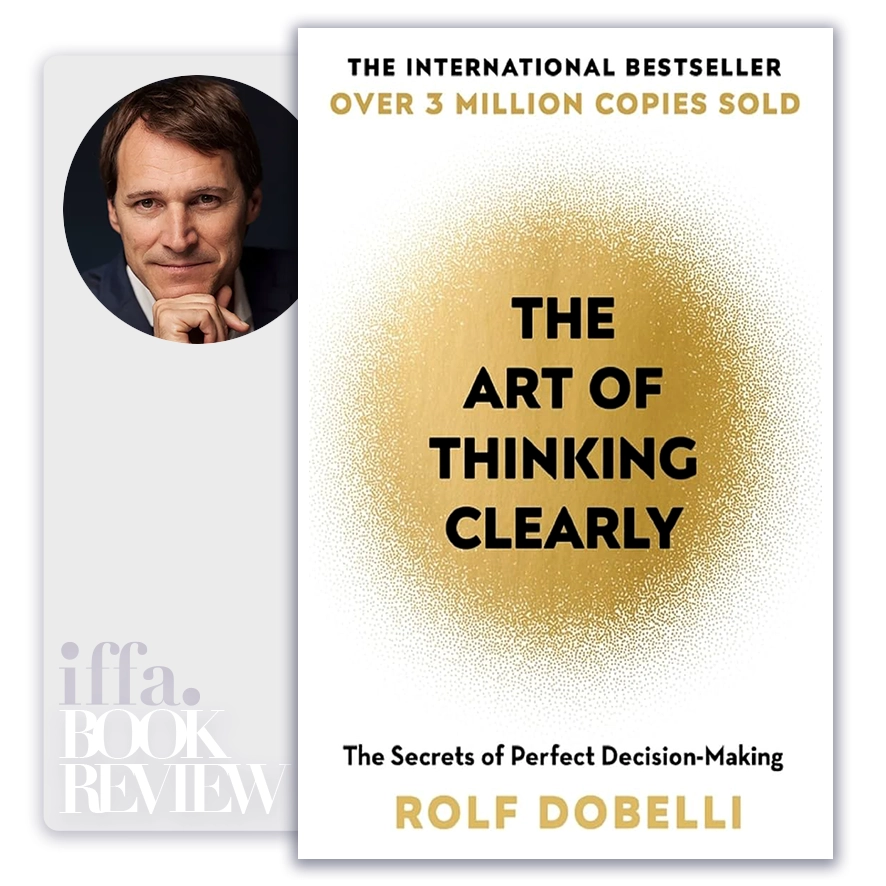
by Rolf Dobelli
Summary Overview:
The Art of Clear Thinking speaks directly to one of the most underestimated risks in leadership and life: poor judgment made under pressure, noise, and emotion. In a world saturated with information, opinions, incentives, and urgency, the challenge is no longer access to knowledge—it is the ability to think clearly when it matters most. Many costly mistakes are not caused by lack of intelligence, but by predictable thinking traps that distort perception and decision-making.
The book reframes clear thinking as a deliberate discipline, not a personality trait. It shows how ego, incentives, shortcuts, and emotional reactions quietly sabotage otherwise capable people—especially those in positions of authority. For executives, investors, and long-term decision-makers, this perspective is deeply practical. Clear thinking becomes a strategic advantage: it protects against impulsive action, improves risk judgment, and enables consistent decision-making over time. By focusing on removing blindspots rather than adding complexity, The Art of Clear Thinking offers a grounded framework for navigating uncertainty with calm, precision, and long-term perspective.
About The Author
Shane Parrish is the founder of Farnam Street, a widely respected platform on decision-making, mental models, and applied wisdom. His authority comes from synthesizing psychology, philosophy, and real-world judgment, with a strong emphasis on clarity over complexity.
Core Idea:
The core idea of The Art of Clear Thinking is that better decisions come from removing obstacles to rational thought rather than adding more intelligence. Humans are not rational by default; we are emotional, biased, and easily influenced by incentives, fear, and ego. Clear thinking begins when we recognize these limitations and design ways to work around them.
Parrish argues that the most effective thinkers focus less on predicting outcomes and more on avoiding obvious mistakes. By controlling emotional reactions, understanding incentives, and creating distance from immediate pressures, individuals can dramatically improve judgment. Clear thinking is not brilliance—it is discipline practiced consistently.
Clear thinking is about removing what clouds judgment, not adding what sounds smart.
Key Concepts:
- Clarity Comes From Subtraction
Parrish emphasizes that most thinking errors arise from noise—distractions, emotions, and social pressure. Removing these inputs often produces clearer judgment than adding more analysis.
- Less noise, better decisions
- Silence improves signal
- Focus beats complexity
Example: Stepping away from immediate reactions often reveals better options than rapid response.
- The Power of Inversion
Instead of asking how to succeed, Parrish suggests asking how to fail—and then avoiding those paths. Inversion highlights risks and blindspots that forward thinking misses.
- Avoid obvious failure modes
- Identify self-sabotage
- Reduce downside first
Example: Leaders who ask “How could this go wrong?” prevent avoidable disasters.
- Emotions as Decision Distorters
Fear, anger, ego, and excitement impair judgment. Clear thinkers learn to pause until emotional intensity subsides.
- Strong emotion equals weak judgment
- Time reduces distortion
- Calm improves accuracy
Example: High-stakes decisions made in anger often create long-term regret.
- Incentives Shape Behavior
People respond to incentives more reliably than to logic or ethics. Understanding incentives explains behavior more accurately than stated intentions.
- Incentives reveal truth
- Misaligned rewards create dysfunction
- Systems beat personalities
Example: Compensation structures often predict behavior better than values statements.
- Second-Order Thinking
Clear thinking requires considering not just immediate outcomes, but downstream effects. Many failures result from ignoring consequences that unfold later.
- Short-term wins create long-term costs
- Effects compound over time
- Patience improves foresight
Example: Cost-cutting that weakens trust often damages future performance.
- Avoiding Self-Deception
Humans are skilled at justifying poor choices. Parrish urges readers to challenge comforting narratives and confront inconvenient truths.
- Rationalization hides error
- Truth requires discomfort
- Honesty improves outcomes
Example: Blaming external factors delays learning from internal mistakes.
- Building Decision Margins of Safety
Borrowed from engineering and investing, margins of safety protect against error, uncertainty, and randomness.
- Assume you are wrong sometimes
- Build buffers
- Resilience beats precision
Example: Conservative assumptions prevent catastrophic failure when forecasts miss.
- Separating Signal From Noise
Not all information is useful. Clear thinkers distinguish meaningful data from distracting inputs.
- More information ≠ better decisions
- Quality beats quantity
- Focus sharpens insight
Example: Constant news consumption often degrades judgment rather than improving it.
- Thinking in Timeframes
Parrish stresses the importance of matching decisions to appropriate time horizons. Short-term thinking often contradicts long-term success.
- Align decisions with time impact
- Avoid urgency traps
- Long-term clarity reduces stress
Example: Leaders who optimize for the next quarter often sacrifice enduring value.
- Character as a Decision Asset
Integrity, patience, and self-control are not moral extras—they are practical tools for clear thinking.
- Character supports judgment
- Discipline enables consistency
- Temperament matters
Example: Calm leaders make better decisions under uncertainty than reactive ones.
Avoiding stupidity is often more powerful than trying to be clever.
Executive Insights:
The Art of Clear Thinking reframes decision-making as a process of error elimination rather than idea generation. Its core implication is that many failures are predictable and preventable if leaders slow down, remove emotional distortion, and design systems that protect against bias.
For executives and boards, the book highlights that culture, incentives, and pace strongly influence judgment quality. Organizations that reward speed, certainty, and confidence often discourage reflection—creating hidden risk.
Key strategic implications include:
- Fewer errors beat more clever ideas
- Incentives shape outcomes more than intention
- Emotional discipline improves leadership judgment
- Margins of safety reduce catastrophic risk
- Long-term thinking protects value
Actionable Takeaways:
The book offers broadly applicable principles for clearer thinking.
- Pause when emotions run high
- Use inversion to identify failure paths
- Design incentives carefully
- Build margins of safety into decisions
- Filter information aggressively
- Think beyond immediate outcomes
- Prioritize temperament alongside intelligence
Final Thoughts:
The Art of Clear Thinking is ultimately a book about self-mastery in decision-making. Shane Parrish shows that clarity is not achieved through brilliance or speed, but through restraint, honesty, and disciplined thinking.
The enduring insight of the book is simple yet demanding: clear thinking is less about knowing more and more about letting go of what misleads us. Leaders who internalize this principle reduce avoidable error, improve long-term outcomes, and gain an advantage that compounds quietly over time.
The ideas in this book go beyond theory, offering practical insights that shape real careers, leadership paths, and professional decisions. At IFFA, these principles are translated into executive courses, professional certifications, and curated learning events aligned with today’s industries and tomorrow’s demands. Discover more in our Courses.
Applied Programs

- Course Code : SBM-409
- Delivery : In-class / Virtual / Workshop
- Duration : 2-4 Days
- Venue: DUBAI HUB

- Course Code : PMA-613
- Delivery : In-class / Virtual / Workshop
- Duration : 3-5 Days
- Venue: DUBAI HUB

- Course Code : CIF-505
- Delivery : In-class / Virtual / Workshop
- Duration : 3-5 Days
- Venue: DUBAI HUB

- Course Code : CIF-512
- Delivery : In-class / Virtual / Workshop
- Duration : 2-4 Days
- Venue: DUBAI HUB
Related Books