

The Executive Summary of
Risk Up Front
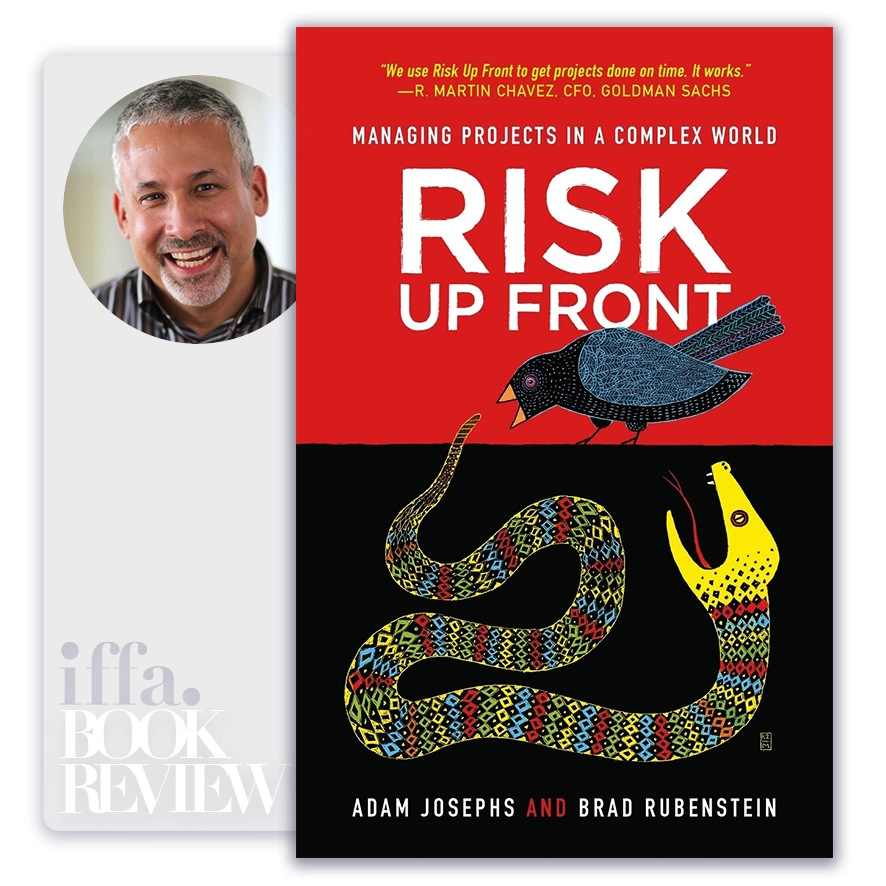
by Adam Josephs
Summary Overview:
Large projects rarely fail because teams lack tools or effort; they fail because risk is discovered too late, after commitments harden and options disappear. Risk Up Front remains relevant because it confronts a persistent leadership blind spot: the tendency to treat risk as a reporting exercise rather than a front-loaded decision discipline. In an era of megaprojects, digital transformation, public–private partnerships, and compressed timelines, the book reframes project management as risk governance under uncertainty, not schedule optimization. For executives, board members, sponsors, and policymakers, its value lies in demonstrating how early clarity about uncertainty preserves optionality, protects capital, and prevents irreversible escalation.
About The Author
Adam Josephs is a project and risk management practitioner with extensive experience advising complex, high-stakes initiatives across sectors. His credibility comes from repeated exposure to projects where uncertainty, interdependence, and stakeholder pressure make traditional planning inadequate.
What distinguishes Josephs’ perspective is his emphasis on decision architecture. Rather than promoting new tools, he focuses on how leaders structure conversations, incentives, and commitments so that risk is surfaced when it can still be acted upon.
Core Idea:
The core idea of Risk Up Front is that risk must be managed at the moment decisions are made, not after plans are approved. Most projects lock in cost, schedule, and outcome exposure early—often before teams fully understand complexity. Treating risk as a downstream activity creates false confidence and drives escalation when reality diverges from plan.
Josephs presents risk as a leadership responsibility embedded in governance. Up-front risk management means confronting uncertainty honestly, testing assumptions early, and sequencing decisions to preserve flexibility. Executives who delay these conversations unintentionally convert uncertainty into commitment, making later “risk management” largely performative.
Risk unmanaged early becomes cost and delay later.
Key Concepts:
- Complexity Is Not Complication
Complex projects involve interdependencies, emergent behavior, and unknowns that cannot be solved by detailed planning alone. Leaders must recognize complexity as a different operating condition, requiring adaptive governance rather than linear control. - Early Decisions Carry Disproportionate Risk
The majority of project value and exposure is determined early through scope, design, contracting, and sequencing choices. This makes early-stage judgment the primary risk lever. - Assumption Testing Over Forecast Precision
Detailed forecasts create the illusion of certainty. Josephs argues for explicit testing of critical assumptions, which reveals fragility faster than refined estimates. - Risk as a Portfolio of Uncertainties
Projects face technical, commercial, political, and behavioral risks simultaneously. Treating risk holistically enables leaders to trade one exposure for another deliberately, rather than discovering conflicts late. - Governance That Encourages Bad News
Projects fail when bad news is suppressed. Effective governance creates psychological safety and structural incentives for early disclosure, turning risk signals into strategic input. - Decision Sequencing to Preserve Optionality
Not all decisions must be made early. Sequencing commitments allows learning to reduce uncertainty before capital is locked in. Optionality is a form of risk control, not indecision. - The Cost of Premature Commitment
Once contracts, reputations, and political capital are committed, organizations resist change. Early risk management aims to delay irreversible commitments until uncertainty is reduced. - Scenario Thinking Over Single-Path Planning
Single-path plans collapse under variance. Scenario-based thinking prepares leaders to navigate divergence without panic, preserving momentum and credibility. - Incentives Shape Risk Behavior
Schedule pressure and performance metrics often discourage honest risk reporting. Aligning incentives with truthful assessment rather than optimistic delivery is essential. - Leadership Temperament Under Uncertainty
Risk up front requires leaders comfortable with ambiguity. The book emphasizes calm curiosity over defensive certainty, a trait that stabilizes teams during early uncertainty.
Projects fail when commitment outruns understanding.
Executive Insights:
Risk Up Front reframes project management as enterprise risk governance, not operational administration. Organizations with similar capabilities diverge sharply based on whether leaders confront uncertainty early or defer it for comfort. The book makes clear that late-stage heroics cannot compensate for early-stage avoidance.
For boards and sponsors, the central implication is that project success depends more on decision discipline at inception than on execution excellence alone.
- Early clarity preserves strategic flexibility
- Assumption testing outperforms optimistic forecasting
- Governance quality determines risk visibility
- Optionality reduces irreversible exposure
- Leadership behavior shapes truth flow
Actionable Takeaways:
Senior leaders should translate the book’s insights into executive-level behaviors and systems:
- Reframe risk management as a front-end leadership discipline, not a reporting function
- Demand explicit assumption testing before major commitments
- Sequence decisions to preserve optionality, especially capital-intensive ones
- Align incentives to reward early truth, not late recovery
- Use scenarios to govern uncertainty, not to predict outcomes
Final Thoughts:
Risk Up Front is ultimately a book about organizational maturity in the face of uncertainty. It challenges leaders to replace false certainty with disciplined curiosity and to treat early discomfort as an investment in long-term control.
Its enduring value lies in its insistence that uncertainty does not disappear when ignored; it compounds. Projects succeed not by eliminating risk, but by confronting it early enough to shape decisions intelligently.
The closing insight is clear and demanding: in complex projects, leadership is defined not by confidence in the plan, but by the courage to surface uncertainty before commitment makes it unmanageable.
The ideas in this book go beyond theory, offering practical insights that shape real careers, leadership paths, and professional decisions. At IFFA, these principles are translated into executive courses, professional certifications, and curated learning events aligned with today’s industries and tomorrow’s demands. Discover more in our Courses.
Applied Programs

- Course Code : SBM-409
- Delivery : In-class / Virtual / Workshop
- Duration : 2-4 Days
- Venue: DUBAI HUB

- Course Code : PMA-613
- Delivery : In-class / Virtual / Workshop
- Duration : 3-5 Days
- Venue: DUBAI HUB

- Course Code : CIF-505
- Delivery : In-class / Virtual / Workshop
- Duration : 3-5 Days
- Venue: DUBAI HUB

- Course Code : CIF-512
- Delivery : In-class / Virtual / Workshop
- Duration : 2-4 Days
- Venue: DUBAI HUB
Related Books