
The Executive Summary of
The Coming Wave
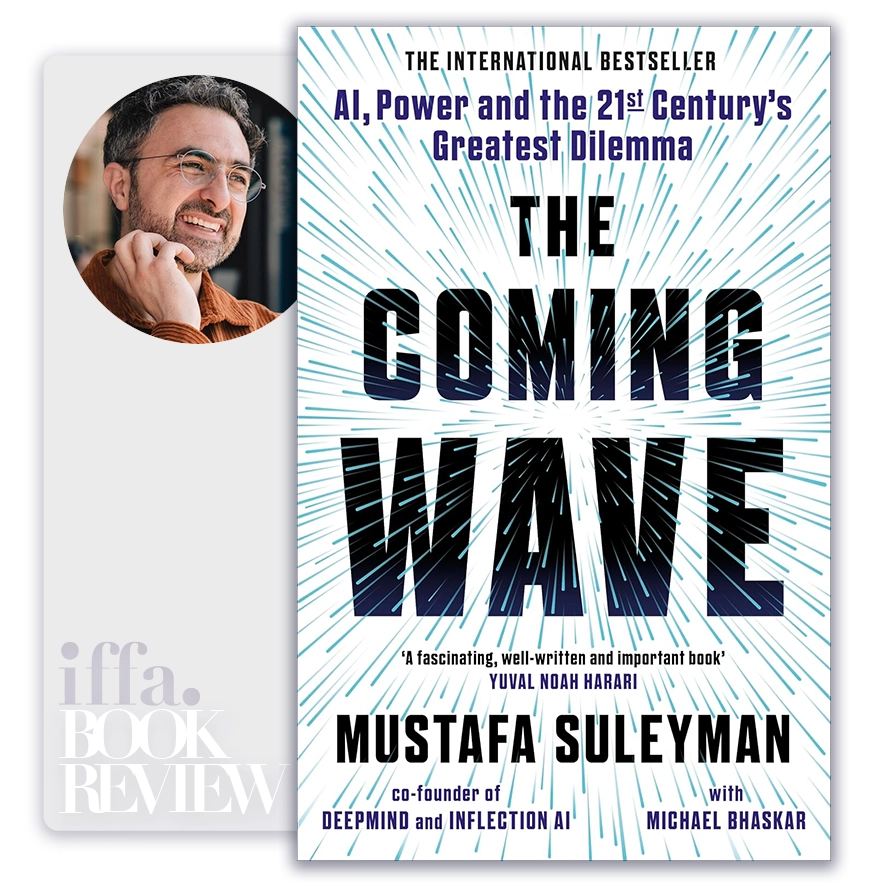
by Mustafa Suleyman
Summary Overview:
The Coming Wave matters because it confronts leaders with a reality most strategy documents avoid: a cluster of fast-advancing technologies is converging faster than our institutions can adapt. Artificial intelligence, synthetic biology, robotics, and energy systems are not arriving as isolated innovations; they are reinforcing one another into a force that will reshape power, security, labor, and governance simultaneously. For CEOs, board members, policymakers, and long-term investors, the book is essential reading because it reframes technological progress as a containment challenge, not a linear growth opportunity. Its relevance today lies in clarifying that the central question is no longer “What can we build?” but “How do we retain control once we do?”
About The Author
Mustafa Suleyman is an entrepreneur and policy thinker at the forefront of artificial intelligence development and governance. He co-founded DeepMind and has worked closely with governments and institutions on AI strategy and safety.
What distinguishes Suleyman’s perspective is his dual credibility: deep exposure to frontier technology development combined with sustained engagement on geopolitical risk, regulation, and ethics. He writes not as an outsider warning of disruption, but as an insider acknowledging responsibility for what has been unleashed.
Core Idea:
The core idea of The Coming Wave is that humanity is entering an era where powerful, general-purpose technologies are cheap, scalable, and accessible, making traditional forms of control increasingly fragile. Unlike previous industrial revolutions, this wave empowers individuals and small groups with capabilities once reserved for states—whether to generate intelligence, engineer biology, or disrupt infrastructure.
Suleyman frames the problem as one of containment versus diffusion. Innovation thrives on openness, but unchecked diffusion undermines safety, stability, and trust. The future will be shaped by whether societies can build legitimate, enforceable, and adaptive guardrails fast enough to channel progress without triggering systemic collapse. Failure is not a distant dystopia; it is a gradual erosion of control that feels manageable—until it isn’t.
The defining challenge of this century is not innovation, but containment.
Key Concepts:
- Convergence of Transformative Technologies
AI, biotech, robotics, and energy systems amplify one another. Their interaction accelerates capability growth beyond what siloed governance can manage. - Democratization of Power
Capabilities once monopolized by states are now available to individuals. This rebalances power downward, destabilizing traditional security models. - Diffusion Outpacing Control
Open research, global supply chains, and digital distribution spread capability faster than regulation can respond, creating structural governance lag. - Containment as a Design Principle
Suleyman argues for embedding constraints into systems themselves—technical, legal, and institutional—rather than relying on post-hoc enforcement. - The Limits of Market Self-Correction
Markets reward speed and scale, not restraint. Left alone, they optimize for capability expansion, not societal stability. - National Security Reimagined
Security is no longer defined only by borders and armies. It now includes model access, compute control, data flows, and bio-manufacturing capacity. - Fragility of Democratic Institutions
Rapid technological shocks strain public trust and decision legitimacy. Democracies must adapt governance without sacrificing openness or accountability. - Corporate Responsibility at the Frontier
Frontier firms act as de facto governors. Their choices on release, access, and safeguards have public consequences beyond private liability. - The Illusion of Technological Neutrality
Technologies encode values through objectives and incentives. Claiming neutrality abdicates responsibility for predictable downstream effects. - A Narrow Window for Action
Containment is easiest early. Once capabilities diffuse widely, reversal becomes politically and technically infeasible. Timing is decisive.
Power is becoming easier to access and harder to govern.
Executive Insights:
The Coming Wave reframes leadership for the 21st century as custodianship under acceleration. Competitive advantage, national power, and corporate growth are increasingly constrained by legitimacy, trust, and safety capacity—not by innovation alone. Organizations that pursue speed without containment invite backlash, regulation, and loss of license to operate.
For boards and senior executives, the implication is stark: frontier capability without governance is a balance-sheet risk, a reputational risk, and a systemic risk. The winners will be those who help shape the rules, not those who race ahead assuming rules will follow.
- Capability growth is exponential; governance is not
- Early constraints preserve long-term freedom
- Legitimacy is now a strategic asset
- Security extends into digital and biological domains
- Delay narrows options irreversibly
Actionable Takeaways:
Senior leaders should translate Suleyman’s arguments into governance-level commitments, not abstract principles:
- Treat containment as a core strategic objective, alongside growth
- Embed safeguards into products and platforms from inception
- Support coordinated regulation and standards, even if it slows rollout
- Align incentives away from pure scale toward safety and trust
- Establish board-level oversight for frontier technology risk
Final Thoughts:
The Coming Wave is ultimately a book about power with responsibility. It neither rejects technological progress nor romanticizes restraint. Instead, it insists that leadership in this era requires moral courage, institutional imagination, and collective action equal to the technologies being unleashed.
Its enduring value lies in naming the dilemma plainly: we are building systems whose power exceeds our current capacity to govern them. Ignoring this gap does not preserve innovation; it endangers it.
The closing insight is clear and demanding: the future will belong to those who learn to contain power without extinguishing progress—and who understand that, in the coming wave, restraint is not the enemy of innovation, but its last line of defense.
The ideas in this book go beyond theory, offering practical insights that shape real careers, leadership paths, and professional decisions. At IFFA, these principles are translated into executive courses, professional certifications, and curated learning events aligned with today’s industries and tomorrow’s demands. Discover more in our Courses.
Applied Programs

- Course Code : SBM-409
- Delivery : In-class / Virtual / Workshop
- Duration : 2-4 Days
- Venue: DUBAI HUB
- Course Code : PMA-613
- Delivery : In-class / Virtual / Workshop
- Duration : 3-5 Days
- Venue: DUBAI HUB

- Course Code : CIF-505
- Delivery : In-class / Virtual / Workshop
- Duration : 3-5 Days
- Venue: DUBAI HUB

- Course Code : CIF-512
- Delivery : In-class / Virtual / Workshop
- Duration : 2-4 Days
- Venue: DUBAI HUB
Related Books