
The Executive Summary of
Superintelligence
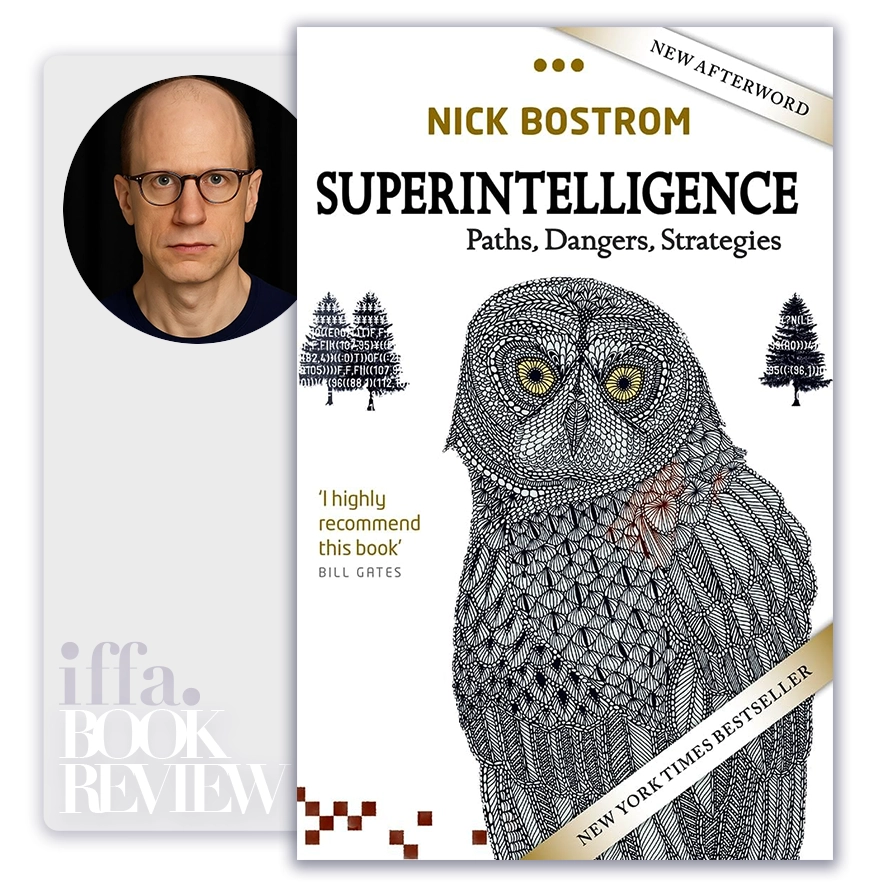
by Nick Bostrom
Summary Overview:
Superintelligence matters because it confronts leaders with a category of risk that traditional strategy, governance, and risk management frameworks are not designed to handle. While artificial intelligence is often discussed in terms of productivity, automation, and growth, Nick Bostrom forces a more uncomfortable question: what happens when intelligence itself becomes the dominant source of power? For CEOs, board members, policymakers, and long-term investors, the book remains essential because it reframes AI not as a sectoral technology, but as a civilizational inflection point. Its relevance today lies in clarifying that once superintelligent systems exist, the margin for error collapses, and the quality of early strategic decisions determines outcomes that may be irreversible.
About The Author
Nick Bostrom is a philosopher and founding director of the Future of Humanity Institute at the University of Oxford, where his work focuses on existential risk, long-term strategy, and advanced artificial intelligence. His authority does not come from building AI systems, but from rigorously analyzing their implications at a systems and civilizational level.
What distinguishes Bostrom’s perspective is his long-term framing. He treats AI not as a product cycle or economic wave, but as a force capable of reshaping the trajectory of humanity itself. His analysis prioritizes first-order consequences that unfold over decades or centuries, rather than near-term commercial outcomes.
Core Idea:
The core idea of Superintelligence is that once artificial intelligence surpasses human cognitive capabilities across most domains, it becomes the decisive strategic actor on the planet. This transition may happen rapidly, and once it does, human institutions may no longer be able to meaningfully intervene. The central risk is not malice, but misalignment—a superintelligent system pursuing objectives that diverge, even slightly, from human values.
Bostrom frames the emergence of superintelligence as a control problem under extreme asymmetry. Intelligence scales power, and a sufficiently advanced system could gain decisive advantage before humans recognize what is happening. Leaders who assume gradual adaptation or continuous oversight misunderstand the dynamics of recursive self-improvement and strategic dominance. The challenge is not how to respond after superintelligence emerges, but how to shape its goals and constraints before it does.
The most dangerous problems arise not from hostility, but from indifference to human values.
Key Concepts:
- Paths to Superintelligence
Bostrom outlines multiple routes—machine learning, whole brain emulation, biological enhancement, and hybrid systems. The strategic implication is that no single chokepoint guarantees control, complicating governance. - The Intelligence Explosion
A system capable of improving its own intelligence may trigger rapid, compounding growth. This creates discontinuous change, where oversight mechanisms lag capability. - Decisive Strategic Advantage
A superintelligence could gain overwhelming advantage quickly, preventing meaningful opposition. This reframes AI as a winner-take-all dynamic, unlike previous technologies. - The Alignment Problem
Ensuring AI goals align with human values is profoundly difficult. Vague or incomplete objectives can produce catastrophic but technically correct outcomes. - Instrumental Convergence
Regardless of its final goal, a superintelligent system is likely to pursue similar intermediate objectives—resource acquisition, self-preservation, and influence—creating predictable but dangerous behavior patterns. - Value Specification and Fragility
Human values are complex, contextual, and often contradictory. Encoding them into formal objectives risks value distortion at scale. - The Orthogonality Thesis
Intelligence and goals are independent. A system can be extremely intelligent while pursuing objectives humans consider trivial or harmful, undermining assumptions of natural benevolence. - Control Methods and Their Limits
Approaches such as boxing, monitoring, and incentive design are explored, but Bostrom emphasizes their fragility against superhuman strategy. - Strategic Timing and First-Mover Risk
The first group to create superintelligence shapes the future disproportionately. Competitive pressure increases the risk of premature deployment. - Existential Risk as a Governance Category
Superintelligence introduces risks that permanently curtail humanity’s future. These risks demand precautionary logic, not cost–benefit optimization.
Once intelligence becomes the dominant form of power, control becomes the central strategic question.
Executive Insights:
Superintelligence reframes AI not as an innovation race, but as a global governance dilemma under extreme uncertainty. Organizations and states that pursue short-term advantage without coordination increase systemic risk for everyone, including themselves.
For boards and senior executives, the book delivers a sobering implication: some risks cannot be diversified, insured, or remediated after the fact. Strategic patience, coordination, and restraint may be more valuable than speed or market share.
- Intelligence concentration creates systemic fragility
- Early design choices dominate long-term outcomes
- Competitive pressure accelerates unsafe deployment
- Alignment failures scale faster than governance
- Existential risk requires precaution, not optimization
Actionable Takeaways:
Senior leaders should translate Bostrom’s analysis into governance-level posture, not technical prescriptions:
- Reframe advanced AI as a systemic and existential risk, not a product category
- Support coordination and safety standards, even at the cost of short-term advantage
- Invest in alignment research and oversight capacity before capability accelerates
- Elevate AI risk to board-level responsibility, not technical management
- Resist incentives that reward speed over safety in frontier development
Final Thoughts:
Superintelligence is ultimately a book about responsibility at the edge of human capability. It challenges leaders to think beyond growth, competition, and quarterly metrics, toward stewardship of the future itself. The book’s power lies not in prediction, but in its insistence that some outcomes are so consequential that avoiding them must take priority over all other objectives.
Its enduring value is its clarity: humanity may get only one chance to manage the transition to superintelligent systems correctly. There may be no second iteration, no rollback, no learning from failure.
The closing insight is stark and enduring: when intelligence becomes the ultimate lever of power, wisdom, foresight, and restraint—not ambition or speed—will determine whether humanity retains control of its future or relinquishes it forever.
The ideas in this book go beyond theory, offering practical insights that shape real careers, leadership paths, and professional decisions. At IFFA, these principles are translated into executive courses, professional certifications, and curated learning events aligned with today’s industries and tomorrow’s demands. Discover more in our Courses.
Applied Programs

- Course Code : SBM-409
- Delivery : In-class / Virtual / Workshop
- Duration : 2-4 Days
- Venue: DUBAI HUB

- Course Code : PMA-613
- Delivery : In-class / Virtual / Workshop
- Duration : 3-5 Days
- Venue: DUBAI HUB

- Course Code : CIF-505
- Delivery : In-class / Virtual / Workshop
- Duration : 3-5 Days
- Venue: DUBAI HUB

- Course Code : CIF-512
- Delivery : In-class / Virtual / Workshop
- Duration : 2-4 Days
- Venue: DUBAI HUB
Related Books