

The Executive Summary of
AI in the Oil and Gas Industry
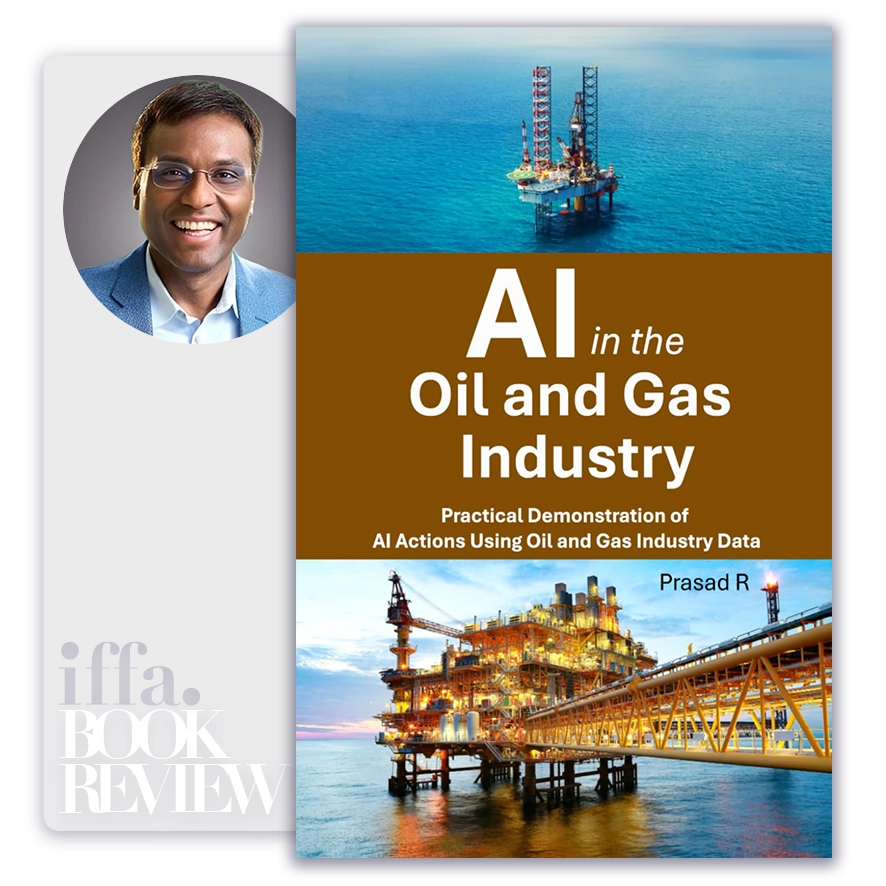
by Rohit Prasad
Summary Overview:
Artificial intelligence is frequently discussed in the oil and gas sector as a future promise or a technical upgrade. AI in the Oil and Gas Industry remains relevant because it cuts through abstraction and focuses on how AI actually behaves when applied to real industry data and operational constraints. For executives, board members, and policymakers navigating volatile markets, decarbonization pressure, and capital discipline, the book matters because it reframes AI not as experimentation, but as a decision-quality amplifier. Its value lies in showing how data-driven intelligence reshapes risk management, asset performance, forecasting reliability, and organizational learning—areas where small improvements compound into material strategic advantage.
About The Author
Rohit Prasad is a prolific researcher and author whose work has fundamentally shaped the landscape of speech technology and conversational intelligence. With an strong academic foundation, he has authored more than 100 scientific articles and holds numerous patents that bridge the gap between human language and machine understanding. His influence is recognized globally.
What distinguishes his viewpoint is an emphasis on demonstration over speculation. He focuses on how algorithms interact with real-world oil and gas data—noisy, incomplete, and constrained by operational realities—making his insights particularly relevant for leaders evaluating AI beyond pilot-stage enthusiasm.
Core Idea:
The core idea of AI in the Oil and Gas Industry is that AI creates value only when embedded into decision systems, not when treated as a standalone technology initiative. Models do not replace expertise; they augment judgment by revealing patterns, probabilities, and early signals that humans alone cannot reliably detect at scale.
Prasad frames AI as an operational intelligence layer that sits across exploration, drilling, production, refining, and logistics. Its power lies not in prediction accuracy alone, but in reducing uncertainty, standardizing decision quality, and accelerating learning cycles. Leaders who deploy AI without aligning governance, data integrity, and decision rights risk automating noise rather than insight.
AI delivers value when it improves decisions, not when it merely produces predictions.
Key Concepts:
- AI as Decision Infrastructure, Not IT Upgrade
AI should be treated as strategic infrastructure that influences how risks are assessed, capital is allocated, and performance is governed. Isolated analytics teams rarely create enterprise impact. - Data Reality in Oil and Gas Operations
Industry data is fragmented, inconsistent, and context-dependent. The book emphasizes data readiness and domain understanding as prerequisites to meaningful AI deployment. - Predictive Maintenance and Asset Reliability
AI models improve equipment uptime by detecting early failure signals. The strategic value lies in shifting from reactive repair to probabilistic risk control, protecting production continuity. - Exploration and Reservoir Intelligence
Machine learning enhances subsurface interpretation by integrating seismic, geological, and production data. This improves confidence intervals, not certainty—supporting better portfolio decisions. - Drilling Optimization Under Uncertainty
AI supports drilling performance through pattern recognition across parameters. Leaders should view this as variance reduction, not automation of judgment. - Production Forecasting and Decline Analysis
Forecasting accuracy improves when AI captures non-linear behavior. More importantly, scenario awareness increases, enabling proactive intervention rather than reactive response. - Refining and Process Optimization
AI identifies operational inefficiencies and energy losses. Strategic value emerges when insights are institutionalized into operating standards, not treated as one-off optimizations. - Risk Management and Anomaly Detection
AI excels at surfacing weak signals. When governance encourages early action, anomaly detection becomes a strategic early-warning system. - Human–AI Collaboration
The book reinforces that AI outputs require human interpretation and accountability. Organizations that clarify decision ownership outperform those that defer to models blindly. - Scaling AI Through Governance, Not Pilots
Many AI initiatives stall at pilot stage. Sustainable scale requires clear value hypotheses, data ownership, and leadership sponsorship, not more experimentation.
Data-driven insight compounds only when leadership embeds it into how choices are made.
Executive Insights:
AI in the Oil and Gas Industry reframes AI adoption as a leadership and governance challenge, not a technical one. Companies with similar data and tools diverge sharply based on whether leaders integrate AI into decision processes or isolate it within analytics teams.
For boards and senior executives, the message is clear: AI advantage is cumulative and path-dependent. Early integration shapes culture, learning speed, and competitive resilience.
- AI improves decision consistency, not just speed
- Data governance determines insight quality
- Human accountability remains non-negotiable
- Early adoption compounds organizational learning
- Pilots without governance create false progress
Actionable Takeaways:
Senior leaders should translate these insights into executive-level posture and systems:
- Reframe AI as decision infrastructure, not digital experimentation
- Stop measuring success by model accuracy alone; measure decision impact
- Invest in data governance and domain alignment before scaling AI
- Clarify human accountability for AI-assisted decisions
- Embed AI outputs into core workflows, not parallel dashboards
Final Thoughts:
AI in the Oil and Gas Industry is ultimately a book about discipline in innovation. It resists both hype and fear, presenting AI as a tool that rewards organizations willing to align technology with governance, culture, and judgment.
Its enduring value lies in reminding leaders that technology does not transform industries—decisions do. AI simply makes the consequences of those decisions arrive faster and more visibly.
The closing insight is calm and strategic: long-term advantage in the oil and gas industry will belong to organizations that use AI not to replace expertise, but to institutionalize better judgment at scale, consistently and responsibly.
The ideas in this book go beyond theory, offering practical insights that shape real careers, leadership paths, and professional decisions. At IFFA, these principles are translated into executive courses, professional certifications, and curated learning events aligned with today’s industries and tomorrow’s demands. Discover more in our Courses.
Applied Programs

- Course Code : SBM-409
- Delivery : In-class / Virtual / Workshop
- Duration : 2-4 Days
- Venue: DUBAI HUB
- Course Code : PMA-613
- Delivery : In-class / Virtual / Workshop
- Duration : 3-5 Days
- Venue: DUBAI HUB

- Course Code : CIF-505
- Delivery : In-class / Virtual / Workshop
- Duration : 3-5 Days
- Venue: DUBAI HUB

- Course Code : CIF-512
- Delivery : In-class / Virtual / Workshop
- Duration : 2-4 Days
- Venue: DUBAI HUB
Related Books