

The Executive Summary of
The Rare Metals War
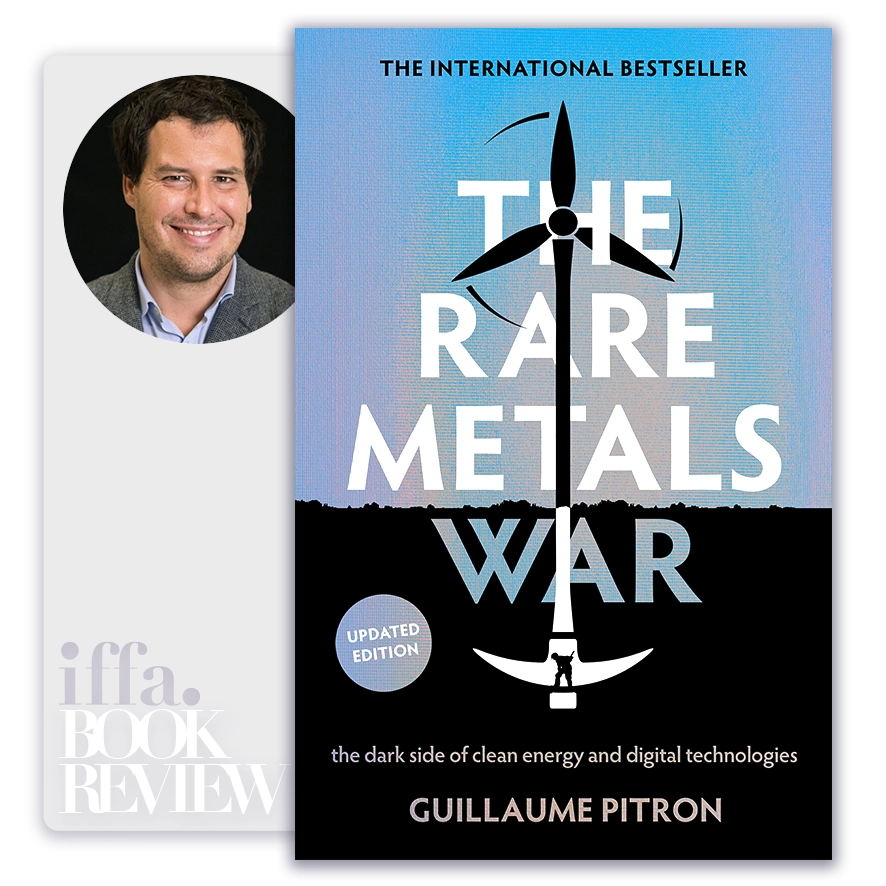
by Guillaume Pitron
Summary Overview:
The global transition to clean energy and digital infrastructure is widely framed as an environmental and technological triumph. The Rare Metals War remains essential because it reveals the hidden material reality beneath that narrative: the energy transition is not dematerialized, but re-materialized around rare and critical metals whose extraction, processing, and control carry profound geopolitical, environmental, and ethical consequences. For CEOs, policymakers, investors, and national security leaders, the book matters because it reframes decarbonization as a supply-chain and power question, not only a climate one. Its enduring relevance lies in exposing how strategic dependence quietly shifts from oil fields to mines, refineries, and processing hubs, reshaping global leverage in ways many leaders underestimate.
About The Author
Guillaume Pitron is an investigative journalist specializing in resource geopolitics, industrial policy, and environmental externalities. His work is grounded in field reporting across mining regions, manufacturing centers, and policy corridors, rather than armchair analysis.
What distinguishes Pitron’s perspective is his insistence on following the material trail. He examines energy and digital technologies from the ground up—literally—connecting consumer-facing innovation to extraction sites, labor conditions, and state strategy, offering a viewpoint that challenges clean-tech idealism with empirical scrutiny.
Core Idea:
The core idea of The Rare Metals War is that the clean energy and digital revolutions are built on a new extractive frontier that concentrates environmental damage, labor risk, and geopolitical power in a limited number of countries. While emissions may fall in consuming nations, the ecological and social burden is displaced, not eliminated.
Pitron frames rare metals—lithium, cobalt, rare earths, nickel, and others—as strategic chokepoints. Control over their extraction and processing determines industrial competitiveness, technological sovereignty, and political leverage. Leaders who treat the energy transition as a purely technological challenge risk creating new dependencies more fragile and opaque than those of the fossil-fuel era.
The energy transition does not eliminate resource dependence; it rearranges it.
Key Concepts:
- Material Intensity of Clean Technologies
Renewables, batteries, and digital systems require far more metals per unit of energy than fossil systems. This makes the transition materially heavier, not lighter. - Concentration of Supply and Processing Power
Mining may be geographically dispersed, but processing is highly concentrated. This creates industrial chokepoints where political leverage accumulates. - China’s Strategic Positioning
China’s dominance in refining and rare earths is the result of long-term industrial policy. The book shows how processing, not mining alone, defines power. - Environmental Displacement
Environmental harm is exported to regions with weaker regulation. Clean outcomes for consumers often rely on dirty upstream realities elsewhere. - Ethical and Labor Externalities
Critical mineral extraction frequently involves hazardous labor conditions. These costs are invisible in clean-tech narratives but material to ESG risk. - Recycling and Circularity Limits
Recycling is essential but insufficient at scale due to growing demand and technical constraints. Primary extraction remains unavoidable for decades. - Strategic Naivety of Importing Nations
Many advanced economies pursued decarbonization without securing supply chains, assuming markets would adjust. This creates strategic exposure masked by moral confidence. - Industrial Policy Returns
Countries that align energy transition with industrial policy retain value creation. Those that do not risk outsourcing both pollution and strategic control. - New Resource Nationalism
As demand rises, producing countries assert greater control. This mirrors past oil dynamics, signaling future volatility and bargaining power shifts. - Illusion of Technological Neutrality
Technology choices embed geopolitical consequences. Selecting one battery chemistry over another reallocates power and dependency, whether acknowledged or not.
Decarbonization without supply sovereignty creates new forms of vulnerability.
Executive Insights:
The Rare Metals War reframes the energy transition as a geostrategic transformation with winners and losers defined by resource access, processing capability, and policy coherence. Organizations and states pursuing climate goals without supply strategy trade one form of dependence for another.
For boards and senior leaders, the implication is stark: sustainability strategy without resource governance is incomplete. Reputational virtue does not substitute for material control.
- Clean tech intensifies material dependency
- Processing power outweighs extraction volume
- Environmental risk is displaced, not erased
- Industrial policy shapes transition winners
- Supply shocks will redefine energy security
Actionable Takeaways:
Senior leaders should translate these insights into strategic posture and governance:
- Reframe energy transition as supply-chain strategy, not technology adoption
- Map critical mineral dependencies across products and portfolios
- Invest in processing, recycling, and substitution, not extraction alone
- Align decarbonization goals with industrial policy to retain sovereignty
- Incorporate upstream environmental and labor risk into ESG governance
Final Thoughts:
The Rare Metals War is ultimately a book about consequences hidden by progress narratives. It does not argue against decarbonization or digitalization; it argues for honesty about their costs and constraints. The transition will happen—but not cleanly, evenly, or apolitically.
Its enduring value lies in reminding leaders that every technological choice is also a geopolitical choice. Ignoring material realities does not make them disappear; it simply delays reckoning and narrows options.
The closing insight is both sober and strategic: a sustainable future will not be secured by clean technologies alone, but by leaders willing to govern the resources, power structures, and trade-offs that those technologies inevitably create.
The ideas in this book go beyond theory, offering practical insights that shape real careers, leadership paths, and professional decisions. At IFFA, these principles are translated into executive courses, professional certifications, and curated learning events aligned with today’s industries and tomorrow’s demands. Discover more in our Courses.
Applied Programs

- Course Code : SBM-409
- Delivery : In-class / Virtual / Workshop
- Duration : 2-4 Days
- Venue: DUBAI HUB

- Course Code : PMA-613
- Delivery : In-class / Virtual / Workshop
- Duration : 3-5 Days
- Venue: DUBAI HUB

- Course Code : CIF-505
- Delivery : In-class / Virtual / Workshop
- Duration : 3-5 Days
- Venue: DUBAI HUB

- Course Code : CIF-512
- Delivery : In-class / Virtual / Workshop
- Duration : 2-4 Days
- Venue: DUBAI HUB
Related Books