The Executive Summary of
Green Building with Concrete
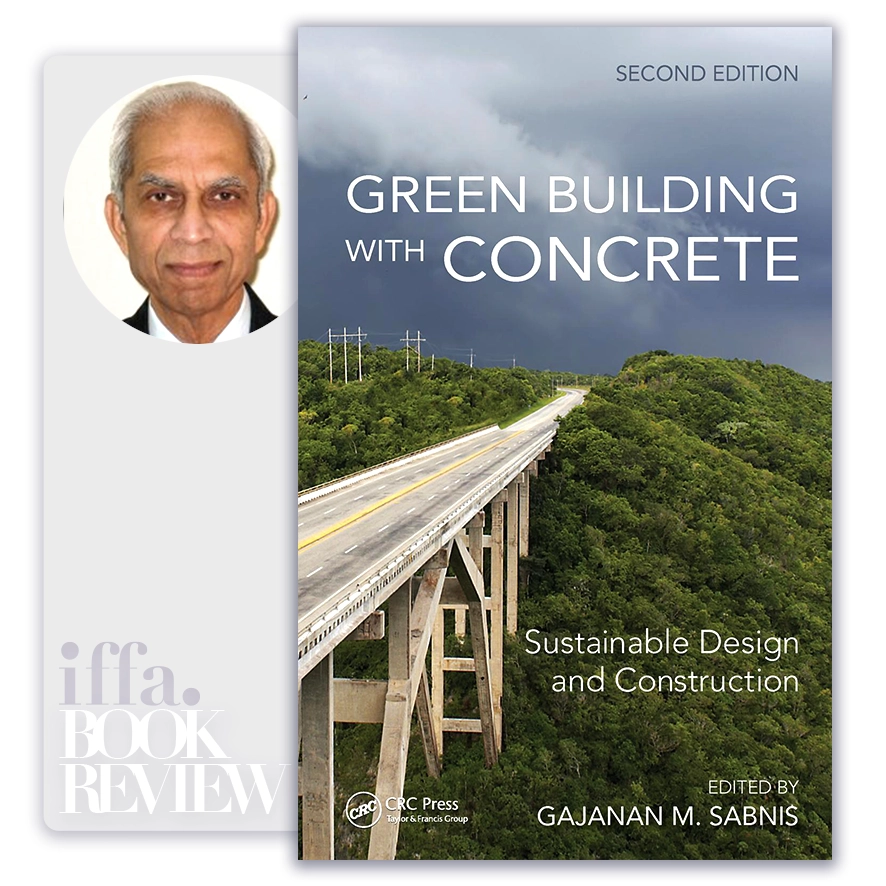
by Gajanan M. Sabnis
Summary Overview:
Green Building with Concrete challenges a common simplification in sustainability discourse: that concrete is inherently incompatible with green building. Gajanan M. Sabnis addresses the material where it is most consequential—at scale, in structural systems, and across long lifecycles—and demonstrates that environmental performance depends less on material labels and more on how materials are designed, specified, and used. The book matters because concrete remains foundational to global infrastructure, and its sustainability impact is determined by engineering judgment, not slogans.
For CEOs, boards, developers, engineers, and long-term investors, the relevance is strategic. Concrete choices influence embodied carbon, durability, maintenance cycles, thermal performance, and adaptability over decades. Sabnis reframes concrete from a carbon problem to be avoided into a performance platform to be optimized, showing how thoughtful design can reduce total lifecycle impact while preserving safety, resilience, and value. In capital-intensive construction, this is not a technical debate—it is a governance decision.
About The Author
Gajanan M. Sabnis is a structural engineer and author with deep expertise in concrete design, building systems, and performance-based construction.
His perspective is distinctive for its engineering rigor and lifecycle realism. Sabnis approaches sustainability through structural performance, durability, and system integration—connecting environmental outcomes directly to design and construction decisions.
Core Idea:
The central thesis of Green Building with Concrete is that concrete can support sustainable building outcomes when it is used intelligently, efficiently, and in alignment with lifecycle performance goals. Sabnis argues that dismissing concrete ignores its strengths—durability, thermal mass, fire resistance, and adaptability—which, when leveraged properly, can reduce total environmental impact over a building’s life.
At a deeper level, the book advances a worldview in which sustainability is a function of longevity and performance stability. Materials that last longer, require fewer replacements, and support flexible reuse often outperform lighter alternatives once full lifecycle impacts are considered. Concrete’s role in green building is therefore not about quantity, but quality of application.
Sustainability is achieved not by avoiding materials, but by using them wisely.
Key Concepts:
- Lifecycle Performance Determines Sustainability
First impressions mislead.
- Service life dominates environmental impact.
- Frequent replacement compounds carbon and cost.
- Durability Is an Environmental Asset
Long-lasting structures reduce resource demand.
- Concrete’s longevity offsets initial impacts.
- Maintenance cycles matter.
- Thermal Mass Reduces Operational Energy
Concrete stabilizes indoor conditions.
- Thermal inertia lowers heating and cooling loads.
- Passive performance complements active systems.
- Structural Efficiency Lowers Material Use
Design quality matters more than material choice.
- Optimized sections reduce volume.
- Overdesign inflates footprint.
- Adaptability Extends Building Life
Flexible structures prevent premature demolition.
- Concrete frames support reuse and reconfiguration.
- Adaptation outperforms replacement.
- Fire and Resilience Reduce Risk
Performance under stress matters.
- Fire resistance protects life and assets.
- Resilience avoids catastrophic loss.
- Integration with Other Systems Is Critical
Concrete works best within coordinated design.
- Envelope, structure, and MEP must align.
- Integration maximizes benefit.
- Material Innovation Improves Outcomes
Concrete is evolving.
- Supplementary cementitious materials reduce impact.
- Performance-based specifications enable progress.
- Construction Quality Shapes Results
Execution affects durability.
- Curing, detailing, and QA/QC matter.
- Poor practice undermines sustainability claims.
- Sustainability Requires Engineering Judgment
Checklists are insufficient.
- Context determines optimal solutions.
- Expertise replaces ideology.
Durability is one of the most undercounted drivers of environmental performance.
Executive Insights:
Sabnis reframes green building with concrete as a long-term value proposition grounded in engineering discipline. Organizations that evaluate materials only on upfront carbon metrics risk unintended consequences—shorter lifespans, higher maintenance, and earlier replacement. By contrast, performance-based use of concrete can stabilize lifecycle cost, reduce operational energy, and preserve asset value.
For boards and senior leadership, the implication is clear: material strategy must consider durability, adaptability, and risk, not just embodied metrics. Concrete, when used judiciously, supports resilient portfolios and long-horizon returns—especially in infrastructure and high-performance buildings.
- Lifecycle thinking improves sustainability outcomes.
- Durability reduces long-term carbon and cost.
- Thermal mass supports energy efficiency.
- Adaptability protects asset relevance.
- Engineering rigor outperforms material avoidance.
Actionable Takeaways:
Sustainable use of concrete requires disciplined choices.
- Evaluate materials using full lifecycle performance.
- Optimize structural design to reduce material intensity.
- Leverage thermal mass in energy strategies.
- Specify for durability, adaptability, and resilience.
- Govern material decisions with engineering evidence, not perception.
Final Thoughts:
Green Building with Concrete offers a measured, evidence-based perspective in a debate often dominated by absolutes. Gajanan M. Sabnis demonstrates that sustainability is not achieved by excluding materials, but by understanding them deeply. Concrete’s environmental impact is not fixed—it is shaped by design intelligence, construction quality, and long-term stewardship.
For leaders responsible for enduring assets, the book delivers a lasting insight: the greenest building is often the one that lasts the longest, adapts the best, and performs reliably over time. When concrete is used with precision and purpose, it becomes not a liability—but a foundation for sustainable value.
In the long run, sustainability belongs to materials chosen with judgment, not prejudice.
The ideas in this book go beyond theory, offering practical insights that shape real careers, leadership paths, and professional decisions. At IFFA, these principles are translated into executive courses, professional certifications, and curated learning events aligned with today’s industries and tomorrow’s demands. Discover more in our Courses.
Applied Programs

- Course Code : SBM-409
- Delivery : In-class / Virtual / Workshop
- Duration : 2-4 Days
- Venue: DUBAI HUB
- Course Code : PMA-613
- Delivery : In-class / Virtual / Workshop
- Duration : 3-5 Days
- Venue: DUBAI HUB
- Course Code : CIF-505
- Delivery : In-class / Virtual / Workshop
- Duration : 3-5 Days
- Venue: DUBAI HUB

- Course Code : CIF-512
- Delivery : In-class / Virtual / Workshop
- Duration : 2-4 Days
- Venue: DUBAI HUB
Related Books