The Executive Summary of
Stop Reading the News
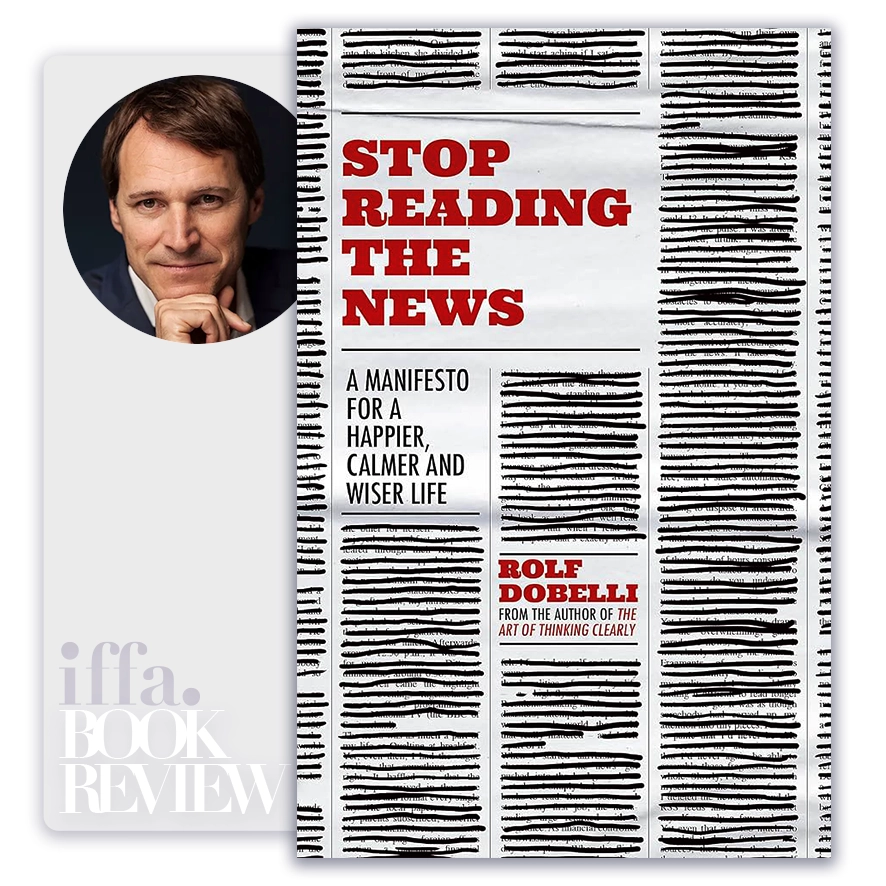
by Rolf Dobelli
Summary Overview:
Stop Reading the News confronts a deeply normalized habit that quietly degrades leadership judgment: the constant consumption of daily news. Rolf Dobelli argues that what presents itself as staying informed often functions as a system of distraction, emotional manipulation, and cognitive distortion. The book matters because it challenges a core assumption of modern professional life—that more information necessarily leads to better decisions.
For CEOs, board members, senior executives, and long-term investors, the relevance is strategic. In complex environments, decision quality depends not on the volume of information consumed, but on clarity, signal detection, and long-term perspective. Dobelli demonstrates that daily news is structurally optimized for novelty, fear, and immediacy, not for truth, relevance, or wisdom. The result is an illusion of knowledge that crowds out deep understanding and thoughtful judgment.
About The Author
Rolf Dobelli is a writer and former entrepreneur known for his work on cognitive errors, mental clarity, and practical wisdom in decision-making.
His perspective is distinctive for its skeptical, evidence-driven approach to modern information habits, focusing on how systems shape thinking—and how disciplined avoidance can restore clarity.
Core Idea:
The central thesis of Stop Reading the News is that daily news consumption harms thinking more than it helps it. Dobelli argues that news is designed to trigger emotional reactions, exploit cognitive biases, and keep attention locked on short-term fluctuations that have little bearing on long-term outcomes.
At a deeper level, the book advances a worldview in which attention is a finite and valuable resource that must be defended deliberately. When leaders surrender attention to the news cycle, they outsource priorities to editors and algorithms whose incentives are misaligned with wisdom. True understanding comes not from constant updates, but from slow information, deep reading, and reflection.
News gives the feeling of being informed without the benefit of understanding.
Key Concepts:
- News Is Noise, Not Knowledge
Most news lacks lasting relevance.
- Short-lived events crowd out enduring insight.
- Signal is buried under novelty.
- News Exploits Cognitive Biases
Fear and outrage capture attention.
- Availability bias distorts perception of risk.
- Rare events feel common.
- Constant Updates Fragment Thinking
Interruptions erode depth.
- Attention switching degrades judgment.
- Reflection becomes impossible.
- News Encourages Short-Termism
The present overwhelms the future.
- Daily fluctuations obscure long-term trends.
- Strategic thinking weakens.
- Being Informed Is Not the Same as Being Wise
Information does not equal understanding.
- Context matters more than headlines.
- Knowledge requires synthesis.
- News Consumption Is Addictive by Design
Dopamine drives habit.
- Uncertainty and novelty reinforce checking behavior.
- Addiction masquerades as responsibility.
- Opinions Form Without Accountability
Commentary replaces analysis.
- Predictions are rarely tracked.
- Confidence is cheap.
- News Rarely Improves Decisions
Actionable value is minimal.
- Most news cannot be acted upon.
- Energy is wasted.
- Long-Form Sources Offer Better Insight
Depth beats immediacy.
- Books, research, and primary sources endure.
- Slow thinking improves accuracy.
- Selective Ignorance Is Rational
Omission improves clarity.
- Not knowing trivia protects judgment.
- Focus enables insight.
What is urgent is rarely important; what is important is rarely urgent.
Executive Insights:
Dobelli reframes news avoidance as a strategic discipline, not an act of disengagement. Leaders who consume less news think more clearly, react less emotionally, and allocate attention toward issues they can actually influence. Organizations saturated with news-driven urgency tend to overreact, misprice risk, and confuse motion with progress.
For boards and senior leadership, the implication is clear: information diets shape organizational behavior. Protecting attention from low-value noise improves strategic patience, risk assessment, and long-term decision quality.
- Reduced noise improves clarity.
- Less emotional reactivity strengthens judgment.
- Long-term focus improves strategy.
- Attention discipline reduces cognitive fatigue.
- Selective ignorance enhances leadership effectiveness.
Actionable Takeaways:
Strategic clarity requires information restraint.
- Eliminate routine consumption of daily news.
- Replace headlines with long-form, timeless sources.
- Focus on information that informs decisions, not emotions.
- Protect uninterrupted time for thinking and synthesis.
- Treat attention as a leadership asset to be governed.
Final Thoughts:
Stop Reading the News delivers a provocative but disciplined message: ignorance of trivia is often the price of wisdom. Rolf Dobelli shows that stepping away from the news does not diminish understanding—it restores it by removing distortion, noise, and false urgency.
For leaders navigating uncertainty and complexity, the enduring insight is decisive: clear thinking requires fewer inputs, not more. Those who escape the news cycle regain control over attention, perspective, and judgment.
In the long run, the best-informed leaders are not those who know the latest headline—but those who understand what actually matters.
The ideas in this book go beyond theory, offering practical insights that shape real careers, leadership paths, and professional decisions. At IFFA, these principles are translated into executive courses, professional certifications, and curated learning events aligned with today’s industries and tomorrow’s demands. Discover more in our Courses.
Applied Programs
- Course Code : SBM-409
- Delivery : In-class / Virtual / Workshop
- Duration : 2-4 Days
- Venue: DUBAI HUB

- Course Code : PMA-613
- Delivery : In-class / Virtual / Workshop
- Duration : 3-5 Days
- Venue: DUBAI HUB
- Course Code : CIF-505
- Delivery : In-class / Virtual / Workshop
- Duration : 3-5 Days
- Venue: DUBAI HUB

- Course Code : CIF-512
- Delivery : In-class / Virtual / Workshop
- Duration : 2-4 Days
- Venue: DUBAI HUB
Related Books