
The Executive Summary of
Deep Work
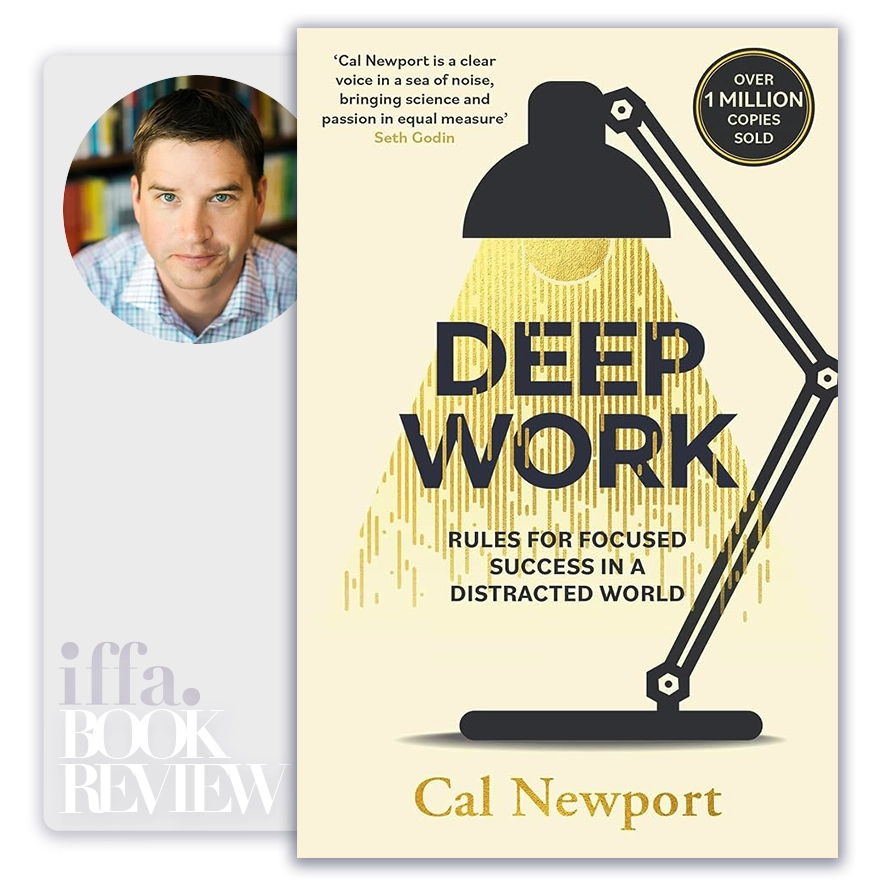
by Cal Newport
Summary Overview:
The modern workplace celebrates busyness, responsiveness, and constant connectivity, yet paradoxically produces shallow output, fragmented thinking, and declining creative value. Notifications, meetings, emails, and multitasking have become proxies for productivity—while meaningful progress quietly erodes. Deep Work confronts this contradiction directly. Cal Newport argues that the ability to focus deeply, without distraction, on cognitively demanding tasks has become the most valuable—and rare—skill in the modern economy.
Deep Work matters because it reframes success not as working more, but as working with intensity, clarity, and depth. In a knowledge economy driven by complex problem-solving, creativity, and learning speed, shallow work scales poorly. For executives, founders, researchers, strategists, and high performers, Deep Work offers a competitive framework: those who cultivate sustained focus will outperform those trapped in distraction—regardless of talent.
About The Author
Cal Newport is a computer scientist, professor, and author whose work focuses on technology, productivity, and meaningful work. Unlike productivity gurus who rely on anecdote or motivational rhetoric, Newport grounds his ideas in cognitive science, economics, and real-world case studies.
His credibility comes from practicing what he preaches: producing influential academic work and bestselling books while maintaining strict boundaries around attention and time. Newport’s perspective is unique because it challenges accepted workplace norms, not individual willpower, arguing that many modern practices are structurally hostile to real productivity.
Core Idea:
At the heart of Deep Work lies a simple but disruptive thesis:
Deep work is the ability to focus without distraction on tasks that create new value—and it is the key to thriving in the knowledge economy.
Newport contrasts deep work with shallow work:
- Deep Work: cognitively demanding, creates value, improves skill, hard to replicate
- Shallow Work: logistical, low-value, easily replicated, often performed while distracted
The problem is not that shallow work exists—but that it has crowded out depth, while organizations reward visibility over value. Newport argues that individuals who intentionally cultivate deep work gain outsized returns in productivity, creativity, and professional relevance.
If you cannot focus deeply, you cannot compete effectively.
Key Concepts:
- Deep Work Is Becoming Increasingly Valuable
Modern economies reward two types of people:
- Those who can learn complex things quickly
- Those who can produce at an elite level of quality and speed
Both capabilities require sustained concentration.
If you cannot focus deeply, you cannot compete effectively. As automation, AI, and outsourcing eliminate routine tasks, deep work becomes the last defensible human advantage.
- Deep Work Is Becoming Increasingly Rare
Despite its value, deep work is disappearing. Why?
- Open offices
- Always-on communication
- Instant messaging culture
- Social media normalization
- Productivity measured by responsiveness
Clarity and depth are sacrificed at the altar of connectivity. Organizations unintentionally train employees to avoid focus, while praising “availability” as engagement.
- Shallow Work Creates the Illusion of Productivity
Email replies, meetings, updates, and Slack messages provide:
- Immediate feedback
- Social validation
- A sense of motion
But they rarely produce lasting value.
Newport warns that shallow work is addictive precisely because it feels productive—while masking the absence of real progress.
- Attention Is a Finite Cognitive Resource
Deep work is not a mindset—it is a neurological condition. The brain requires:
- Long stretches of uninterrupted focus
- Low context switching
- Recovery time
Frequent distraction damages the brain’s ability to concentrate, reducing focus stamina over time.
What you practice is what your brain becomes good at. Constant distraction trains shallow thinking.
- The Craftsman Mindset
Newport introduces the craftsman mindset, which emphasizes:
- Skill development
- Quality output
- Mastery over passion
Rather than asking “What do I want?”, deep workers ask:
“How good can I become at something rare and valuable?”
This mindset shifts focus from self-expression to excellence, which leads to autonomy, recognition, and impact.
- Four Philosophies of Deep Work Scheduling
Newport outlines four practical approaches to integrating deep work:
- Monastic – eliminating most shallow obligations entirely
- Bimodal – dividing time between deep and shallow periods
- Rhythmic – building a daily habit of deep work
- Journalistic – switching into deep work whenever time appears
Each approach emphasizes intentionality, not flexibility.
- Rituals Reduce Cognitive Resistance
Deep work requires rituals to minimize friction:
- Defined time blocks
- Dedicated locations
- Clear rules (no internet, no messaging)
- Specific goals
Willpower is unreliable—systems are not. Rituals protect focus when motivation fades.
- Embrace Boredom to Train Focus
Newport argues that boredom is a training ground for focus. Constant stimulation conditions the brain to seek novelty.
By resisting the urge to fill every idle moment with input, individuals rebuild attention control.
This principle directly contradicts modern digital habits—but is essential for deep concentration.
- Quit Social Media Strategically
Rather than moralizing technology, Newport advocates selective adoption. Tools should be evaluated based on:
- Concrete benefit
- Opportunity cost
- Alignment with professional goals
Not all tools deserve your attention—no matter how popular they are.
- Drain the Shallows
Deep work thrives only when shallow work is constrained.
Newport recommends:
- Scheduling shallow work explicitly
- Limiting meeting frequency
- Reducing email usage
- Setting clear availability boundaries
This forces organizations and individuals to prioritize output over presence.
Clarity and depth are sacrificed at the altar of connectivity.
Executive Insights:
Deep Work reframes leadership and productivity as attention management problems, not time management problems.
Strategic Implications for Leaders:
- Focus is a competitive advantage
- Busyness is not a proxy for value
- Knowledge work requires protected cognitive space
- Distraction scales inefficiency
- Deep work cultures outperform shallow ones
Organizations that fail to protect focus leak talent and creativity—even when compensation is high.
Actionable Takeaways:
Newport translates philosophy into operational discipline.
For Individuals
- Schedule deep work blocks weekly
- Eliminate or batch shallow tasks
- Create focus rituals
- Reduce digital distractions deliberately
- Measure output, not activity
- Train focus by resisting constant stimulation
For Leaders and Organizations
- Reward results, not responsiveness
- Redesign meetings and communication norms
- Allow uninterrupted work periods
- Model deep work behavior at the top
- Treat focus as organizational infrastructure
Final Thoughts:
Deep Work is a manifesto against distraction disguised as productivity. Cal Newport delivers a clear and uncomfortable truth: the ability to concentrate deeply is no longer optional—it is foundational to meaningful success.
In a world optimized for interruption, those who cultivate depth will produce work that matters, learn faster, and build careers—and organizations—that endure.
The ideas in this book go beyond theory, offering practical insights that shape real careers, leadership paths, and professional decisions. At IFFA, these principles are translated into executive courses, professional certifications, and curated learning events aligned with today’s industries and tomorrow’s demands. Discover more in our Courses.
Applied Programs

- Course Code : SBM-409
- Delivery : In-class / Virtual / Workshop
- Duration : 2-4 Days
- Venue: DUBAI HUB

- Course Code : PMA-613
- Delivery : In-class / Virtual / Workshop
- Duration : 3-5 Days
- Venue: DUBAI HUB
- Course Code : CIF-505
- Delivery : In-class / Virtual / Workshop
- Duration : 3-5 Days
- Venue: DUBAI HUB

- Course Code : CIF-512
- Delivery : In-class / Virtual / Workshop
- Duration : 2-4 Days
- Venue: DUBAI HUB
Related Books