The Executive Summary of
Prompt Engineering for Generative AI
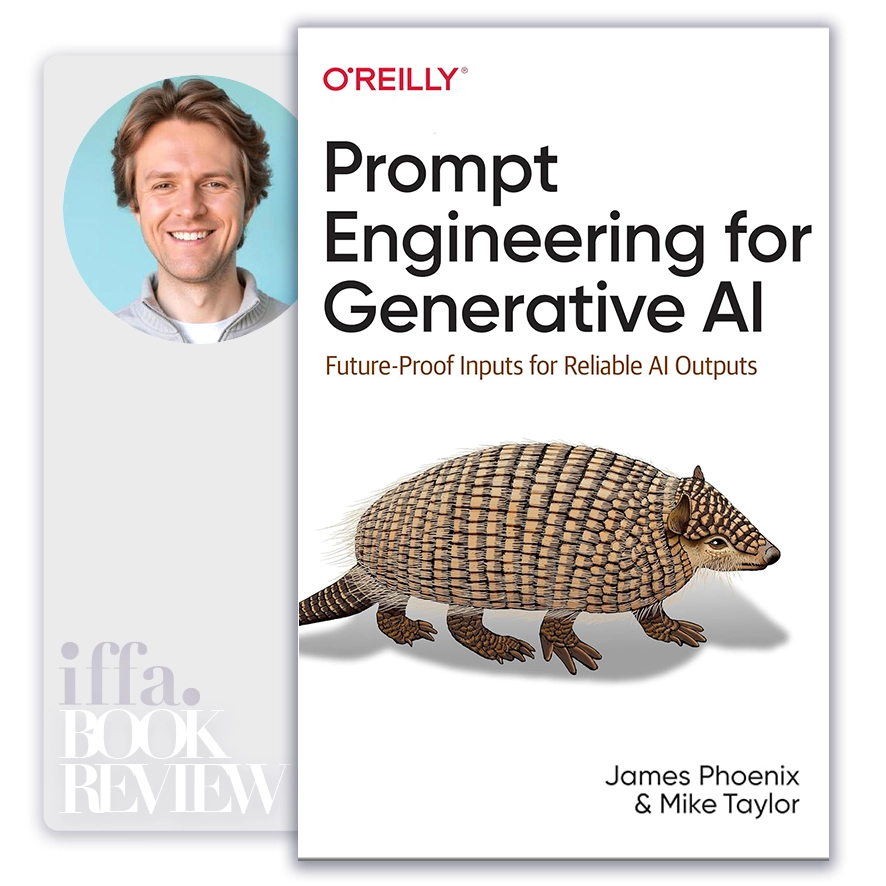
by James Phoenix
Summary Overview:
Generative AI has moved from experimentation to enterprise dependency, yet most organizations still experience volatile outputs, inconsistent quality, and hidden risk. Prompt Engineering for Generative AI matters because it addresses the overlooked control layer between human intent and machine behavior: the prompt as an operational instrument. For CEOs, board members, and senior executives, the book reframes prompting not as a clever trick, but as a design discipline that governs reliability, safety, and decision integrity. In a world where models evolve rapidly and capabilities diffuse quickly, the enduring advantage is not the model itself but the quality of instructions that shape its behavior—a strategic lever many leaders underestimate.
About The Author
James Phoenix is a practitioner focused on applied generative AI, human–AI interaction, and system reliability. His work centers on translating rapidly evolving model capabilities into repeatable, dependable outcomes within real organizational constraints.
What distinguishes Phoenix’s perspective is his emphasis on durability over novelty. Rather than chasing model-specific hacks, he concentrates on prompt structures and interaction patterns that remain effective across versions, vendors, and use cases—making his approach particularly relevant for leaders seeking stability amid rapid change.
Core Idea:
The core idea of Prompt Engineering for Generative AI is that prompts are the primary governance mechanism for generative systems. They encode intent, constraints, context, and evaluation criteria—effectively acting as the operating instructions for probabilistic intelligence. As models become more powerful and general, the prompt becomes the decisive factor separating useful automation from unreliable improvisation.
Phoenix frames prompt engineering as a systems design problem, not a linguistic one. Reliable outputs emerge when prompts specify role, scope, format, standards, and failure modes explicitly. Leaders who rely on intuition or ad hoc phrasing invite inconsistency and risk. Those who design prompts deliberately create repeatability, auditability, and trust, even as underlying models change.
Generative AI reliability is determined less by the model than by the clarity of the instruction.
Key Concepts:
- Prompts as Decision Architecture
Prompts structure how AI reasons, prioritizes, and responds. They are not queries; they are decision frameworks that determine outcome quality. - Reliability Over Creativity
While generative models excel at creativity, enterprise value depends on consistency and constraint. Prompt design channels creativity toward acceptable variance. - Role, Context, and Objective Definition
Explicitly defining the AI’s role, audience, and objective reduces ambiguity. Clarity at input prevents volatility at output. - Constraint Design as Risk Control
Constraints on tone, sources, format, and assumptions act as guardrails. Absence of constraints increases hallucination and drift. - Decomposition and Stepwise Reasoning
Breaking complex tasks into structured steps improves reasoning reliability. This transforms AI from a single-response generator into a guided problem solver. - Evaluation Criteria Embedded Up Front
Prompts that include success criteria and checks enable self-correction. This shifts quality control from post hoc review to built-in discipline. - Model-Agnostic Prompting
Vendor- or version-specific tricks decay quickly. Phoenix emphasizes principled prompting that survives model upgrades and platform changes. - Human-in-the-Loop by Design
Prompts can define escalation points, uncertainty thresholds, and review triggers. This preserves human accountability while scaling automation. - Prompt Libraries as Organizational Assets
Reusable, tested prompts become intellectual capital. Treating prompts as assets enables standardization and governance across teams. - Prompting as a Leadership Skill
As AI mediates more decisions, leaders must articulate intent precisely. Prompting becomes a proxy for strategic clarity—vagueness scales failure.
The prompt is the control surface of intelligent systems.
Executive Insights:
Prompt Engineering for Generative AI reframes AI adoption as an input-quality problem before it is a model-quality problem. Organizations with access to the same frontier models diverge sharply based on whether they invest in prompt design, testing, and governance—or leave outcomes to improvisation.
For boards and senior executives, the implication is clear: prompt discipline is a control mechanism. It determines compliance risk, reputational exposure, and decision consistency in AI-mediated workflows.
- Input clarity determines output reliability
- Constraints reduce hallucination and variance
- Prompt design encodes governance choices
- Standardization scales trust and efficiency
- Leadership clarity compounds through AI systems
Actionable Takeaways:
Senior leaders should translate Phoenix’s insights into enterprise-level practices:
- Reframe prompting as system design, not user behavior
- Standardize critical prompts for high-impact workflows
- Embed constraints and evaluation criteria at input stage
- Treat prompt libraries as governed assets, not ad hoc text
- Build executive literacy in prompt design to govern intent at scale
Final Thoughts:
Prompt Engineering for Generative AI is ultimately a book about control in an age of probabilistic intelligence. It dispels the notion that reliability will emerge automatically as models improve and instead shows that clarity, structure, and intent must be designed deliberately.
Its enduring value lies in shifting attention upstream—from output management to input mastery. As models grow more capable and less predictable, the organizations that win will be those that engineer their questions as carefully as their answers.
The closing insight is both practical and strategic: in a world where AI can say almost anything, the decisive advantage belongs to leaders who know exactly what to ask, how to constrain it, and how to turn intent into repeatable intelligence.
The ideas in this book go beyond theory, offering practical insights that shape real careers, leadership paths, and professional decisions. At IFFA, these principles are translated into executive courses, professional certifications, and curated learning events aligned with today’s industries and tomorrow’s demands. Discover more in our Courses.
Applied Programs

- Course Code : SBM-409
- Delivery : In-class / Virtual / Workshop
- Duration : 2-4 Days
- Venue: DUBAI HUB

- Course Code : PMA-613
- Delivery : In-class / Virtual / Workshop
- Duration : 3-5 Days
- Venue: DUBAI HUB
- Course Code : CIF-505
- Delivery : In-class / Virtual / Workshop
- Duration : 3-5 Days
- Venue: DUBAI HUB

- Course Code : CIF-512
- Delivery : In-class / Virtual / Workshop
- Duration : 2-4 Days
- Venue: DUBAI HUB
Related Books