
The Executive Summary of
The Five Dysfunctions of a Team
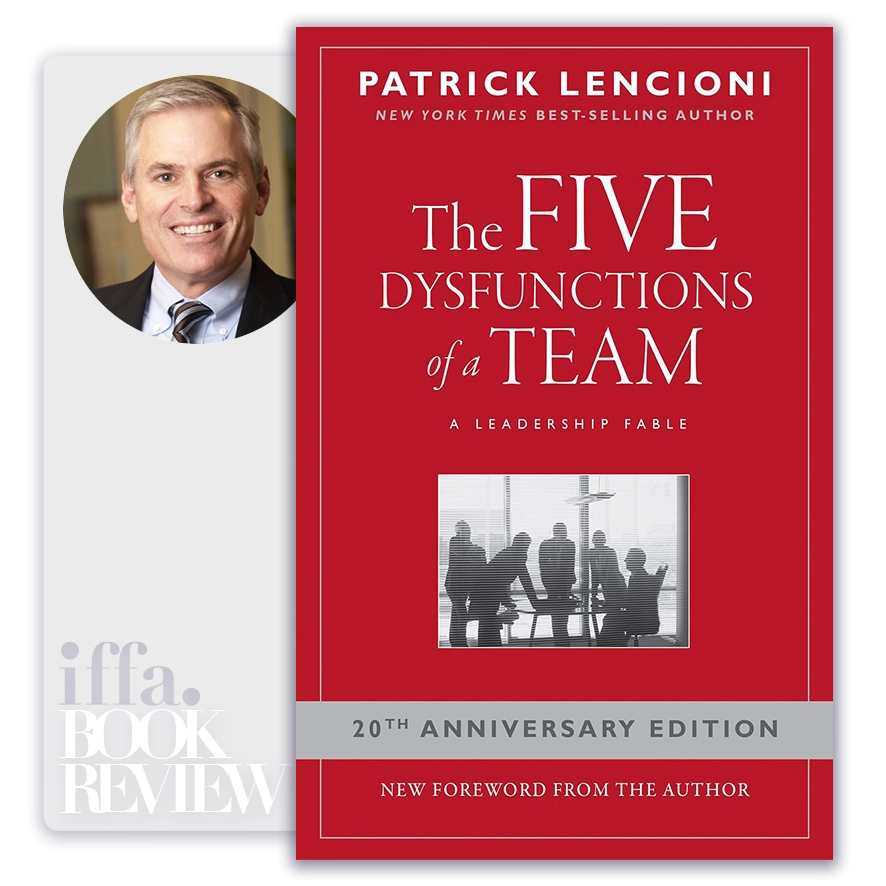
by Patrick M. Lencioni
Summary Overview:
Team failure at the senior level is rarely visible in strategy documents or financial reports; it manifests quietly through slow decisions, artificial harmony, diluted accountability, and missed execution. The Five Dysfunctions of a Team remains relevant because it exposes the human and behavioral mechanics behind these failures with unusual clarity. While presented as a fable, the book endures as a serious leadership diagnosis of why capable individuals routinely underperform when operating together. For CEOs, board members, and senior executives, its value lies in revealing how trust, conflict, commitment, accountability, and results function as a single system—and how weakness at the top cascades through the entire organization.
About The Author
Patrick M. Lencioni is a leadership consultant and organizational advisor whose work focuses on team effectiveness, executive alignment, and cultural health. His credibility is rooted in sustained advisory work with senior leadership teams across industries, rather than academic abstraction.
What distinguishes Lencioni’s perspective is his insistence on behavioral realism. He addresses leadership dysfunctions as lived patterns—how people avoid discomfort, protect status, and misinterpret harmony—rather than as abstract management failures. His work consistently centers on what leaders actually do under pressure, not what they intend.
Core Idea:
The core idea of The Five Dysfunctions of a Team is that team failure is predictable and systemic, not mysterious or personality-driven. Dysfunction arises when leadership teams fail to establish vulnerability-based trust, leading to artificial harmony, weak commitment, avoidance of accountability, and misaligned focus on results.
Lencioni frames team effectiveness as a behavioral hierarchy. Each layer depends on the one beneath it. When trust is absent, conflict becomes political or suppressed. When conflict is avoided, commitment becomes ambiguous. When commitment is weak, accountability erodes. When accountability fades, results give way to ego and departmental interest. Executives who address symptoms without repairing foundations institutionalize mediocrity despite talent and effort.
Team dysfunction is rarely about skill; it is about unaddressed behavior at the top.
Key Concepts:
- Absence of Trust as the Foundational Failure
Trust, in Lencioni’s framework, is not about reliability but vulnerability. Teams fail when leaders cannot admit mistakes, ask for help, or acknowledge limitations. Without this trust, collaboration becomes defensive and political. - Fear of Conflict Creates Artificial Harmony
Healthy teams engage in productive, unfiltered debate. When conflict is avoided to preserve comfort, decisions suffer. Executives mistake politeness for alignment and silence for agreement. - Lack of Commitment Through Ambiguity
Commitment does not require consensus; it requires clarity. Teams that avoid conflict produce vague decisions, leading to hesitation, second-guessing, and fragmented execution. - Avoidance of Accountability at Peer Level
High-performing teams hold one another accountable. When leaders rely solely on hierarchy for accountability, peers hesitate to challenge underperformance, allowing standards to erode quietly. - Inattention to Collective Results
When trust, conflict, commitment, and accountability weaken, leaders prioritize personal success, departmental goals, or reputation over collective outcomes. Results become secondary to status. - Leadership Teams as Cultural Architects
Senior teams model behavior that cascades throughout the organization. Their dysfunction becomes organizational culture, replicated at every level. - The Cost of Comfort in Leadership
Many dysfunctions persist because leaders prioritize personal comfort over collective performance. Avoidance of difficult conversations is one of the highest hidden costs in organizations. - Simplicity as Strategic Advantage
The model’s strength lies in its simplicity. Complex organizations often fail due to simple behavioral gaps left unaddressed, not strategic ignorance. - Alignment Over Consensus
Effective teams value alignment and clarity over unanimous agreement. Once a decision is made, leaders commit fully, even if they initially disagreed. - Discipline Over Personality
Team health is not about hiring better personalities. It requires disciplined behavior, consistent reinforcement, and leadership courage.
Results suffer when leaders protect comfort over clarity.
Executive Insights:
The Five Dysfunctions of a Team reframes team performance as a governance issue, not a soft-skills concern. Leadership teams with similar intelligence and experience diverge sharply based on whether they address behavioral foundations or tolerate dysfunction in the name of professionalism.
For boards and CEOs, the book highlights a critical truth: strategic failure often originates in unresolved team dynamics, not flawed analysis.
- Trust deficits slow decision-making
- Avoided conflict reduces decision quality
- Ambiguity undermines execution
- Weak accountability erodes standards
- Results suffer when ego overrides enterprise
Actionable Takeaways:
Senior leaders should translate the book’s insights into executive-level behaviors and systems:
- Reframe trust as vulnerability, not politeness
- Normalize constructive conflict at the leadership table
- Demand clarity in decisions, even without consensus
- Encourage peer accountability, not only hierarchical control
- Measure leadership success by collective results, not individual visibility
Final Thoughts:
The Five Dysfunctions of a Team is ultimately a book about leadership courage. It demonstrates that high performance requires emotional maturity, restraint, and willingness to endure discomfort in service of clarity and results. The model’s durability lies in its realism: these dysfunctions recur precisely because they reflect human instinct under pressure.
Its enduring value is in reminding leaders that team health is not self-correcting. It must be governed deliberately, reinforced consistently, and protected against drift. When leadership teams function well, strategy accelerates, execution sharpens, and organizations regain coherence.
The final insight is simple and demanding: organizational success is constrained less by the quality of ideas than by the quality of interaction among the people responsible for acting on them.
The ideas in this book go beyond theory, offering practical insights that shape real careers, leadership paths, and professional decisions. At IFFA, these principles are translated into executive courses, professional certifications, and curated learning events aligned with today’s industries and tomorrow’s demands. Discover more in our Courses.
Applied Programs

- Course Code : SBM-409
- Delivery : In-class / Virtual / Workshop
- Duration : 2-4 Days
- Venue: DUBAI HUB

- Course Code : PMA-613
- Delivery : In-class / Virtual / Workshop
- Duration : 3-5 Days
- Venue: DUBAI HUB
- Course Code : CIF-505
- Delivery : In-class / Virtual / Workshop
- Duration : 3-5 Days
- Venue: DUBAI HUB

- Course Code : CIF-512
- Delivery : In-class / Virtual / Workshop
- Duration : 2-4 Days
- Venue: DUBAI HUB
Related Books