The Executive Summary of
Begin With WE
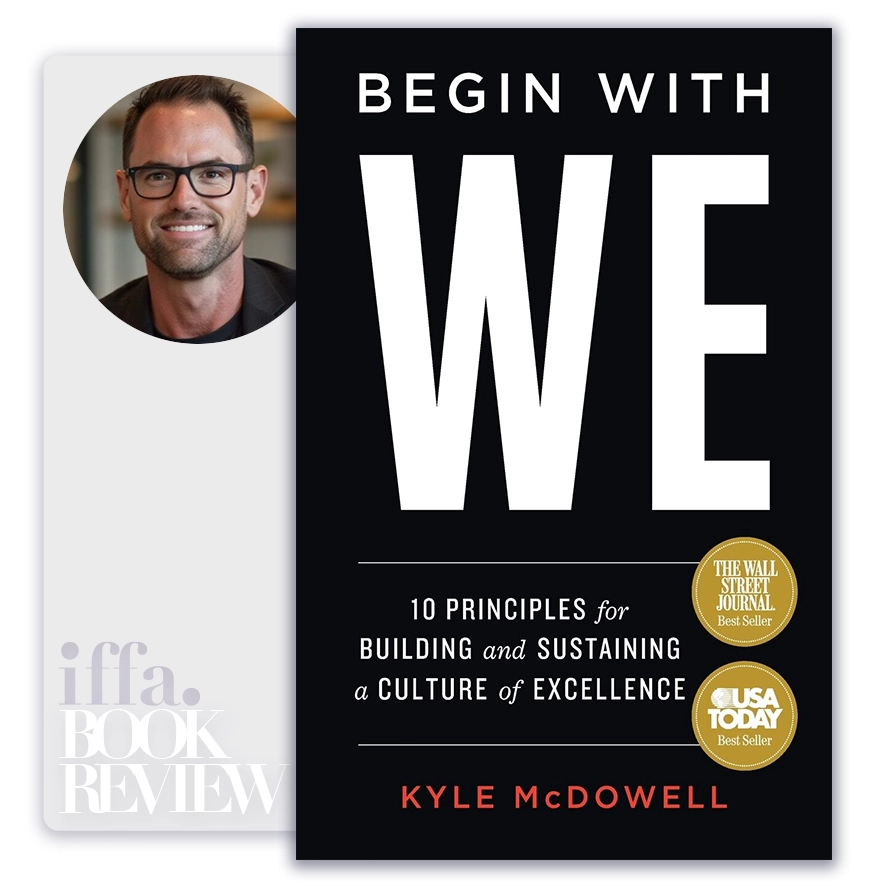
by Kyle McDowell
Summary Overview:
Organizations rarely fail for lack of strategy; they fail because behavior, incentives, and accountability drift apart. Begin With WE remains relevant because it confronts that gap directly, offering a disciplined way to align how people behave with what leaders say they value. In an environment defined by distributed work, relentless change, and fragile trust, the book reframes culture not as sentiment or perks, but as a system of shared commitments that governs decisions under pressure. For CEOs, boards, and senior leaders, its value lies in clarifying how excellence is sustained when results, ethics, and execution must advance together—without relying on charisma, slogans, or episodic interventions.
About The Author
Kyle McDowell is a leadership advisor and practitioner whose work centers on organizational culture, accountability, and performance under stress. His perspective is shaped by years of working with leaders responsible for large, complex teams where results depend on consistent behavior at scale, not isolated heroics.
What distinguishes McDowell’s viewpoint is its operational focus. He treats culture as a set of observable actions reinforced by leadership choices, governance mechanisms, and consequence management—placing responsibility squarely on leaders to design and protect the conditions for excellence.
Core Idea:
The core idea of Begin With WE is that excellence emerges when organizations replace individual-centric norms with a shared “WE” commitment to standards, accountability, and mutual responsibility. Culture is not what leaders intend; it is what teams do when trade-offs arise. McDowell argues that sustainable performance requires explicit principles that guide behavior consistently, even when outcomes are uncertain or inconvenient.
The book positions culture as a governance system for behavior. By defining clear commitments—and enforcing them uniformly—leaders reduce ambiguity, align incentives, and create trust. Organizations that neglect this clarity drift into inconsistency, where results may be achieved temporarily but credibility erodes and performance decays.
Culture becomes real only when standards apply equally to everyone.
Key Concepts:
- “WE” as a Behavioral Contract
“WE” is not collectivism; it is a shared contract that defines how people treat one another, how decisions are made, and how standards are upheld—especially under pressure. - Principles Over Personalities
Strong cultures rely on clear principles, not strong personalities. When principles govern behavior, organizations outperform even when leadership changes. - Standards Create Trust
Trust is built when standards are explicit and consistently enforced. Selective enforcement destroys credibility faster than poor performance. - Accountability Without Drama
McDowell reframes accountability as calm, consistent consequence management, not confrontation. Predictable accountability stabilizes performance. - Alignment Beats Motivation
Motivation fluctuates; alignment endures. Excellence depends on clear expectations, decision rights, and consequences, not inspiration. - The Cost of Exceptions
High performers granted exceptions quietly corrode culture. The book underscores that no individual result justifies cultural erosion. - Leadership as Stewardship
Leaders are stewards of standards. Their primary role is to model, reinforce, and protect the principles that define “how we work.” - Clarity Reduces Friction
Ambiguity forces people to guess. Clear principles reduce conflict, speed decisions, and lower coordination costs across the organization. - Feedback as a Cultural Mechanism
Feedback sustains standards when it is timely, specific, and expected. Avoided feedback signals tolerance for drift. - Culture as a Strategic Asset
A disciplined culture compounds advantage by enabling faster execution, higher trust, and resilience during disruption.
Excellence is sustained by shared commitments, not individual exceptions.
Executive Insights:
Begin With WE reframes culture as infrastructure, not atmosphere. Organizations with similar strategies diverge sharply based on whether leaders govern behavior deliberately or allow informal norms to prevail. The book makes clear that culture failures are leadership failures—often born from inconsistency rather than malice.
For boards and senior executives, the implication is direct: standards must be explicit, owned, and enforced at the top to protect long-term value and reputation.
- Consistency builds credibility faster than charisma
- Exceptions erode culture disproportionately
- Clear principles reduce execution friction
- Accountability stabilizes performance under stress
- Culture determines speed, trust, and resilience
Actionable Takeaways:
Senior leaders should translate these ideas into executive-level behaviors and systems:
- Define non-negotiable principles that govern decisions and conduct
- Enforce standards uniformly, regardless of role or performance
- Stop rewarding results achieved at cultural cost
- Embed feedback and accountability into normal operations
- Treat culture as governance, not communication
Final Thoughts:
Begin With WE is ultimately a book about organizational adulthood. It replaces vague aspirations with disciplined commitments and replaces personality-driven leadership with principle-driven governance. Its message is demanding but stabilizing: excellence is not accidental, and culture does not self-correct.
The enduring contribution of the book is its insistence that leaders must choose clarity over comfort. When standards are explicit and consequences predictable, people perform with confidence, trust deepens, and results compound.
The closing insight is both simple and enduring: organizations sustain excellence not by asking people to do their best, but by agreeing—clearly and collectively—on what “our best” requires, every day, without exception.
The ideas in this book go beyond theory, offering practical insights that shape real careers, leadership paths, and professional decisions. At IFFA, these principles are translated into executive courses, professional certifications, and curated learning events aligned with today’s industries and tomorrow’s demands. Discover more in our Courses.
Applied Programs

- Course Code : SBM-409
- Delivery : In-class / Virtual / Workshop
- Duration : 2-4 Days
- Venue: DUBAI HUB

- Course Code : PMA-613
- Delivery : In-class / Virtual / Workshop
- Duration : 3-5 Days
- Venue: DUBAI HUB
- Course Code : CIF-505
- Delivery : In-class / Virtual / Workshop
- Duration : 3-5 Days
- Venue: DUBAI HUB

- Course Code : CIF-512
- Delivery : In-class / Virtual / Workshop
- Duration : 2-4 Days
- Venue: DUBAI HUB
Related Books