
The Executive Summary of
The 80/20 Principle
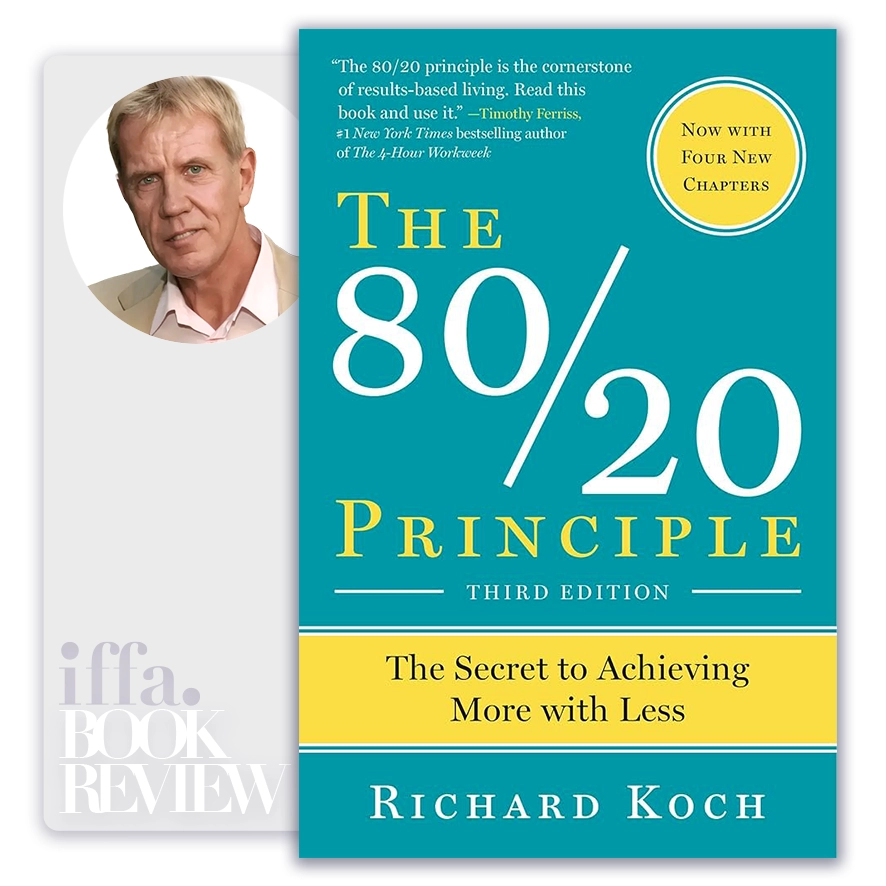
by Richard Koch
Executive Summary:
In an era where leaders are overwhelmed by complexity, data overload, and constant activity, The 80/20 Principle delivers a powerful and liberating insight: most results come from a small fraction of causes. Richard Koch reframes productivity, strategy, and decision-making by showing that effectiveness is not about doing more—but about focusing on what truly matters. For executives, entrepreneurs, and strategists, this book offers a clarity-driven framework for disproportionate impact.
The 80/20 Principle matters because most organizations waste enormous resources on low-impact activities, mistaking busyness for progress. Koch demonstrates that success—whether in business, wealth creation, relationships, or personal productivity—is highly uneven. Leaders who understand and apply this principle can simplify strategy, amplify results, and reclaim control over time and resources.
About The Author
Richard Koch is a former management consultant, entrepreneur, and investor, best known for popularizing the 80/20 Principle in business and personal development. His authority comes from practical application across consulting, investing, and company-building.
Koch’s perspective is unique because he translates a statistical observation into a pragmatic decision-making philosophy, accessible and actionable for leaders at all levels.
Core Idea:
The central idea of The 80/20 Principle is deceptively simple yet profoundly disruptive:
A minority of inputs—often around 20%—generate the majority of outputs—often around 80%.
This imbalance is not an exception; it is a fundamental pattern of reality. Koch argues that most people and organizations intuitively assume linearity—that equal effort produces equal results. In practice, outcomes are highly skewed, with a small number of customers, products, decisions, or actions accounting for most value.
The strategic implication is clear: success is achieved by identifying, nurturing, and doubling down on the vital few—while reducing, delegating, or eliminating the trivial many.
Outputs are rarely proportional to inputs.
Key Concepts:
- The 80/20 Principle as a Universal Law
The 80/20 pattern appears across:
- Business profits and customers
- Wealth distribution
- Time management and productivity
- Quality issues and failures
This unevenness is not inefficiency—it is how complex systems naturally operate.
- Focus Creates Leverage
High performers are not more active—they are more selective. By concentrating effort on high-impact areas, leaders can:
- Achieve greater results with less effort
- Reduce stress and complexity
- Improve strategic clarity
The principle rewards focus over balance and effectiveness over fairness.
- Business Strategy Through 80/20 Thinking
In organizations:
- A small percentage of customers generate most profits
- A few products drive most revenue
- A handful of processes cause most problems
Koch argues that leaders should redesign strategy around these asymmetries, rather than spreading resources evenly.
- Time, Productivity, and Personal Effectiveness
Most individuals experience that:
- A few hours produce most meaningful work
- A small set of relationships brings most fulfillment
- A limited number of skills drive most success
Applying 80/20 thinking allows individuals to reclaim time, energy, and attention by eliminating low-value commitments.
- Simplification as a Competitive Advantage
Koch emphasizes simplification, not optimization. Complexity diffuses effort and hides value, while simplicity:
- Sharpens priorities
- Improves execution
- Enhances decision speed
Great leaders simplify reality into actionable focus areas.
- Wealth, Happiness, and Lifestyle Design
The 80/20 Principle extends beyond business into life design:
- A few activities produce most happiness
- A small number of decisions shape life outcomes
- Selective effort leads to greater freedom
Success, Koch argues, is about designing life intentionally around high-impact choices.
The goal is not to work harder—but to work where it matters most.
Executive Insights:
The 80/20 Principle reframes leadership from managing complexity to curating impact. It challenges executives to abandon the myth of equal importance and instead embrace strategic imbalance.
Strategic Implications for Leaders:
- Equality of effort is inefficient
- Focus creates disproportionate advantage
- Most resources are misallocated
- Simplification improves performance
- Elimination is as important as execution
Actionable Takeaways:
The principles in The 80/20 Principle can be applied immediately across strategy, operations, leadership, and personal productivity.
Practical Actions for Executives and Leaders:
- Identify the top 20% driving 80% of results
- Reallocate resources toward high-impact areas
- Eliminate or delegate low-value activities
- Redesign strategy around core profit drivers
- Protect time for highest-leverage work
- Simplify goals, metrics, and priorities
Final Thoughts:
The 80/20 Principle is a clarity-driven guide for intelligent effort. Its message is both empowering and demanding: you cannot do everything—but you do not need to. Success comes from choosing wisely, focusing deeply, and acting selectively.
In a world of overload, the ultimate advantage belongs to those who master focus.
To conclude, the ideas explored in this book go far beyond theory; they offer practical insight that can shape real careers, leadership paths, and professional decisions.
At IFFA, these same principles are transformed into structured executive training courses, professional certifications, and curated learning events designed to align with today’s industries and tomorrow’s demands. Find out more on Courses.
Applied Programs

- Course Code : SBM-409
- Delivery : In-class / Virtual / Workshop
- Duration : 2-4 Days
- Venue: DUBAI HUB

- Course Code : PMA-613
- Delivery : In-class / Virtual / Workshop
- Duration : 3-5 Days
- Venue: DUBAI HUB

- Course Code : CIF-505
- Delivery : In-class / Virtual / Workshop
- Duration : 3-5 Days
- Venue: DUBAI HUB

- Course Code : CIF-512
- Delivery : In-class / Virtual / Workshop
- Duration : 2-4 Days
- Venue: DUBAI HUB
Related Books