
The Executive Summary of
On Time and Water
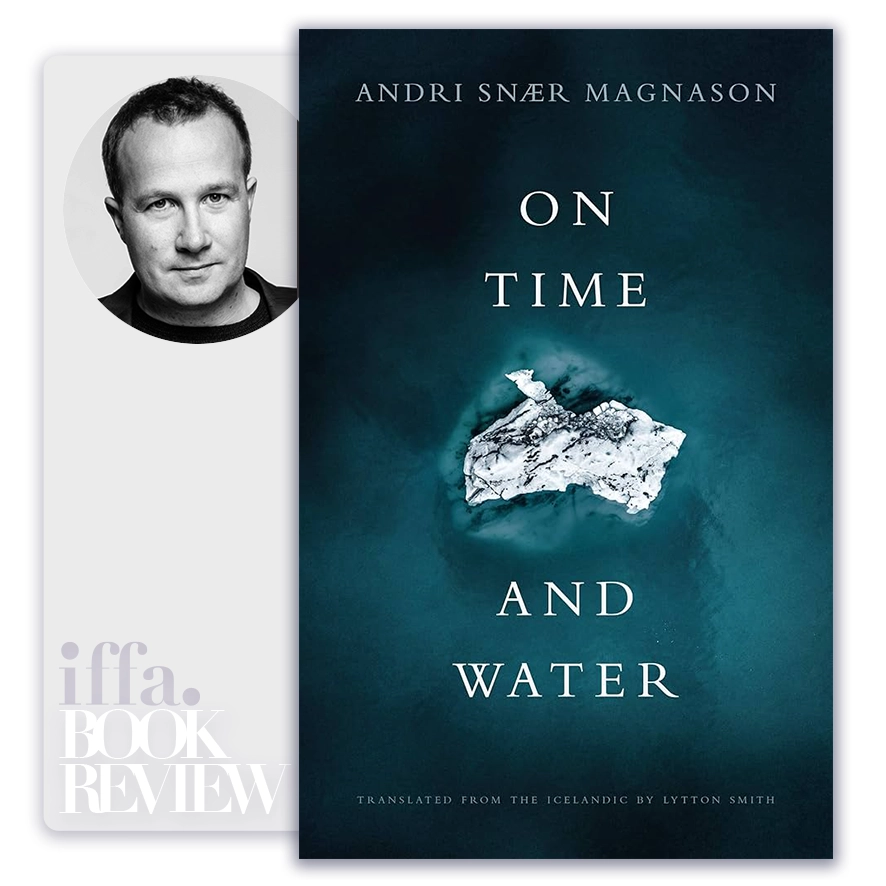
by Andri Snær Magnason
Summary Overview:
On Time and Water matters because it addresses a fundamental failure in how modern societies understand the climate crisis: we struggle to relate to it in human terms. Climate change unfolds across timescales that exceed individual lifetimes, political cycles, and quarterly reporting—making it abstract, distant, and easy to defer. Magnason confronts this gap directly, not with data alone, but by reshaping how we think about time, responsibility, and continuity.
In an age saturated with climate statistics, targets, and policy frameworks, this book takes a different and necessary approach. It asks why, despite overwhelming evidence, societies remain slow to act. The answer, Magnason suggests, lies not only in economics or politics, but in imagination and narrative. We lack the language to emotionally grasp changes that unfold over centuries yet are triggered by present decisions.
For leaders, policymakers, and institutions, the book offers a rare strategic value: it reframes climate change as a governance challenge of intergenerational accountability. It encourages decision-makers to think beyond immediate outcomes and to recognize how today’s actions will be interpreted by descendants who must live with their consequences. In doing so, On Time and Water becomes less a climate book and more a meditation on long-term leadership under irreversible conditions.
About The Author
Andri Snær Magnason is an Icelandic author and public intellectual whose work bridges literature, environmental science, and civic discourse. His perspective is distinctive for blending personal narrative with planetary scale, making abstract environmental risks emotionally and ethically legible.
Core Idea:
The core idea of On Time and Water is that climate change is fundamentally a crisis of time perception and moral distance. Human institutions are optimized for short horizons, while climate systems operate across centuries and millennia. This mismatch allows irreversible damage to occur without triggering proportional urgency.
Magnason uses stories—of melting glaciers, family histories, and future descendants—to collapse these timescales. By connecting past, present, and future into a single narrative, the book argues that responsibility only becomes real when consequences are made imaginable. Climate action, therefore, depends not only on knowledge, but on our ability to relate emotionally to long-term outcomes.
We fail to act on climate change not because we lack facts, but because we lack language for deep time.
Key Concepts:
- Deep Time Versus Political Time
Magnason contrasts geological and climatic timescales with electoral and economic cycles. While glaciers evolve over thousands of years, policies are shaped by years or months. This structural mismatch explains why climate risks are consistently underweighted in decision-making. - Glaciers as Memory Systems
Glaciers are presented as archives of climate history—holding records of atmosphere, temperature, and time itself. Their disappearance represents not just environmental loss, but the erasure of planetary memory, severing links between past and future. - The Invisibility of Slow Catastrophe
Climate change lacks the immediacy of sudden disasters. Its slow progression makes it psychologically easy to ignore, even as impacts accumulate. Magnason shows how societies respond poorly to threats that are gradual but irreversible. - Language Shapes Urgency
The book argues that technical language—parts per million, degrees Celsius—fails to convey moral weight. Without narratives that translate data into lived meaning, climate risks remain abstract and politically negotiable. - Intergenerational Ethics
Magnason frames climate change as an ethical relationship between generations. Decisions made today determine the options available to people not yet born. Ignoring this relationship allows present convenience to override future survival. - Cultural Amnesia and Normalization
Each generation tends to accept environmental degradation as normal. Rivers shrink, glaciers retreat, and ecosystems vanish within a single lifetime, yet memory resets. This “shifting baseline” erodes resistance to loss. - Irreversibility as a Strategic Threshold
The book emphasizes tipping points—moments after which systems cannot return to prior states. Leadership failure occurs when action is delayed beyond these thresholds, turning manageable risks into permanent loss. - Iceland as a Microcosm
Magnason uses Iceland’s glaciers and energy debates as a case study in global tensions between development and preservation. Small systems reveal the same trade-offs faced worldwide, but with consequences that are easier to see. - Responsibility Beyond Intent
Good intentions are insufficient when outcomes are destructive. The book challenges leaders to judge decisions by long-term consequences, not present rationale or popularity. - Hope Rooted in Awareness, Not Optimism
Magnason does not offer false reassurance. Hope, in his view, emerges from clarity and responsibility—recognizing what is at stake and choosing to act despite uncertainty.
Long-term responsibility begins when future generations feel present in today’s decisions.
Executive Insights:
On Time and Water reframes climate change as a leadership problem rooted in temporal blindness. Institutions are not failing due to lack of expertise, but because their structures discourage long-term accountability. The book challenges leaders to expand their definition of stakeholders to include future generations and irreversible systems.
Strategically, the book suggests that climate risk is mispriced because its costs fall outside conventional planning horizons. Leaders who fail to integrate deep-time thinking into strategy expose their organizations—and societies—to reputational, environmental, and existential risk.
Key strategic implications include:
- Short-term governance structures are misaligned with long-term planetary risk
- Climate leadership requires narrative clarity as well as technical solutions
- Irreversible loss represents strategic failure, not acceptable trade-off
- Intergenerational accountability strengthens long-term legitimacy
- Awareness of time horizons improves decision quality under uncertainty
Actionable Takeaways:
The book translates into broad, practical principles for leadership and policy.
- Extend decision horizons to include intergenerational impact
- Treat irreversible environmental damage as a non-negotiable constraint
- Use narratives and stories to make long-term risks tangible
- Challenge policies that optimize short-term gain at long-term cost
- Incorporate climate thresholds and tipping points into strategic planning
- Preserve institutional memory to counter normalization of loss
- Frame sustainability as responsibility, not branding or compliance
Final Thoughts:
On Time and Water is not a technical manual or policy blueprint—it is a reframing of how humans relate to time, nature, and responsibility. Its power lies in making the invisible visible and the distant personal.
The enduring insight of the book is both sobering and clarifying: the future is already watching us through the consequences we set in motion today. Leaders who learn to think across generations—rather than within terms—will be better equipped to act with wisdom, restraint, and courage in a century defined by irreversible choices.
The ideas in this book go beyond theory, offering practical insights that shape real careers, leadership paths, and professional decisions. At IFFA, these principles are translated into executive courses, professional certifications, and curated learning events aligned with today’s industries and tomorrow’s demands. Discover more in our Courses.
Applied Programs

- Course Code : SBM-409
- Delivery : In-class / Virtual / Workshop
- Duration : 2-4 Days
- Venue: DUBAI HUB

- Course Code : PMA-613
- Delivery : In-class / Virtual / Workshop
- Duration : 3-5 Days
- Venue: DUBAI HUB

- Course Code : CIF-505
- Delivery : In-class / Virtual / Workshop
- Duration : 3-5 Days
- Venue: DUBAI HUB

- Course Code : CIF-512
- Delivery : In-class / Virtual / Workshop
- Duration : 2-4 Days
- Venue: DUBAI HUB
Related Books