
The Executive Summary of
Green Swans: The Coming Boom in Regenerative Capitalism
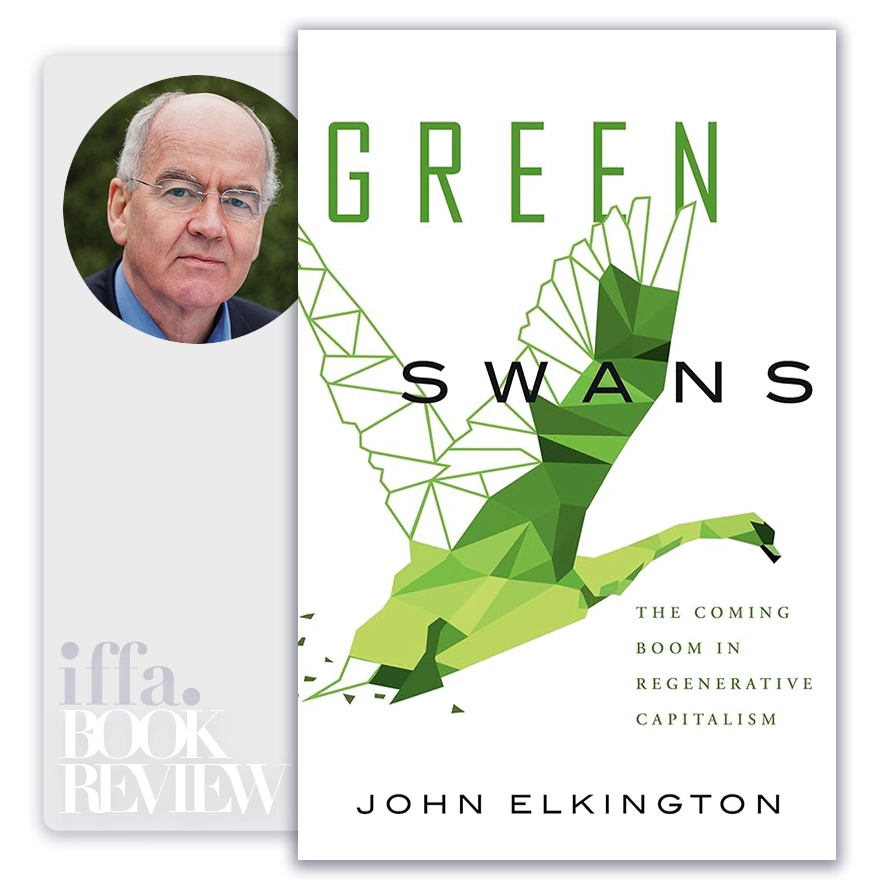
by John Elkington
Summary Overview:
For decades, sustainability has been framed as a matter of risk mitigation, compliance, and incremental improvement. Green Swans argues that this framing is no longer sufficient. John Elkington contends that humanity is approaching a convergence of systemic crises—climate, biodiversity, inequality, financial instability—that cannot be solved by marginal efficiency gains or ESG box-ticking.
This book matters because it challenges leaders to rethink capitalism itself—not to abandon markets, but to re-engineer them for regeneration rather than extraction. Elkington introduces the concept of “Green Swans”: positive, exponential disruptions that can reshape economies as profoundly as Black Swans—but toward renewal rather than collapse. For executives and investors, Green Swans is a call to move beyond sustainability as defense and toward sustainability as offense, innovation, and opportunity.
About The Author
John Elkington is one of the world’s most influential sustainability thinkers and the originator of the Triple Bottom Line (People, Planet, Profit). With decades of experience advising corporations, governments, and investors, Elkington has consistently pushed the frontier of how business engages with environmental and social challenges.
His credibility lies in both foresight and humility. Notably, Elkington publicly “recalled” his own Triple Bottom Line concept, arguing it had been diluted into accounting rather than transformation. Green Swans represents his next evolution: a push from measurement to systemic change.
Core Idea:
The central thesis of Green Swans is ambitious and unsettling:
Incremental sustainability will fail. Only systemic, regenerative transformation can meet the scale and speed of today’s global challenges.
Elkington argues that:
- ESG has become procedural rather than transformational
- Risk management alone cannot prevent systemic collapse
- Markets are approaching tipping points—both negative and positive
“Green Swans” are nonlinear breakthroughs—technological, financial, policy-driven, or cultural—that can rapidly accelerate sustainable outcomes once critical thresholds are crossed.
Doing “less bad” is not the same as doing “enough.”
Key Concepts:
- From Black Swans to Green Swans
Elkington builds on the concept of Black Swans—rare, high-impact negative events—by proposing their positive counterpart.
Green Swans are:
- Disruptive, not incremental
- System-shaping, not marginal
- Often resisted before they succeed
The same dynamics that can collapse systems can also regenerate them—if redirected. Climate breakthroughs, circular economies, and regenerative finance can scale faster than traditional forecasts predict.
- The Limits of ESG and Incrementalism
While acknowledging ESG’s progress, Elkington is clear-eyed about its limits.
Problems include:
- Focus on disclosure over outcomes
- Incremental targets disconnected from planetary boundaries
- Corporate capture of sustainability narratives
Doing “less bad” is not the same as doing “enough.” ESG, in its current form, often optimizes within a broken system instead of changing the system itself.
- Planetary Boundaries and Tipping Points
The book integrates insights from earth-system science, emphasizing planetary boundaries:
- Climate stability
- Biodiversity
- Nitrogen and phosphorus cycles
- Freshwater systems
Crossing planetary boundaries triggers nonlinear, often irreversible change. The same logic applies to markets: once thresholds are crossed, change accelerates dramatically—for better or worse.
- Regenerative Capitalism vs. Sustainable Capitalism
Elkington distinguishes between:
- Sustainable capitalism (slowing harm)
- Regenerative capitalism (restoring systems)
Regenerative models aim to:
- Rebuild natural capital
- Strengthen social systems
- Create net-positive outcomes
Sustainability maintains the system; regeneration renews it. This requires rethinking value creation, not just efficiency.
- Finance as a Force Multiplier
Capital markets are central to the Green Swan thesis.
Elkington highlights:
- The rise of impact investing
- Shifts in fiduciary interpretation
- Climate-aligned financial regulation
Capital allocation decisions shape the future faster than policy alone. Once financial flows realign, transformation can become self-reinforcing.
- Innovation, Technology, and Exponential Change
Green Swans often emerge from:
- Clean energy breakthroughs
- Circular materials
- Digital transparency
- Nature-based solutions
However, Elkington cautions against tech solutionism.
Technology accelerates change—but values determine direction. Innovation must be aligned with ecological and social goals to avoid rebound effects.
- Policy, Regulation, and System Reset
Markets do not transform in isolation. Elkington emphasizes the role of:
- Carbon pricing
- Mandatory disclosure
- Industrial policy
- Legal accountability
Rules define markets—and rewriting rules rewrites outcomes. Well-designed regulation can catalyze Green Swans rather than constrain innovation.
- Corporate Leadership at the Edge
Elkington challenges CEOs and boards to:
- Move from risk avoidance to opportunity creation
- Accept short-term discomfort for long-term resilience
- Align lobbying with sustainability commitments
Leadership in the 21st century means steering toward disruption—not away from it. Neutrality is increasingly a strategic risk.
- Cultural and Narrative Shifts
Beyond economics and policy, Green Swans emphasizes storytelling and mindset.
Narratives shape:
- Consumer behavior
- Investor confidence
- Political will
The stories we tell about the future influence whether it arrives. Optimistic, solution-oriented narratives are essential to mobilize action at scale.
- From Linear Forecasts to Systems Thinking
A recurring warning in the book is against linear thinking.
The future will not arrive gradually—it will arrive suddenly.
Leaders must prepare for nonlinear change, both risks and opportunities, by adopting systems thinking rather than trend extrapolation.
The same dynamics that can collapse systems can also regenerate them, if redirected.
Executive Insights:
Green Swans reframes sustainability as strategic transformation, not compliance.
Strategic Implications for Leaders and Boards:
- Incremental ESG is insufficient
- Systemic risks demand systemic responses
- Capital flows are leverage points
- Regeneration is the next competitive frontier
- Policy and markets will co-evolve
- Leadership neutrality is eroding
- Narratives drive momentum
- Tipping points can work in our favor
Actionable Takeaways:
Elkington’s ideas translate into decisive executive action.
Practical Actions for Executives, Investors, and Policymakers:
- Audit where your strategy relies on incrementalism
- Identify potential Green Swan opportunities in your sector
- Align capital allocation with regenerative outcomes
- Integrate planetary boundaries into strategy
- Support regulation that accelerates system change
- Invest in innovation with systemic impact
- Ensure lobbying matches sustainability commitments
- Adopt systems thinking in risk management
- Communicate a credible, regenerative vision
Final Thoughts:
Green Swans is neither a manifesto nor a technical manual—it is a strategic wake-up call. John Elkington argues that the same forces threatening global stability can be redirected toward renewal—if leaders act boldly, early, and systemically.
The book’s ultimate message is challenging yet hopeful:
The future will be shaped by disruption—our choice is whether it will be destructive or regenerative.
For leaders navigating climate risk, ESG evolution, capital allocation, and long-term resilience, Green Swans offers a defining insight:
Those who help trigger Green Swans will shape the next era of capitalism; those who cling to incrementalism will be overtaken by it.
The ideas in this book go beyond theory, offering practical insights that shape real careers, leadership paths, and professional decisions. At IFFA, these principles are translated into executive courses, professional certifications, and curated learning events aligned with today’s industries and tomorrow’s demands. Discover more in our Courses.
Applied Programs

- Course Code : SBM-409
- Delivery : In-class / Virtual / Workshop
- Duration : 2-4 Days
- Venue: DUBAI HUB

- Course Code : PMA-613
- Delivery : In-class / Virtual / Workshop
- Duration : 3-5 Days
- Venue: DUBAI HUB

- Course Code : CIF-505
- Delivery : In-class / Virtual / Workshop
- Duration : 3-5 Days
- Venue: DUBAI HUB

- Course Code : CIF-512
- Delivery : In-class / Virtual / Workshop
- Duration : 2-4 Days
- Venue: DUBAI HUB
Related Books