

The Executive Summary of
Why Nations Fail
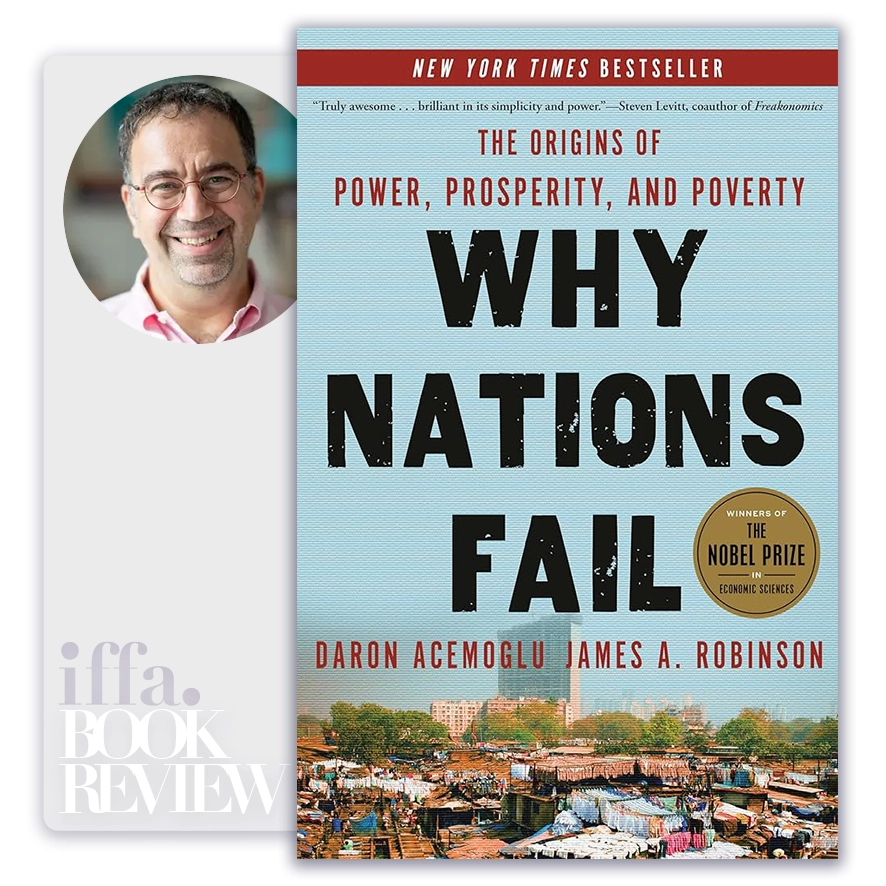
by Daron Acemoglu & James A. Robinson
Summary Overview:
Across history, nations with similar geography, culture, and resources have experienced radically different economic outcomes. Some prosper, innovate, and create opportunity for their citizens—while others stagnate, collapse, or remain trapped in poverty. Why Nations Fail tackles one of the most important questions in economics, governance, and global leadership: what truly determines long-term national success or failure.
This book matters because it dismantles simplistic explanations—such as geography, culture, climate, or ignorance—and replaces them with a far more powerful framework: institutions determine destiny. For policymakers, executives, investors, development leaders, and strategists, Why Nations Fail provides a rigorous yet accessible lens for understanding why some systems scale prosperity while others concentrate power and suppress growth. It is not a book about economics alone—it is a strategic manual for institutional design, leadership accountability, and sustainable progress.
About The Authors
Daron Acemoglu is one of the world’s most influential economists and a professor at MIT, renowned for his work on political economy, institutions, and growth. James A. Robinson is a leading political scientist and development economist with extensive field experience in Africa, Latin America, and fragile states.
Their authority comes from decades of empirical research, historical analysis, and real-world observation. What sets their work apart is the ability to combine academic rigor with clear narrative case studies—making complex institutional theory directly relevant to leaders, governments, and organizations.
Core Idea:
At the heart of Why Nations Fail lies a decisive and evidence-backed insight:
Nations succeed or fail because of their institutions—not their geography, culture, or resources.
Institutions are defined as the rules of the game in a society: the political and economic structures that shape incentives, power distribution, innovation, and participation. The authors divide institutions into two broad categories:
- Inclusive institutions, which encourage broad participation, protect property rights, reward innovation, and constrain power
- Extractive institutions, which concentrate power and wealth in the hands of a few, suppress competition, and block creative destruction
The book argues that inclusive institutions create sustained prosperity, while extractive institutions may generate short-term growth—but inevitably lead to stagnation, inequality, and collapse.
Prosperity is not created by elites, it is created when incentives are open to all.
Key Concepts:
- Inclusive vs. Extractive Institutions
This distinction is the backbone of the book.
Inclusive economic institutions:
- Protect property rights
- Enforce contracts
- Encourage investment and innovation
- Enable social mobility
- Allow market entry and competition
Extractive economic institutions:
- Transfer wealth to elites
- Block competition
- Discourage innovation
- Limit opportunity to insiders
Prosperity is not created by elites—it is created when incentives are open to all. Inclusive political institutions reinforce economic inclusion by:
- Distributing power broadly
- Enforcing rule of law
- Limiting arbitrary authority
- Enabling accountability
Without political inclusion, economic inclusion cannot survive.
- The Myth of Geography and Culture
The book systematically dismantles popular explanations for poverty:
- Geography: Climate and natural resources do not determine success (e.g., Singapore vs. tropical failures)
- Culture: Values alone do not explain outcomes (e.g., same cultures divided by institutions)
- Ignorance: Leaders often know what would help—but choose otherwise to preserve power
Bad outcomes are rarely accidents—they are incentives working as designed.
- Creative Destruction and Elite Resistance
Economic growth requires creative destruction—the process by which new technologies, firms, and ideas replace old ones. Inclusive systems allow this disruption. Extractive systems fear it.
Elites resist creative destruction because it:
- Threatens political power
- Undermines monopolies
- Disrupts established hierarchies
As a result, extractive regimes suppress innovation—even when it would raise overall prosperity.
- The Iron Law of Oligarchy
The book highlights how extractive institutions tend to reproduce themselves. Power begets power. Wealth funds influence. Influence reshapes rules.
This creates:
- Entrenched elites
- Weak accountability
- Institutional inertia
Institutions persist not because they are efficient—but because they benefit those who control them. Breaking this cycle requires political struggle, not technocratic reform alone.
- Critical Junctures: When History Turns
While institutions are persistent, they are not immutable. The authors introduce the concept of critical junctures—moments of shock or disruption (wars, revolutions, pandemics, colonization) that open paths for institutional change.
At these moments:
- Small differences can have large effects
- Leadership choices matter enormously
- Paths diverge for centuries
Examples include:
- The Glorious Revolution in England
- Divergent colonial institutions in North vs. South America
- Post-war rebuilding paths
- The Virtuous and Vicious Cycles
Inclusive institutions tend to create virtuous cycles:
- Inclusion → innovation → growth → stronger institutions
Extractive institutions create vicious cycles:
- Concentration of power → exclusion → stagnation → instability
These cycles explain why reform is difficult and why partial fixes often fail.
- Growth Without Inclusion Is Fragile
The book explains why some authoritarian or extractive regimes experience temporary growth spurts—often through resource exploitation or state-led investment—but fail to sustain them.
Without inclusion:
- Innovation stalls
- Inequality grows
- Political instability rises
- Growth collapses
Growth that excludes eventually destroys itself.
- Institutions Over Individuals
While charismatic leaders matter, the authors stress that institutions outlast individuals. Sustainable prosperity requires:
- Checks and balances
- Rule-based governance
- Independent institutions
- Predictable enforcement
Personalized rule may deliver speed—but lacks durability.
Bad outcomes are rarely accidents, they are incentives working as designed.
Executive Insights:
Why Nations Fail offers powerful lessons beyond nation-states. Its logic applies directly to corporations, ecosystems, industries, and platforms.
Strategic Implications for Leaders and Policymakers:
- Incentives matter more than intentions
- Concentrated power erodes innovation
- Inclusion fuels resilience and growth
- Short-term control undermines long-term value
- Institutions shape behavior more than culture
Organizations that centralize power excessively mirror extractive states—and face similar risks: stagnation, disengagement, and eventual disruption.
Actionable Takeaways:
The book translates institutional theory into practical leadership guidance.
For Governments and Policymakers:
- Strengthen rule of law and accountability
- Distribute economic opportunity broadly
- Protect competition and market entry
- Limit elite capture of institutions
- Invest in inclusive education and infrastructure
For Executives and Boards:
- Design organizations with open incentives
- Encourage internal creative destruction
- Avoid monopolistic behavior that stifles innovation
- Align governance with long-term value creation
- Build systems, not personalities
Final Thoughts:
Why Nations Fail is one of the most important books of the modern era because it explains success and failure without illusion or ideology. Acemoglu and Robinson deliver a clear, sobering message: prosperity is a political and institutional choice.
Nations—and organizations—that choose inclusion, accountability, and openness build lasting wealth. Those that choose extraction, control, and exclusion may rise quickly—but they always fall.
The ideas in this book go beyond theory, offering practical insights that shape real careers, leadership paths, and professional decisions. At IFFA, these principles are translated into executive courses, professional certifications, and curated learning events aligned with today’s industries and tomorrow’s demands. Discover more in our Courses.
Applied Programs

- Course Code : SBM-409
- Delivery : In-class / Virtual / Workshop
- Duration : 2-4 Days
- Venue: DUBAI HUB

- Course Code : PMA-613
- Delivery : In-class / Virtual / Workshop
- Duration : 3-5 Days
- Venue: DUBAI HUB

- Course Code : CIF-505
- Delivery : In-class / Virtual / Workshop
- Duration : 3-5 Days
- Venue: DUBAI HUB

- Course Code : CIF-512
- Delivery : In-class / Virtual / Workshop
- Duration : 2-4 Days
- Venue: DUBAI HUB
Related Books