
The Executive Summary of
The Not-To-Do List
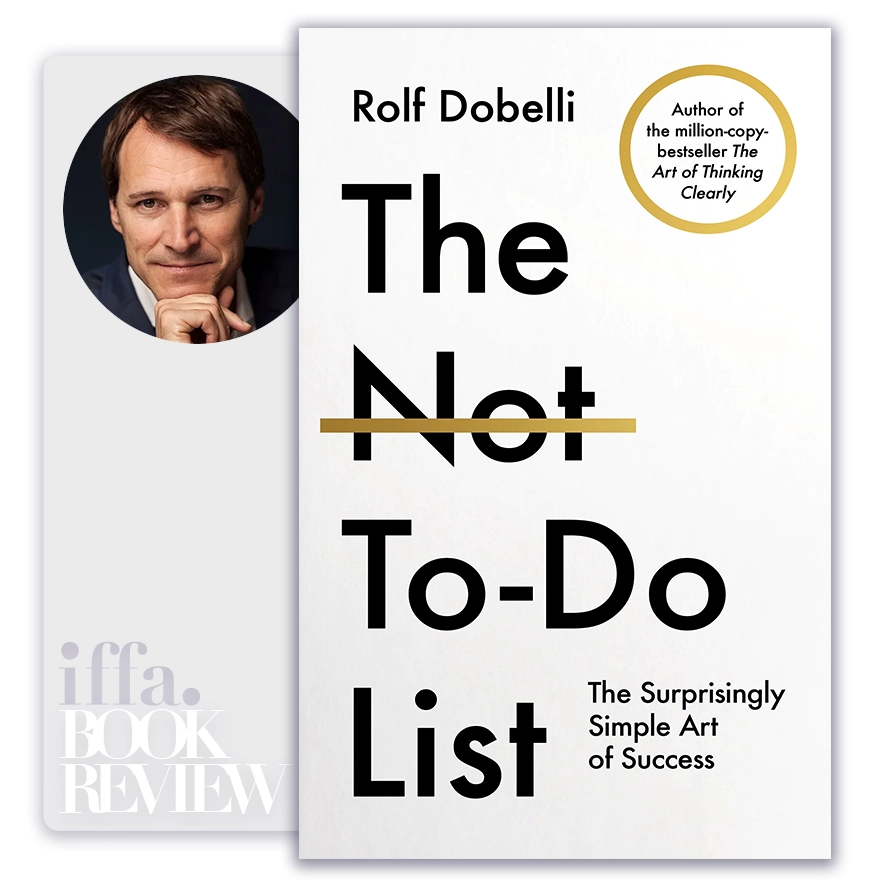
by Rolf Dobelli
Summary Overview:
The Not-To-Do List addresses a blind spot in modern leadership thinking: most damage to performance, judgment, and well-being comes not from what leaders fail to do, but from what they do unnecessarily. Rolf Dobelli challenges the default bias toward action, growth, and optimization, arguing instead for disciplined subtraction. The book matters because it reframes success as the result of systematic avoidance of predictable errors, rather than relentless execution.
For CEOs, board members, senior executives, and long-term investors, the relevance is strategic. In environments overloaded with information, incentives, and urgency, decision quality often deteriorates not due to lack of effort, but due to overextension, distraction, and self-inflicted complexity. Dobelli shows that many professional failures follow repeatable patterns—and that avoiding them yields outsized gains. In high-stakes settings, not doing the wrong things consistently beats doing more things aggressively.
About The Author
Rolf Dobelli is a writer and former entrepreneur best known for his work on cognitive errors, decision-making, and practical wisdom.
His perspective is distinctive for emphasizing error avoidance over success formulas. Rather than prescribing heroic habits, Dobelli focuses on removing behaviors that reliably undermine judgment, performance, and long-term outcomes.
Core Idea:
The central thesis of The Not-To-Do List is that progress comes faster by eliminating harmful behaviors than by adding productive ones. Dobelli argues that human judgment is systematically biased, and that many failures are the result of predictable cognitive and behavioral traps—distraction, overconfidence, social comparison, and short-termism.
At a deeper level, the book advances a worldview in which wisdom is largely subtractive. By identifying what consistently leads to poor outcomes and committing to avoid it, leaders improve clarity, focus, and resilience. Success, in this frame, is not about optimization—but about not sabotaging oneself.
It is easier to avoid stupidity than to achieve brilliance.
Key Concepts:
- Error Avoidance Beats Skill Accumulation
Preventing mistakes yields asymmetric returns.
- Losses compound faster than gains.
- Avoidable errors dominate outcomes.
- Overconfidence Is a Primary Risk
Self-belief distorts judgment.
- Certainty increases exposure.
- Humility protects decision quality.
- Information Overload Reduces Insight
More input does not mean better thinking.
- Noise crowds out signal.
- Selectivity improves clarity.
- Social Comparison Warps Priorities
External benchmarks mislead.
- Status chasing erodes focus.
- Independent thinking preserves value.
- Busyness Is Not Effectiveness
Activity disguises avoidance.
- Motion replaces progress.
- Stillness supports judgment.
- Short-Term Optimization Destroys Long-Term Value
Immediate gains hide future cost.
- Compounding favors patience.
- Myopia increases fragility.
- Multitasking Is Cognitive Debt
Attention switching carries cost.
- Depth outperforms breadth.
- Focus reduces error.
- Incentives Create Blind Spots
Rewards shape behavior.
- Misaligned incentives encourage bad decisions.
- Governance must anticipate distortion.
- Reputation Management Distorts Truth
Image competes with reality.
- Honesty preserves resilience.
- Spin compounds risk.
- Simplicity Is a Competitive Advantage
Complexity breeds failure.
- Fewer rules outperform more controls.
- Clarity stabilizes systems.
What you don’t do often matters more than what you do.
Executive Insights:
Dobelli reframes leadership effectiveness as the disciplined avoidance of predictable mistakes. Organizations often invest heavily in training, tools, and initiatives while leaving obvious failure patterns untouched—overmeeting, overcommunication, reactive decision-making, and incentive misalignment.
For boards and senior leadership, the implication is clear: a robust “not-to-do” discipline improves governance. By removing behaviors that consistently degrade judgment, leaders protect capital, attention, and reputation. Error prevention scales more reliably than best-practice adoption.
- Fewer mistakes compound into better outcomes.
- Simplicity reduces operational fragility.
- Focus improves judgment under pressure.
- Incentive awareness prevents distortion.
- Subtraction clarifies strategy.
Actionable Takeaways:
Strategic restraint improves performance.
- Identify behaviors that reliably create bad outcomes.
- Eliminate sources of distraction and noise.
- Resist incentives that reward short-term optics.
- Protect focus and independent judgment.
- Build systems that prevent error, not just enable action.
Final Thoughts:
The Not-To-Do List delivers a calm but powerful insight: success is often the result of consistent avoidance rather than exceptional execution. Rolf Dobelli shows that many failures are optional—predictable consequences of habits and biases that can be consciously removed.
For leaders operating in complex, high-stakes environments, the enduring lesson is decisive: clarity emerges when unnecessary actions are eliminated. By subtracting distraction, ego, and short-term temptation, leaders create space for judgment, patience, and long-term value.
In the long run, the most effective leaders are not those who do the most—but those who avoid doing what reliably goes wrong.
The ideas in this book go beyond theory, offering practical insights that shape real careers, leadership paths, and professional decisions. At IFFA, these principles are translated into executive courses, professional certifications, and curated learning events aligned with today’s industries and tomorrow’s demands. Discover more in our Courses.
Applied Programs

- Course Code : SBM-409
- Delivery : In-class / Virtual / Workshop
- Duration : 2-4 Days
- Venue: DUBAI HUB

- Course Code : PMA-613
- Delivery : In-class / Virtual / Workshop
- Duration : 3-5 Days
- Venue: DUBAI HUB

- Course Code : CIF-505
- Delivery : In-class / Virtual / Workshop
- Duration : 3-5 Days
- Venue: DUBAI HUB

- Course Code : CIF-512
- Delivery : In-class / Virtual / Workshop
- Duration : 2-4 Days
- Venue: DUBAI HUB
Related Books