
The Executive Summary of
The Machine That Changed the World
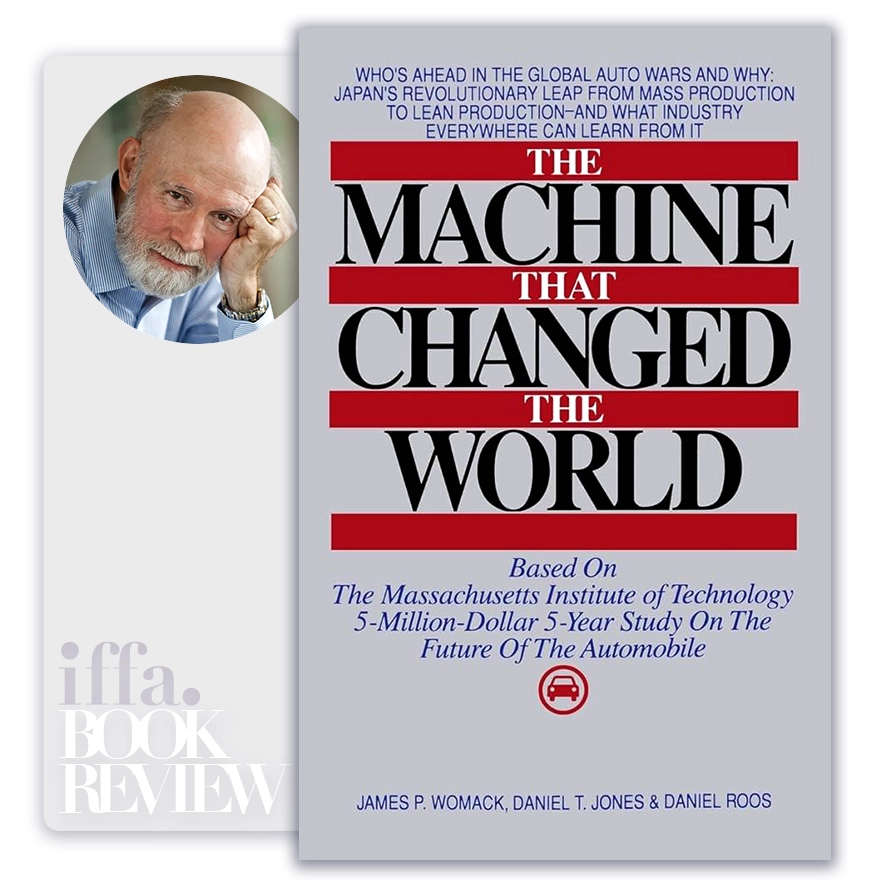
by James P. Womack
Summary Overview:
The Machine That Changed the World captures one of the most consequential shifts in modern industrial history: the move from mass production to lean production as a dominant management logic. This shift did not merely improve factory efficiency; it fundamentally altered how organizations think about quality, cost, speed, innovation, and human capability. The effects of this transformation continue to shape global competition across manufacturing, services, and complex supply chains.
Drawing on unprecedented comparative research, the book reveals why lean production consistently outperformed traditional scale-driven systems. It shows how flow, problem visibility, people development, and continuous learning replaced buffers, inspection, and rigid hierarchy as sources of advantage. For executives, board members, and long-term strategists, the book provides more than historical insight—it offers a clear explanation of why organizations that design systems to learn and adapt outperform those that rely on size, inventory, and control. In a world facing volatility, sustainability pressure, and operational fragility, the logic introduced in this book remains a foundational guide to building resilient, high-performing enterprises.
About The Author
James P. Womack and Daniel T. Jones are leading thinkers in Lean management, known for translating production insights into system-wide organizational principles. Daniel Roos, as director of MIT’s International Motor Vehicle Program, provided the rigorous empirical foundation behind the research.
Their authority is distinctive because the book is based on the largest comparative industrial study of its time, covering automakers across continents. Rather than theory or advocacy, the book presents evidence-driven conclusions that reshaped how executives understood productivity and competition.
Core Idea:
The core idea of The Machine That Changed the World is that lean production fundamentally outperforms mass production by eliminating waste, engaging people, and aligning the entire value stream around customer value. Lean production delivers higher quality, lower cost, faster innovation, and greater flexibility—not through intensity or automation alone, but through system design.
The authors demonstrate that mass production optimized scale at the expense of adaptability, while lean production optimized flow, learning, and continuous improvement. This shift changed the economics of industry: smaller batches beat larger ones, problem-solving beat inspection, and engaged workers beat rigid hierarchies. Lean became the new “machine” driving global competitiveness.
Lean production wins not by working harder, but by wasting less.
Key Concepts:
- Lean Production vs. Mass Production
Mass production relies on large batches, buffers, and inspection. Lean production relies on flow, pull, and built-in quality. At executive level, this distinction explains why scale without flexibility becomes a liability.
- Mass production hides problems
- Lean exposes and solves them
- Visibility drives improvement
- Waste as the Central Enemy
Lean defines waste broadly: excess inventory, waiting, defects, overprocessing, unnecessary motion, and underutilized talent. Strategically, this reframes cost reduction from cutting resources to removing non-value work. - Built-In Quality Over Inspection
Rather than fixing defects after the fact, lean systems prevent them at the source. This reduces cost while increasing trust.
- Quality becomes systemic
- Rework collapses
- Learning accelerates
Executives see that quality is a design choice, not a control function.
- Just-in-Time as a Learning System
Just-in-Time is not about speed alone—it exposes problems immediately. Inventory hides inefficiency; flow reveals it.
- Low inventory forces discipline
- Problems surface early
- Correction becomes cheaper
This insight is critical for supply-chain resilience.
- Respect for People as Productivity Driver
Lean production treats workers as problem-solvers, not labor inputs. Engagement improves quality and innovation.
- Knowledge lives at the front line
- Respect increases accountability
- Culture compounds performance
Organizations that ignore this principle copy tools but miss results.
- Continuous Improvement as Daily Work
Lean embeds improvement into routine operations rather than treating it as a project.
- Small gains compound
- Learning never stops
- Performance stabilizes
Executively, this explains why lean organizations outperform over decades.
- Supplier Integration Over Adversarial Sourcing
Lean firms collaborate deeply with suppliers, improving the entire value chain.
- Shared learning reduces cost
- Trust replaces policing
- System performance improves
This reframes procurement as a strategic partnership, not a negotiation contest.
- Faster Product Development Through Lean Thinking
Lean organizations develop products with fewer changes, less waste, and faster cycles.
- Early problem resolution
- Cross-functional coordination
- Knowledge reuse
Innovation speed becomes a structural advantage.
- Global Implications Beyond Automotive
The book shows that lean principles apply across industries and geographies. This universality is why lean spread globally.
- Services mirror production flows
- Information work has waste
- Systems thinking scales
- Lean as a Management Philosophy, Not a Toolkit
The authors stress that lean is not a checklist. It is a way of thinking about work, value, and responsibility.
- Tools without mindset fail
- Leadership behavior matters
- Culture sustains results
The most powerful productivity gains come from system design, not scale alone.
Executive Insights:
The Machine That Changed the World reframes competitiveness as a system-level leadership challenge. The companies that won did not adopt isolated practices—they redesigned how work flowed, how problems were surfaced, and how people were engaged.
For executives and boards, the book explains why cost-cutting programs often fail while lean transformations endure. Lean reduces cost by improving capability, not by stripping resources. It also reveals why digital transformation without process discipline often disappoints: technology amplifies systems—it does not fix them.
The book carries a clear warning: organizations that cling to mass-production logic become slower, more expensive, and less resilient over time.
Actionable Takeaways:
The book offers enduring principles for leaders across sectors.
- Design systems to eliminate waste, not hide it
- Optimize flow over scale
- Build quality into processes
- Treat people as problem-solvers
- Use inventory and buffers sparingly
- Integrate suppliers into learning systems
- Embed improvement into daily work
Final Thoughts:
The Machine That Changed the World is ultimately a book about how organizations learn faster than their competitors. Womack, Jones, and Roos show that lean production reshaped industry not through ideology, but through disciplined attention to value, waste, and human capability.
The enduring insight of the book is unmistakable: the organizations that win in the long run are those that design systems which learn, adapt, and improve continuously. Leaders who internalize this lesson stop chasing scale for its own sake and begin building enterprises that are efficient, resilient, and built to endure.
The ideas in this book go beyond theory, offering practical insights that shape real careers, leadership paths, and professional decisions. At IFFA, these principles are translated into executive courses, professional certifications, and curated learning events aligned with today’s industries and tomorrow’s demands. Discover more in our Courses.
Applied Programs

- Course Code : SBM-409
- Delivery : In-class / Virtual / Workshop
- Duration : 2-4 Days
- Venue: DUBAI HUB
- Course Code : PMA-613
- Delivery : In-class / Virtual / Workshop
- Duration : 3-5 Days
- Venue: DUBAI HUB

- Course Code : CIF-505
- Delivery : In-class / Virtual / Workshop
- Duration : 3-5 Days
- Venue: DUBAI HUB

- Course Code : CIF-512
- Delivery : In-class / Virtual / Workshop
- Duration : 2-4 Days
- Venue: DUBAI HUB
Related Books