
The Executive Summary of
Start. Scale. Exit. Repeat.
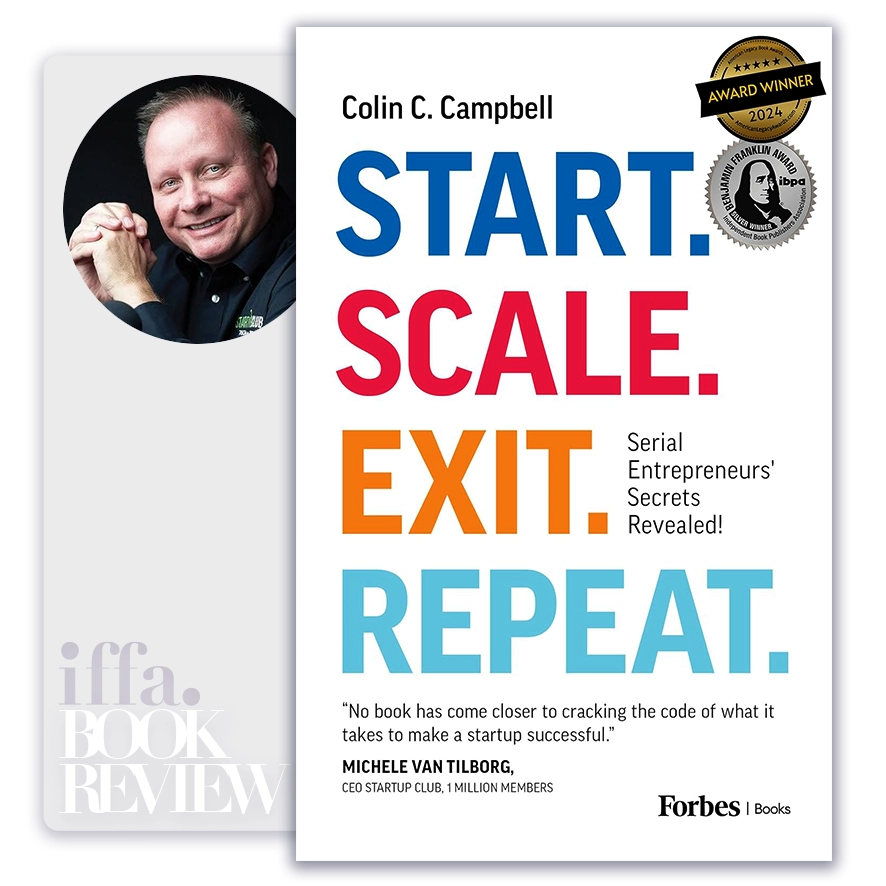
by Colin C. Campbell
Summary Overview:
Entrepreneurship is often portrayed as a singular heroic journey, defined by passion, hustle, and perseverance. Start. Scale. Exit. Repeat. remains relevant because it dismantles that mythology and replaces it with a repeatable, capital-aware system for building companies with intent. Rather than treating exits as accidental outcomes or emotional endings, the book reframes entrepreneurship as a cycle of value creation, harvesting, and reinvestment. For senior executives, founders, board members, and investors, its relevance lies in clarifying how disciplined exits, not just successful starts, determine long-term wealth, resilience, and strategic freedom. It is a book about entrepreneurship as infrastructure, not identity.
About The Author
Colin C. Campbell is a serial entrepreneur, investor, and ecosystem builder with direct experience in founding, scaling, and exiting multiple ventures across industries. His credibility stems from repeated exposure to the full business lifecycle rather than a single success story.
What distinguishes Campbell’s perspective is his portfolio mindset. He writes not as a motivational figure, but as a practitioner who understands entrepreneurship as capital allocation over time, shaped by judgment, timing, and governance discipline rather than emotional attachment.
Core Idea:
The core idea of Start. Scale. Exit. Repeat. is that entrepreneurship should be designed as a repeatable system, not a one-off personal crusade. The most successful entrepreneurs do not merely build companies; they build, exit, and redeploy capital and experience intentionally, improving judgment with each cycle.
Campbell reframes exits as strategic objectives, not events to be improvised under pressure. Companies should be started with clarity about how value will ultimately be realized, for whom, and under what conditions. Entrepreneurs who fail to design for exit often trap themselves inside businesses that may be operationally successful but strategically illiquid.
Entrepreneurship creates freedom only when exits are intentional, not accidental.
Key Concepts:
- Entrepreneurship as a Repeatable Cycle
The book challenges the notion of the “once-in-a-lifetime” startup. True entrepreneurial leverage comes from compounding experience and capital across multiple ventures, not maximizing emotional attachment to one. - Start With the End in Mind
Exit planning is not pessimism; it is discipline. Founders who define exit pathways early make clearer strategic decisions about markets, customers, governance, and scalability. - Value Creation Versus Lifestyle Comfort
Many businesses generate income without creating transferable value. Campbell distinguishes between operational success and enterprise value, a critical distinction for long-term wealth. - Scaling as a Governance Challenge
Growth exposes weak systems, unclear roles, and founder bottlenecks. Scaling succeeds when decision rights, processes, and leadership layers evolve deliberately, not organically. - The Founder as Architect, Not Operator
Founders who cling to daily operations limit scalability and exit potential. Campbell emphasizes the transition from doer to designer, where leadership focuses on structure, talent, and alignment. - Exit Types and Strategic Fit
Not all exits are acquisitions. Trade sales, management buyouts, private equity, and strategic partnerships each reward different business architectures. Clarity determines preparedness. - Timing and Market Cycles
Exits are influenced by external conditions as much as internal performance. Entrepreneurs who understand market timing and buyer psychology preserve optionality and negotiating leverage. - Emotional Discipline and Detachment
Attachment clouds judgment. Campbell highlights how emotional over-identification with a business leads to missed exits, poor negotiations, and regretful outcomes. - Capital Recycling and Optionality
Exiting well is not an end; it is the beginning of the next cycle. Capital, credibility, and insight gained from exits enable faster, smarter subsequent ventures. - Building an Entrepreneurial Portfolio
Over time, serial entrepreneurs think in portfolios rather than projects. Risk is diversified, learning compounds, and failure becomes informative rather than fatal.
Founders who plan only to start often forget to plan how to finish well.
Executive Insights:
Start. Scale. Exit. Repeat. reframes entrepreneurship as long-term strategic capital management, not a romantic pursuit. Organizations and founders with similar talent diverge sharply based on whether they treat exit planning as taboo or as a core design constraint.
For boards, investors, and senior leadership, the book highlights how founder psychology directly affects governance quality, scalability, and realizable value.
- Exit clarity improves strategic discipline
- Founder detachment increases enterprise value
- Governance readiness determines buyer confidence
- Timing often outweighs absolute performance
- Repeatability compounds entrepreneurial advantage
Actionable Takeaways:
Senior leaders and founders should translate these insights into strategic posture and system design:
- Reframe exit planning as responsible leadership, not loss of commitment
- Design businesses for transferability, not founder dependence
- Stop equating activity with value creation
- Build governance and management depth early
- Treat entrepreneurship as a repeatable capital cycle, not a singular identity
Final Thoughts:
Start. Scale. Exit. Repeat. is ultimately a book about maturity in entrepreneurship. It replaces mythology with method and emotion with intent. Campbell’s message is neither cynical nor romantic; it is pragmatic and empowering.
The book’s enduring value lies in reminding founders that success is not measured by how long you stay, but by how well you leave. Exits done thoughtfully create freedom, resilience, and the ability to contribute again at a higher level.
The closing insight is clear and enduring: long-term entrepreneurial success belongs not to those who cling hardest to their first creation, but to those who design, release, and redeploy value with judgment, discipline, and perspective.
The ideas in this book go beyond theory, offering practical insights that shape real careers, leadership paths, and professional decisions. At IFFA, these principles are translated into executive courses, professional certifications, and curated learning events aligned with today’s industries and tomorrow’s demands. Discover more in our Courses.
Applied Programs

- Course Code : SBM-409
- Delivery : In-class / Virtual / Workshop
- Duration : 2-4 Days
- Venue: DUBAI HUB

- Course Code : PMA-613
- Delivery : In-class / Virtual / Workshop
- Duration : 3-5 Days
- Venue: DUBAI HUB

- Course Code : CIF-505
- Delivery : In-class / Virtual / Workshop
- Duration : 3-5 Days
- Venue: DUBAI HUB

- Course Code : CIF-512
- Delivery : In-class / Virtual / Workshop
- Duration : 2-4 Days
- Venue: DUBAI HUB
Related Books