
The Executive Summary of
Management Lessons from Taiichi Ohno
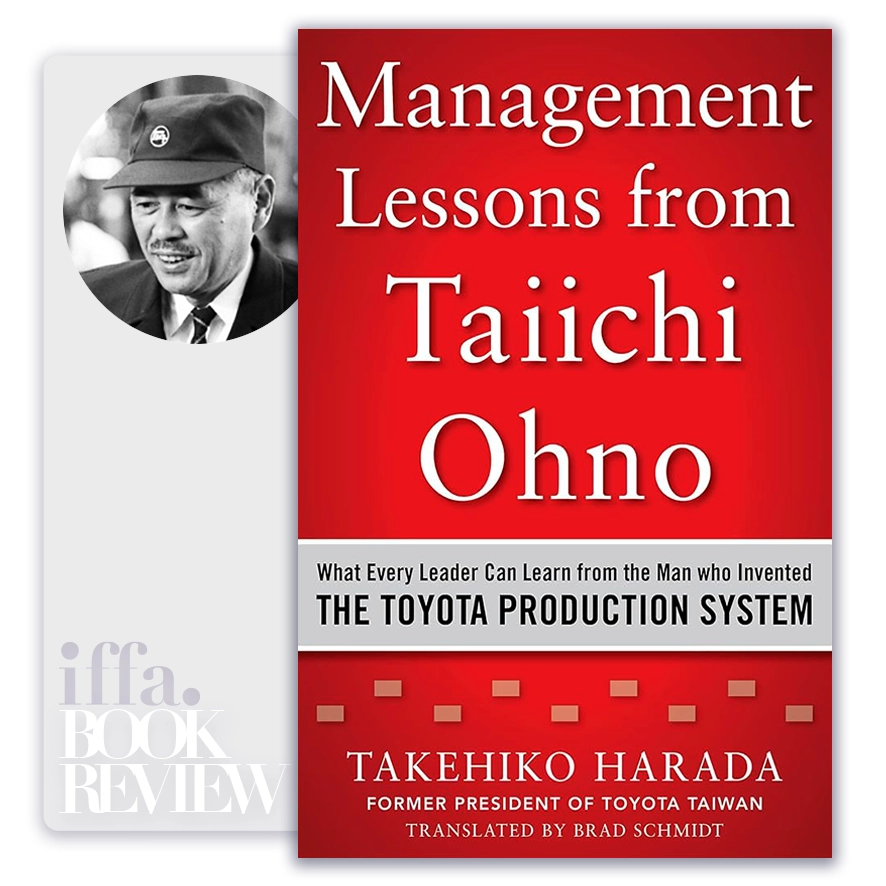
by Takehiko Harada
Summary Overview:
Management Lessons from Taiichi Ohno shifts attention from tools and techniques to something far more consequential: the managerial thinking that made the Toyota Production System possible. While many organizations adopt Lean methods, few internalize the leadership discipline that sustains them. Takehiko Harada’s work matters because it clarifies that Ohno’s legacy was not a set of operational practices, but a way of seeing problems, people, and systems.
For CEOs, board members, COOs, and senior executives, this book is essential because it exposes why most operational transformations fail. They copy mechanisms without changing managerial behavior. Harada shows that Ohno’s approach demanded personal involvement, intolerance for illusion, and relentless attention to reality at the source. In a world of dashboards, abstractions, and delegated accountability, these lessons are increasingly rare—and increasingly valuable.
About The Author
Takehiko Harada is a respected scholar and practitioner of Toyota-style management, known for interpreting Taiichi Ohno’s philosophy for modern leaders. His work focuses on the behavioral and managerial foundations of operational excellence.
Harada’s authority comes from proximity to Toyota thinking and long-term observation. Rather than translating Ohno into simplified Lean doctrine, he preserves the rigor, discomfort, and discipline that defined Ohno’s management style.
Core Idea:
The central thesis of Management Lessons from Taiichi Ohno is that management quality determines system quality. Harada argues that Taiichi Ohno’s true contribution was not process optimization, but a leadership model that forced reality to surface and required managers to think deeply before acting.
At a deeper level, the book presents a worldview in which management exists to design learning systems, not to issue instructions or monitor results from a distance. Ohno believed that managers who avoid the workplace, rely on reports, or soften standards create waste by default. Real efficiency emerges only when leaders accept discomfort, expose problems early, and develop people as thinkers.
Ohno did not build systems to make work easier—he built systems that made problems impossible to ignore.
Key Concepts:
- Management Exists to Reveal Problems
Ohno viewed problems as assets, not failures.
- Hidden problems cannot be solved.
- Managers must design systems that surface issues immediately.
- Go and See Is a Leadership Obligation
Decisions must be grounded in direct observation.
- Reports filter reality.
- Firsthand understanding sharpens judgment.
- Standards Are Tools for Thinking
Standards exist to enable improvement, not enforce compliance.
- Without standards, learning collapses.
- Deviation is a signal, not a crime.
- Overproduction Reflects Managerial Weakness
Producing excess masks planning and leadership failures.
- Overproduction hides inefficiency.
- Discipline begins with restraint.
- People Are Developed Through Challenge
Ohno deliberately placed pressure on managers and teams.
- Comfort prevents growth.
- Capability emerges through responsibility.
- Management Must Resist Illusion
Metrics and averages can deceive.
- Local optimization distorts system health.
- Leaders must question apparent success.
- Waste Is Created by Decisions, Not Workers
Ohno rejected blaming frontline employees.
- Management designs the conditions.
- Systems shape behavior.
- Learning Speed Is Competitive Advantage
Organizations improve by shortening feedback loops.
- Fast learning beats large scale.
- Delay compounds waste.
- Authority Comes With Accountability
Ohno demanded personal ownership of outcomes.
- Delegated blame weakens leadership.
- Responsibility cannot be outsourced.
- Improvement Has No Finish Line
Ohno resisted declaring success.
- Complacency is the final waste.
- Continuous questioning sustains excellence.
Management failure begins the moment leaders stop seeing reality for themselves.
Executive Insights:
Harada’s interpretation makes clear that Taiichi Ohno’s management philosophy is deeply uncomfortable for traditional leadership cultures. It demands humility, presence, and intellectual effort from managers—qualities often replaced by reporting layers and performance theater. Organizations that struggle with Lean are usually suffering from managerial distance, not technical complexity.
For boards and senior leadership teams, the implication is decisive: operational excellence is inseparable from leadership behavior. Systems reflect how leaders think, what they tolerate, and what they personally inspect. Without changing management habits, no transformation will endure.
- Leadership behavior shapes system outcomes.
- Transparency outperforms control.
- Learning speed defines resilience.
- Accountability must be personal.
- Long-term performance depends on managerial discipline.
Actionable Takeaways:
Sustainable excellence begins with leadership conduct.
- Design systems that expose problems early.
- Require managers to observe work directly.
- Treat standards as learning tools, not enforcement tools.
- Eliminate buffers that hide inefficiency.
- Develop people by increasing responsibility, not comfort.
Final Thoughts:
Management Lessons from Taiichi Ohno is a reminder that great systems are built by demanding leaders, not permissive ones. Harada shows that Ohno’s genius lay in his refusal to accept surface-level success or delegated understanding. His management philosophy was austere, rigorous, and profoundly human—because it treated people as thinkers capable of growth.
For executives entrusted with long-term stewardship, the book offers a lasting insight: organizations do not improve because leaders want change—they improve because leaders change how they see and act. Management, at its best, is not supervision—it is education through reality.
In the long run, the strongest organizations are those led by managers who refuse to look away from the truth.
The ideas in this book go beyond theory, offering practical insights that shape real careers, leadership paths, and professional decisions. At IFFA, these principles are translated into executive courses, professional certifications, and curated learning events aligned with today’s industries and tomorrow’s demands. Discover more in our Courses.
Applied Programs

- Course Code : SBM-409
- Delivery : In-class / Virtual / Workshop
- Duration : 2-4 Days
- Venue: DUBAI HUB

- Course Code : PMA-613
- Delivery : In-class / Virtual / Workshop
- Duration : 3-5 Days
- Venue: DUBAI HUB

- Course Code : CIF-505
- Delivery : In-class / Virtual / Workshop
- Duration : 3-5 Days
- Venue: DUBAI HUB

- Course Code : CIF-512
- Delivery : In-class / Virtual / Workshop
- Duration : 2-4 Days
- Venue: DUBAI HUB
Related Books