
The Executive Summary of
Lean Solutions
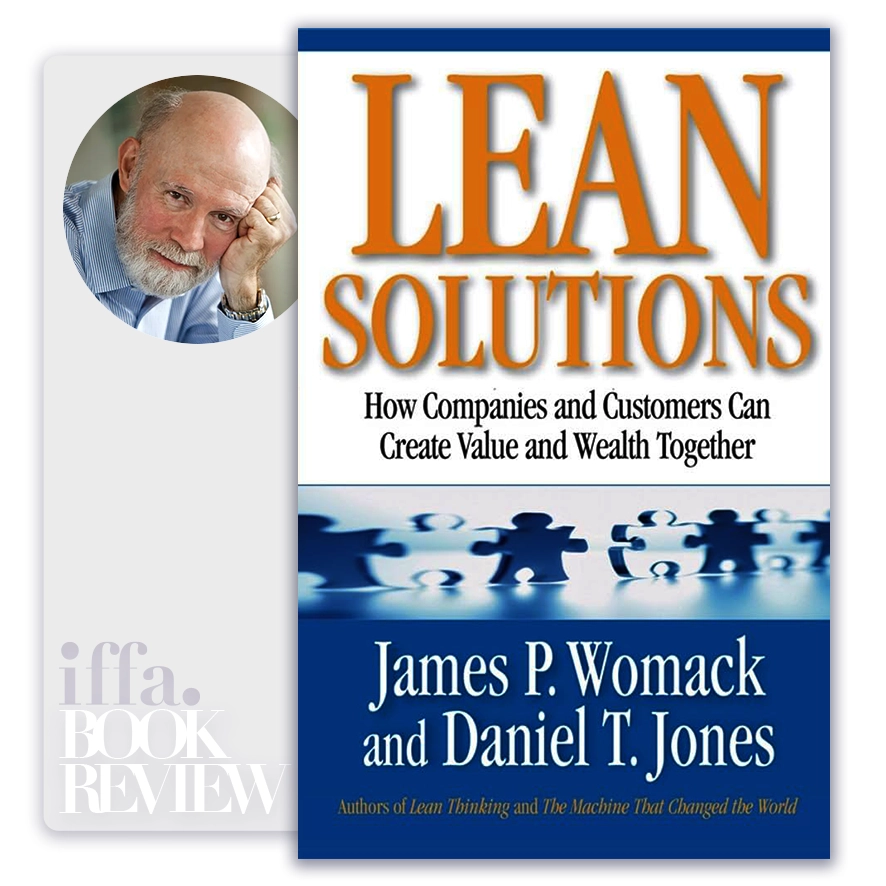
by James P. Womack
Summary Overview:
Lean Solutions shifts the focus of efficiency from inside the organization to the experience of the customer. While many improvement efforts succeed in reducing internal costs, they often do so by exporting complexity, delay, and frustration downstream. This book challenges that logic, arguing that the largest untapped gains in modern economies lie in eliminating the waste customers are forced to absorb.
James P. Womack and Daniel T. Jones reframe Lean as a system-level, customer-facing discipline, especially relevant in service-driven, interconnected markets. For executives, platform leaders, and policymakers, the book offers a powerful lens on how value is truly created—not through transactions, but through solving customer problems end to end. By showing how producers can absorb variability, simplify interactions, and redesign value streams across organizational boundaries, Lean Solutions provides a durable framework for reducing total system cost while increasing trust, loyalty, and long-term competitiveness.
About The Author
James P. Womack is a leading authority on Lean thinking and co-founder of the Lean Enterprise Institute, widely known for shaping global understanding of Lean beyond manufacturing. Daniel T. Jones is a respected researcher and consultant who helped articulate Lean as a system-level philosophy rather than a set of factory practices.
Their distinctive contribution in this book is extending Lean thinking into customer experience, service systems, and cross-organizational value streams, demonstrating that waste is often mutual—and solvable only through collaboration.
Core Idea:
The core idea of Lean Solutions is that true efficiency is achieved by eliminating waste across the entire value stream, including the customer’s time, effort, and frustration. Traditional business models optimize producer efficiency while shifting complexity onto customers—forcing them to navigate confusing choices, fill out redundant information, wait unnecessarily, or correct errors.
Womack and Jones argue that this model is fundamentally flawed. Lean solutions require producers to take responsibility for solving customer problems end to end, even when those problems span multiple organizations or touchpoints. When producers absorb complexity instead of exporting it, total system cost falls and value rises for everyone involved.
The greatest waste in modern economies is the waste we force customers to absorb.
Key Concepts:
- Value Is Defined by the Customer’s Problem
Lean solutions begin by understanding what the customer is actually trying to accomplish—not what the organization is structured to deliver. At executive level, this shifts strategy from product-centric to problem-centric value creation. - Waste Extends Beyond the Factory
Waiting, confusion, rework, and unnecessary choice are forms of waste experienced by customers daily. Strategically, this expands Lean from internal optimization to market-facing differentiation.
- Time wasted navigating systems
- Errors corrected by customers
- Complexity disguised as choice
- Complexity Is Often a Producer Convenience
Organizations add complexity to protect internal silos or legacy processes. Customers pay the price. Leaders who confront this reality unlock disproportionate improvement.
- Internal efficiency ≠ customer efficiency
- Silo optimization increases system cost
- Simplicity is a strategic choice
- Solutions Replace Transactions
Rather than selling products or services as isolated transactions, Lean solutions bundle activities to solve complete problems.
- Outcomes over offerings
- Responsibility over handoffs
- Continuity over fragmentation
This perspective is critical for service industries, platforms, and B2B ecosystems.
- Producers Must Absorb Variability
Customers vary; processes should not punish them for it. Lean solutions design flexibility into systems so customers do not have to compensate for rigidity.
- Variability is natural
- Design absorbs variation
- Blame shifts to systems
- Transparency Reduces Friction
Clear processes, predictable outcomes, and visible status reduce anxiety and wasted effort. Transparency is a cost-reduction mechanism, not just a trust signal. - Cross-Organizational Value Streams Matter
Many customer problems span multiple firms. Lean solutions require collaboration across suppliers, partners, and regulators.
- End-to-end thinking beats local optimization
- Shared incentives reduce friction
- Coordination lowers total cost
- Pull Systems Apply to Services Too
Demand-driven flow is not limited to manufacturing. Services improve when they respond to real demand rather than forecasts or batch logic.
- Pull reduces waiting
- Flow improves experience
- Responsiveness builds trust
- Standardization Enables Customization
Counterintuitively, standard processes make customization easier by removing unnecessary variation.
- Standards reduce error
- Flexibility becomes intentional
- Personalization improves quality
- Lean Is a Moral as Well as Economic Choice
The authors make an implicit ethical argument: wasting people’s time is not just inefficient—it is disrespectful. Leaders shape whether organizations honor or consume customer attention.
Lean succeeds when producers solve problems instead of shifting them downstream.
Executive Insights:
Lean Solutions reframes Lean as a strategic design philosophy for modern economies, not a cost-cutting program. Its insights explain why many efficiency initiatives fail to improve customer satisfaction: they optimize the firm while externalizing pain.
For executives and boards, the book highlights a powerful but demanding shift—own the customer’s problem completely or risk being replaced by those who will. Digital-native competitors often win not through superior technology, but by removing friction others accept as normal.
The book also underscores that customer-centricity is not a slogan. It requires redesigning incentives, metrics, and accountability around total value-stream performance.
Actionable Takeaways:
The book offers durable principles for leaders across sectors.
- Define value from the customer’s perspective
- Identify waste the customer experiences
- Absorb complexity instead of exporting it
- Design solutions, not transactions
- Optimize end-to-end value streams
- Use transparency to reduce friction
- Treat customer time as a scarce resource
Final Thoughts:
Lean Solutions is ultimately a book about respect—for customers, for time, and for system integrity. Womack and Jones show that the next frontier of efficiency lies not inside the organization, but in the experience it creates for others.
The enduring insight of the book is clear: organizations that make life easier for customers inevitably make their own systems stronger. Leaders who embrace this principle move beyond cost reduction toward a deeper, more sustainable form of competitive advantage—one built on clarity, responsibility, and trust.
The ideas in this book go beyond theory, offering practical insights that shape real careers, leadership paths, and professional decisions. At IFFA, these principles are translated into executive courses, professional certifications, and curated learning events aligned with today’s industries and tomorrow’s demands. Discover more in our Courses.
Applied Programs

- Course Code : SBM-409
- Delivery : In-class / Virtual / Workshop
- Duration : 2-4 Days
- Venue: DUBAI HUB
- Course Code : PMA-613
- Delivery : In-class / Virtual / Workshop
- Duration : 3-5 Days
- Venue: DUBAI HUB

- Course Code : CIF-505
- Delivery : In-class / Virtual / Workshop
- Duration : 3-5 Days
- Venue: DUBAI HUB

- Course Code : CIF-512
- Delivery : In-class / Virtual / Workshop
- Duration : 2-4 Days
- Venue: DUBAI HUB
Related Books