
The Executive Summary of
Kaizen Mastery
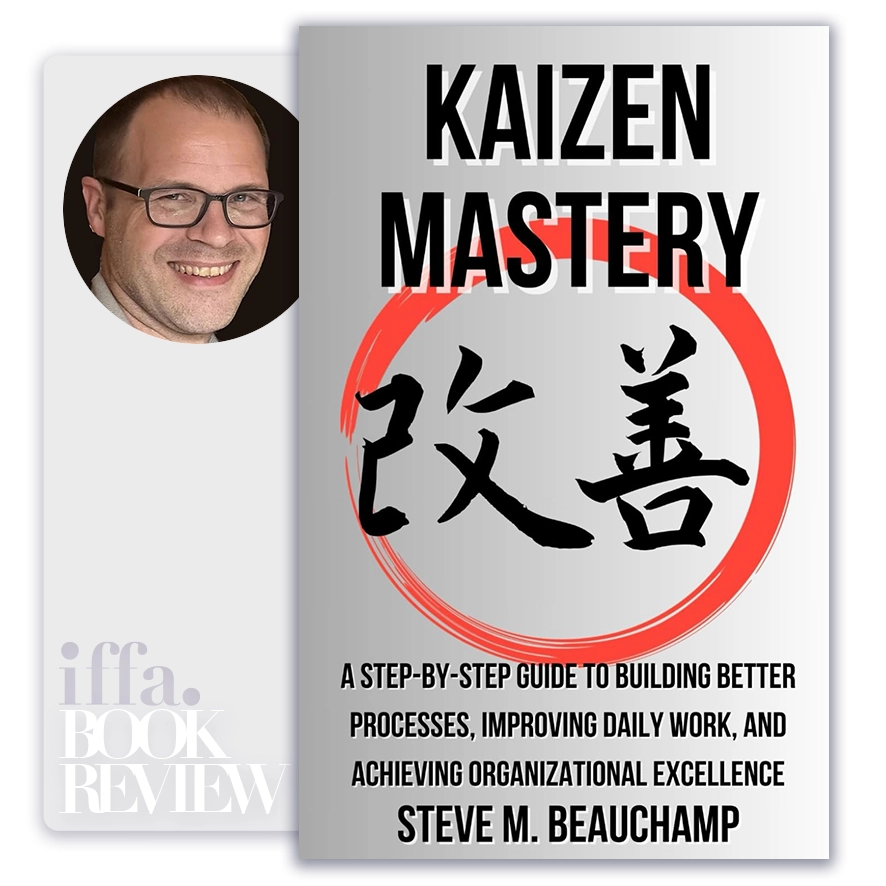
by Steve M. Beauchamp
Summary Overview:
Continuous improvement is often celebrated rhetorically and practiced inconsistently. Kaizen Mastery remains relevant because it clarifies why most improvement efforts fail at the system level, not the tool level. In organizations facing margin pressure, operational complexity, and cultural fatigue, the book reframes Kaizen as a leadership discipline that compounds over time, rather than a workshop-driven initiative. For senior executives and board members, its value lies in showing how small, governed improvements create durable strategic advantage, while unmanaged change programs quietly erode credibility and trust.
About The Author
Steve M. Beauchamp is a practitioner and advisor focused on continuous improvement, operational excellence, and process design across complex organizations. His work is grounded in hands-on implementation rather than abstract methodology.
What distinguishes Beauchamp’s perspective is his emphasis on behavioral systems and leadership ownership. He approaches Kaizen not as a Japanese artifact or a set of tools, but as a management capability that must be deliberately designed, reinforced, and protected.
Core Idea:
The core idea of Kaizen Mastery is that sustainable improvement is a management system, not an event. Organizations do not improve because they introduce Lean tools; they improve because leaders establish clear problem-definition norms, disciplined feedback loops, and psychological safety for incremental change.
Beauchamp presents Kaizen as a governance framework for learning. Improvement emerges when leadership creates structures that encourage observation, experimentation, and reflection at every level. Executives who treat Kaizen as delegation misunderstand its power; improvement only compounds when leadership models restraint, curiosity, and consistency.
Improvement compounds only when leadership protects the process, not the pace.
Key Concepts:
- Kaizen as a Leadership System
Kaizen succeeds when leaders own it personally. Delegation without visible leadership commitment reduces improvement to temporary compliance. - Process Thinking Over Outcome Fixation
Focusing on outcomes alone drives firefighting. Beauchamp emphasizes process literacy as the foundation of durable performance. - Small Changes, Large Compounding Effects
Incremental improvements outperform transformational initiatives over time. Compounding depends on consistency, not scale. - Psychological Safety as Infrastructure
Improvement requires people to surface problems without fear. Safety is not cultural rhetoric; it is reinforced by leadership response to bad news. - Standardization as a Platform for Change
Standards do not prevent innovation; they enable it. Without standards, improvement efforts lack baseline reference points. - Visual Management and Transparency
Visibility accelerates learning. Making work observable creates shared understanding and accountability without bureaucracy. - Problem Framing Before Problem Solving
Most failures stem from poorly framed problems. Leaders must slow down to define reality accurately before acting. - Managerial Patience and Tempo Control
Pushing speed destroys learning. Effective leaders control tempo, ensuring depth precedes breadth in improvement efforts. - Avoiding Tool-Centric Kaizen
Tools are secondary. Organizations that fetishize methods lose sight of behavioral change and system design. - Institutionalizing Continuous Learning
Kaizen endures when learning is embedded into routines, reviews, and incentives. Without institutionalization, improvement reverts under pressure.
Kaizen fails when results are demanded before learning is allowed.
Executive Insights:
Kaizen Mastery makes clear that continuous improvement is a test of leadership maturity. Organizations with similar talent and resources diverge sharply based on how leaders design learning, respond to failure, and govern attention.
For boards and senior executives, Kaizen is not an operational program but a strategic capability that determines adaptability under uncertainty.
- Improvement reflects leadership behavior, not workforce effort
- Systems outlast initiatives
- Patience enables compounding advantage
- Learning speed depends on psychological safety
- Governance determines sustainability
Actionable Takeaways:
Senior leaders should translate Kaizen into executive-level behavior and systems:
- Reframe improvement as a leadership responsibility, not a delegated function
- Stop demanding results before learning stabilizes
- Embed process thinking into reviews and decision-making
- Protect psychological safety as strategic infrastructure
- Reward consistency and learning, not heroics
Final Thoughts:
Kaizen Mastery is ultimately a book about how organizations learn without exhausting themselves. It strips Kaizen of mythology and restores it as a disciplined, humane, and strategically potent way of working.
Its enduring contribution lies in reminding leaders that improvement is not acceleration; it is alignment. When leadership governs pace, behavior, and attention, small changes accumulate into structural advantage.
The closing insight is calm and demanding: long-term excellence is built not through dramatic change, but through leadership systems that make thoughtful improvement inevitable, repeatable, and trusted.
The ideas in this book go beyond theory, offering practical insights that shape real careers, leadership paths, and professional decisions. At IFFA, these principles are translated into executive courses, professional certifications, and curated learning events aligned with today’s industries and tomorrow’s demands. Discover more in our Courses.
Applied Programs

- Course Code : SBM-409
- Delivery : In-class / Virtual / Workshop
- Duration : 2-4 Days
- Venue: DUBAI HUB

- Course Code : PMA-613
- Delivery : In-class / Virtual / Workshop
- Duration : 3-5 Days
- Venue: DUBAI HUB

- Course Code : CIF-505
- Delivery : In-class / Virtual / Workshop
- Duration : 3-5 Days
- Venue: DUBAI HUB

- Course Code : CIF-512
- Delivery : In-class / Virtual / Workshop
- Duration : 2-4 Days
- Venue: DUBAI HUB
Related Books