

The Executive Summary of
The Box
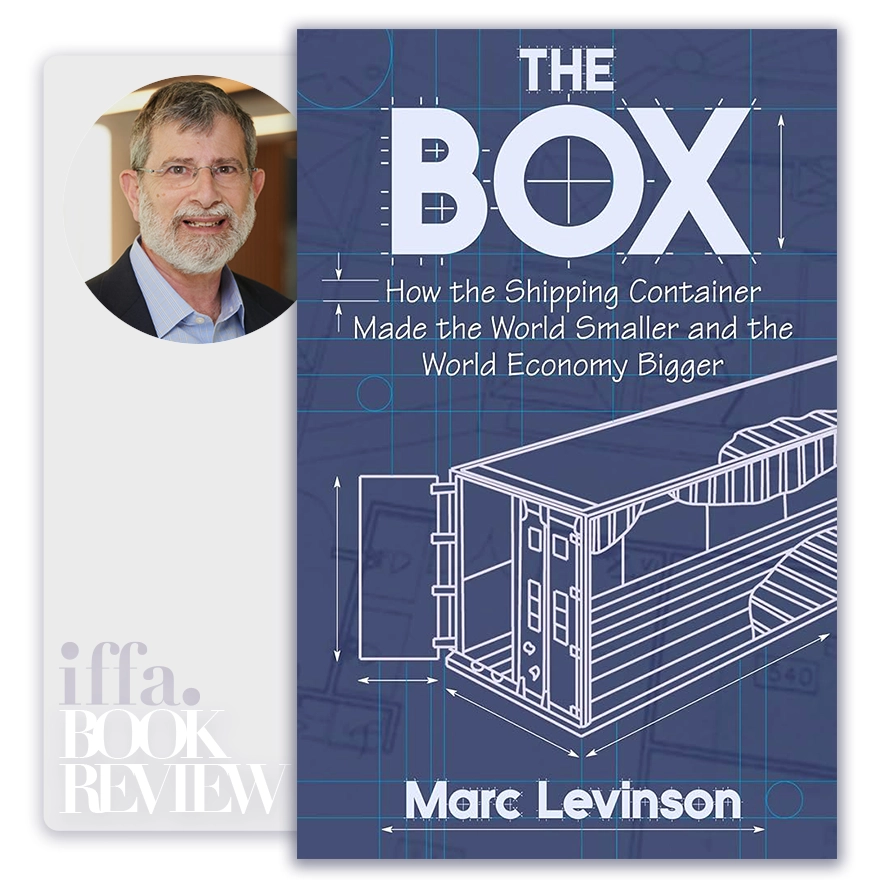
by Marc Levinson
Summary Overview:
Most revolutions that reshape the global economy are invisible while they are happening. The Box tells the story of one such revolution—the standardized shipping container—and shows how a simple, unglamorous innovation quietly rewired global trade, manufacturing, labor, geopolitics, and supply chains. Without the container, globalization as we know it would not exist.
This book matters because today’s leaders operate in a world of just-in-time supply chains, offshore manufacturing, global sourcing, and hyper-efficient logistics, often without understanding the foundational system that made all of this possible. Marc Levinson demonstrates that the container did not merely reduce shipping costs—it restructured entire industries, displaced cities, reshaped ports, weakened labor power, and shifted economic gravity across continents. For executives, policymakers, and strategists, The Box is a masterclass in how infrastructure innovation creates irreversible economic change.
About The Author
Marc Levinson is an economist and journalist specializing in economic history, globalization, and transportation. His work focuses on the structural forces that shape trade and productivity, rather than headline events.
Levinson’s authority comes from his ability to connect technical innovation with economic consequence, showing how mundane operational changes can trigger global transformation far beyond their original intent.
Core Idea:
The central thesis of The Box is clear and powerful:
The shipping container was the critical enabler of modern globalization, not trade agreements, finance, or technology alone.
Before containers, global trade was:
- Slow
- Labor-intensive
- Expensive
- Unreliable
By standardizing cargo into sealed, stackable boxes, containerization:
- Slashed transport costs
- Reduced theft and damage
- Accelerated shipping speed
- Enabled large-scale manufacturing relocation
The container turned shipping from a bottleneck into a strategic advantage, allowing companies to redesign production around global efficiency.
The real innovation was not the container, it was the system that made it universal.
Key Concepts:
- Before the Container: Trade Was Inefficient and Costly
Prior to containerization, cargo was handled as break-bulk:
- Goods were packed, unpacked, and repacked at every port
- Ships sat idle for days or weeks
- Dock labor was powerful, slow, and expensive
- Damage and theft were routine
Shipping costs often exceeded production costs, making long-distance trade economically unattractive.
High transport costs protected local manufacturing more effectively than tariffs ever could.
- The Container as a System, Not a Box
Levinson emphasizes that the container’s power came not from the steel box itself, but from the system built around it:
- Standard sizes
- Specialized ships
- Gantry cranes
- Container yards
- Intermodal rail and truck networks
Containerization required end-to-end redesign of ports, ships, roads, railways, and operations.
The real innovation was not the container—it was the system that made it universal.
- Malcolm McLean and Entrepreneurial Persistence
The container revolution is closely associated with Malcolm McLean, a trucking entrepreneur who saw inefficiency others accepted as normal.
McLean faced:
- Industry resistance
- Regulatory barriers
- Labor opposition
- Massive capital requirements
Yet his persistence demonstrates a key strategic lesson: transformational innovation often looks uneconomic, impractical, or disruptive—until it works.
- Ports Were Winners and Losers
Containerization radically reshaped geography:
- Traditional urban ports declined
- New deep-water ports emerged
- Massive land requirements displaced waterfront cities
- Ports moved away from city centers
Cities that adapted thrived; those that resisted declined.
Infrastructure innovation redistributes economic power, not evenly—but decisively.
- Labor Displacement and Productivity Shock
The container dramatically reduced the need for dock labor:
- Thousands of jobs disappeared
- Powerful unions lost leverage
- Productivity soared
This shift illustrates a recurring economic pattern:
Efficiency gains create wealth—but not necessarily shared prosperity.
The book highlights how logistics innovation can outpace social and political adaptation.
- Manufacturing Goes Global
Once shipping became cheap and reliable:
- Factories no longer needed to be near markets
- Production shifted to low-cost regions
- Supply chains fragmented across countries
This enabled:
- The rise of East Asian manufacturing
- Decline of Western industrial centers
- Birth of global value chains
The container made distance economically irrelevant.
- Inventory, Speed, and Just-in-Time Production
Containerization reduced uncertainty:
- Transit times became predictable
- Damage rates fell
- Insurance costs dropped
This allowed firms to:
- Reduce inventory
- Adopt just-in-time manufacturing
- Increase capital efficiency
Logistics became a strategic discipline, not an operational afterthought.
- Standardization as Competitive Advantage
The success of containerization depended on global standards:
- Uniform dimensions
- Interoperability across modes
- International agreements
Standardization:
- Lowered coordination costs
- Enabled scale
- Reduced friction
Standards beat customization when scale is the objective.
- Hidden Fragility of Hyper-Efficiency
Levinson also hints at a critical vulnerability:
- Highly optimized supply chains are fragile
- Disruption at one node cascades globally
- Efficiency trades off with resilience
This insight has become increasingly relevant in:
- Pandemic disruptions
- Geopolitical conflicts
- Port congestion
- Climate shocks
The same system that enables efficiency also amplifies disruption.
- Globalization Without Visibility
Perhaps the most striking lesson of The Box is that one of the most consequential economic revolutions happened almost unnoticed.
No grand speeches.
No ideological debates.
Just steel boxes, cranes, and schedules.
This underscores a profound truth:
The future is often shaped by operational innovations, not strategic declarations.
The container made distance economically irrelevant.
Executive Insights:
The Box reframes globalization as an infrastructure-led phenomenon, not a policy-driven one.
Strategic Implications for Leaders and Policymakers:
- Infrastructure determines strategy
- Operational efficiency reshapes geopolitics
- Cost reduction can trigger systemic change
- Standardization enables scale
- Logistics is a source of competitive advantage
- Efficiency increases fragility
- Innovation redistributes power unevenly
Actionable Takeaways:
The lessons of The Box apply directly to supply chains, platforms, energy transition, and digital infrastructure.
Practical Actions for Executives and Strategists:
- Treat logistics as a strategic function
- Map infrastructure dependencies
- Balance efficiency with resilience
- Anticipate labor and social impacts of automation
- Invest in interoperability and standards
- Understand how cost changes reshape entire ecosystems
- Plan for second-order effects of innovation
- Design systems for disruption—not just optimization
Final Thoughts:
The Box is a reminder that the most powerful forces in the global economy are often the least visible. A simple steel container quietly reshaped how goods move, where factories operate, and how nations compete.
Marc Levinson shows that globalization was not inevitable—it was engineered, box by box, crane by crane, port by port.
The book’s enduring lesson is this:
If you want to understand the future of trade, power, and resilience, don’t just watch markets—watch infrastructure.
For modern leaders navigating supply-chain shocks, geopolitical risk, and sustainability transitions, The Box offers a timeless insight:
Those who control the flow of goods shape the flow of wealth.
The ideas in this book go beyond theory, offering practical insights that shape real careers, leadership paths, and professional decisions. At IFFA, these principles are translated into executive courses, professional certifications, and curated learning events aligned with today’s industries and tomorrow’s demands. Discover more in our Courses.
Applied Programs

- Course Code : SBM-409
- Delivery : In-class / Virtual / Workshop
- Duration : 2-4 Days
- Venue: DUBAI HUB
- Course Code : PMA-613
- Delivery : In-class / Virtual / Workshop
- Duration : 3-5 Days
- Venue: DUBAI HUB

- Course Code : CIF-505
- Delivery : In-class / Virtual / Workshop
- Duration : 3-5 Days
- Venue: DUBAI HUB

- Course Code : CIF-512
- Delivery : In-class / Virtual / Workshop
- Duration : 2-4 Days
- Venue: DUBAI HUB
Related Books