

The Executive Summary of
Economics of Sea Transport and International Trade
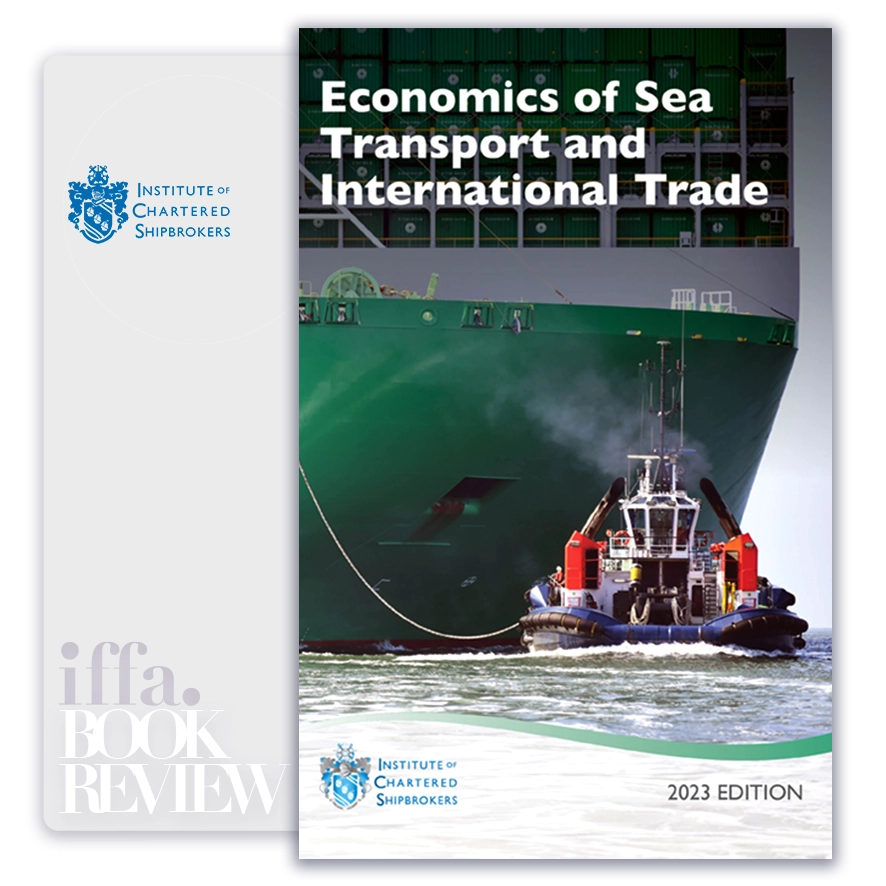
Institute of Chartered Shipbrokers (ICS)
Summary Overview:
Economics of Sea Transport and International Trade matters because it explains the economic logic that makes globalization possible. Nearly all internationally traded goods depend on sea transport to be commercially viable, yet the mechanisms that govern freight rates, shipping cycles, and transport costs are often misunderstood or oversimplified. This book provides a disciplined foundation for understanding how maritime economics connects ships, ports, commodities, and trade flows into a single global system.
In a period marked by freight volatility, port congestion, energy transition, geopolitical tension, and supply chain reconfiguration, shipping economics has moved from technical background knowledge to strategic leadership relevance. Decisions taken by shipowners, charterers, traders, financiers, port authorities, and policymakers all rely—explicitly or implicitly—on the economic principles explained in this work. The book clarifies why shipping markets behave unpredictably in the short term yet follow identifiable patterns over the long term.
For executives, investors, regulators, and maritime professionals, this text reframes sea transport as economic infrastructure rather than a transport service. It shows that shipping costs shape trade competitiveness, inflation transmission, industrial location, and even food and energy security. Understanding these dynamics is essential for long-term planning in an increasingly fragile global economy.
About The Institution
The Institute of Chartered Shipbrokers is a globally respected professional body dedicated to education and standards in shipping, chartering, and maritime economics. Its perspective is distinctive for combining practical industry experience with rigorous economic reasoning, making complex market dynamics accessible without losing analytical depth.
Core Idea:
The core idea of Economics of Sea Transport and International Trade is that shipping markets are the economic transmission mechanism between global production and consumption. Sea transport does not merely respond to trade; it conditions which trades occur, at what scale, and at what cost. Freight rates, vessel availability, and port efficiency directly influence comparative advantage and trade patterns.
The book emphasizes that shipping is a capital-intensive, cyclical, and globally competitive industry. Long asset lives, delayed capacity response, and volatile demand produce recurring boom-and-bust cycles. These cycles are not market failures but structural features of maritime economics. Understanding them is essential for sound decision-making.
Sea transport costs quietly determine the feasibility of global trade long before goods reach the market.
Key Concepts:
- Sea Transport as Derived Demand
Demand for shipping arises from demand for goods, not from shipping itself. Changes in consumption, industrial production, or trade policy are immediately transmitted to freight markets.
- Shipping follows trade, not the reverse
- Trade volatility amplifies freight volatility
- Forecasting trade is central to shipping strategy
- Cost Structure of Shipping
The book explains the dominance of fixed costs in shipping. Capital costs, crew, insurance, and maintenance are largely unavoidable, while marginal voyage costs are comparatively low.
- High fixed-cost base
- Utilization drives profitability
- Idle capacity destroys value
- Economies of Scale and Vessel Size
Larger vessels reduce unit transport cost but only when demand, port infrastructure, and network design support them. Scale delivers efficiency and fragility simultaneously.
- Scale lowers cost per tonne
- Infrastructure constraints limit benefits
- Overcapacity magnifies downturns
- Freight Rate Formation
Freight rates are market-clearing prices set by marginal supply and demand. Small imbalances lead to large price swings, explaining extreme volatility even in stable trade environments.
- Rates respond to marginal shifts
- Volatility is inherent
- Stability cannot be assumed
- Shipping Cycles and Investment Timing
Long construction lead times cause delayed supply response. Investment decisions made during strong markets often result in overcapacity during downturns.
- Asset lead times distort timing
- Herd behavior amplifies cycles
- Discipline matters more than optimism
- Tramp Shipping Versus Liner Trades
The book distinguishes between tramp markets, driven by spot demand and price discovery, and liner shipping, driven by service frequency and network reliability.
- Tramp markets price risk continuously
- Liner markets price service consistency
- Economic logic differs by segment
- Ports as Economic Bottlenecks
Ports are not neutral interfaces. Port charges, productivity, congestion, and governance materially affect total transport cost and trade competitiveness.
- Port inefficiency raises systemic cost
- Congestion disrupts supply chains
- Governance shapes performance
- Transport Costs and Comparative Advantage
Low sea transport costs expand global specialization. Rising costs or disruptions can rapidly reverse trade flows and encourage reshoring or regionalization.
- Transport cost shapes trade geography
- Distance becomes elastic
- Cost shocks reconfigure supply chains
- Regulation, Safety, and Environmental Economics
Regulatory requirements affect operating cost, capital expenditure, and competitive balance. Environmental regulation increasingly reshapes fleet economics and fuel strategy.
- Compliance alters cost structures
- Regulation redistributes advantage
- Policy risk is economic risk
- Shipping as Invisible Infrastructure
When shipping works, it is unnoticed. When it fails, economic consequences are immediate and widespread. This invisibility often leads to underinvestment and misaligned policy.
- Efficiency hides importance
- Failure reveals dependency
- Reliability has macroeconomic value
Shipping cycles are structural outcomes of capital intensity, not anomalies to be engineered away.
Executive Insights:
This book reframes maritime transport as macroeconomic infrastructure essential to trade stability and competitiveness. Its insights explain why shipping markets resist control, why volatility persists, and why policy interventions often produce unintended effects.
For leaders and policymakers, the book clarifies that shipping economics influence inflation, commodity pricing, industrial competitiveness, and national resilience. Misunderstanding freight markets leads to poor capital allocation, regulatory missteps, and fragile supply chains.
The text also underscores a strategic tension: while efficiency reduces cost, excessive efficiency without resilience increases systemic risk. Long-term advantage lies in balancing cost discipline with capacity flexibility and institutional strength.
Key strategic implications include:
- Freight volatility is structural, not exceptional
- Capacity decisions have long-term consequences
- Ports and shipping form an integrated cost system
- Regulation reshapes competitive dynamics
- Sea transport underpins national economic security
Actionable Takeaways:
The book provides enduring principles for maritime and trade leadership.
- Treat sea transport as strategic economic infrastructure
- Plan for cyclical volatility rather than average conditions
- Align port development with shipping economics
- Understand cost structures before setting policy or strategy
- Balance scale efficiency with systemic resilience
- Integrate environmental regulation into long-term planning
- Build institutional and analytical capability alongside assets
Final Thoughts:
Economics of Sea Transport and International Trade offers a rigorous explanation of how global trade actually functions beneath the surface. By grounding shipping activity in economic fundamentals, it replaces intuition and anecdote with structure and clarity.
The enduring insight of the book is decisive: global trade is only as stable as the economics of the ships, ports, and markets that carry it. Leaders who understand maritime economics gain more than operational knowledge—they gain strategic foresight into how cost, risk, and opportunity move across the world economy.
The ideas in this book go beyond theory, offering practical insights that shape real careers, leadership paths, and professional decisions. At IFFA, these principles are translated into executive courses, professional certifications, and curated learning events aligned with today’s industries and tomorrow’s demands. Discover more in our Courses.
Applied Programs

- Course Code : SBM-409
- Delivery : In-class / Virtual / Workshop
- Duration : 2-4 Days
- Venue: DUBAI HUB

- Course Code : PMA-613
- Delivery : In-class / Virtual / Workshop
- Duration : 3-5 Days
- Venue: DUBAI HUB

- Course Code : CIF-505
- Delivery : In-class / Virtual / Workshop
- Duration : 3-5 Days
- Venue: DUBAI HUB

- Course Code : CIF-512
- Delivery : In-class / Virtual / Workshop
- Duration : 2-4 Days
- Venue: DUBAI HUB
Related Books