
The Executive Summary of
How to Talk to AI
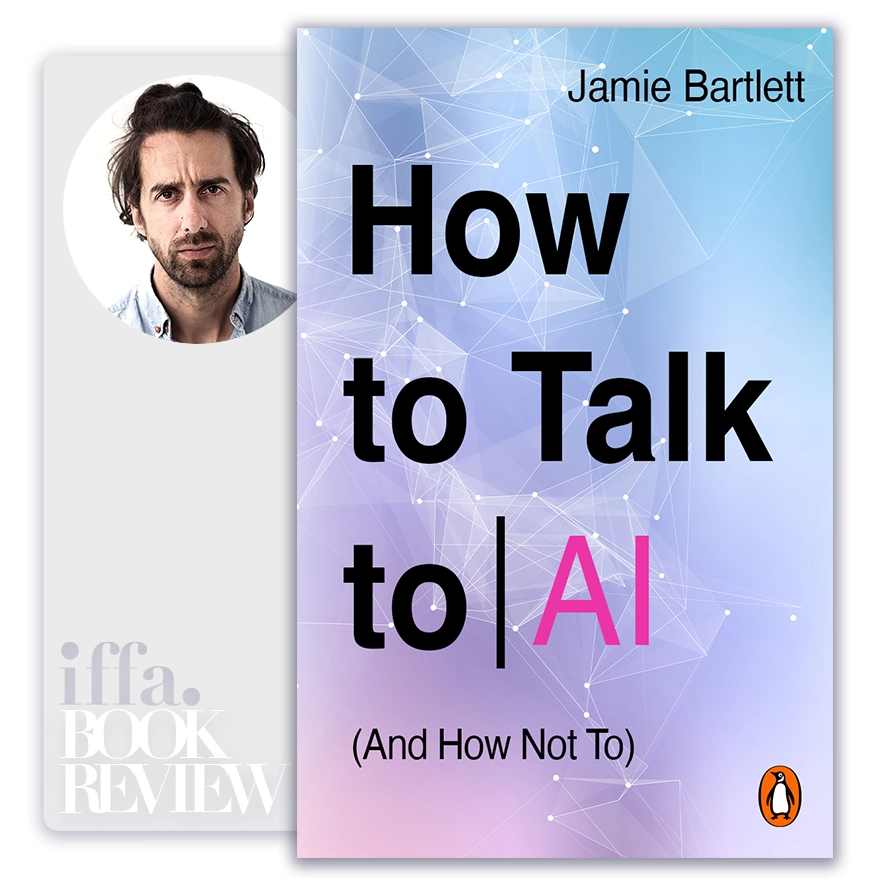
by Jamie Bartlett
Summary Overview:
How to Talk to AI matters because it addresses a subtle but critical failure in how societies engage with artificial intelligence: we increasingly interact with AI systems without understanding how to question them, interpret them, or challenge their outputs. As AI becomes conversational, persuasive, and embedded in everyday decisions, the risk is no longer only technical error—it is misplaced authority.
In workplaces, institutions, and public life, AI systems now summarize information, recommend actions, generate narratives, and simulate expertise. Bartlett argues that the most important skill is no longer coding or model building, but knowing how to communicate with AI systems intelligently and skeptically. Poor interaction leads to overreliance, misinterpretation, and subtle erosion of human judgment.
The book is especially relevant as AI tools are adopted faster than governance norms evolve. Leaders, professionals, and citizens are increasingly asked to “work with AI” without guidance on how to interrogate its assumptions, limitations, and incentives. How to Talk to AI provides a framework for engagement that treats AI neither as an oracle nor as a threat, but as a powerful system that requires informed dialogue and active oversight.
About The Author
Jamie Bartlett is a technology commentator known for examining the social and political consequences of digital systems. His perspective is distinctive for focusing on human behavior, power, and communication, rather than technical mechanics, making complex technologies accessible and governable.
Core Idea:
The core idea of How to Talk to AI is that AI systems shape outcomes through interaction, and the quality of those interactions depends on how well humans ask questions, set constraints, and interpret responses. AI does not simply deliver answers; it reflects data, design choices, and probabilistic patterns that must be actively navigated.
Bartlett reframes AI literacy as a conversational and critical skill. Knowing how to “talk to AI” means understanding what it can and cannot know, how it produces outputs, and where its confidence exceeds its competence. The book argues that human judgment remains essential, not despite AI’s capabilities, but because of them.
AI becomes dangerous not when it is powerful, but when it is treated as authoritative.
Key Concepts:
- AI as a Conversational System, Not an Expert Mind
Bartlett emphasizes that conversational AI creates an illusion of understanding. Fluency is mistaken for intelligence. Recognizing this distinction is essential to avoid granting AI unwarranted authority. - Questions Shape Outputs
AI responses depend heavily on how prompts are framed. Ambiguous, leading, or overly broad questions produce misleading results. Effective interaction requires precision, context, and constraint. - Confidence Is Not Accuracy
AI systems often present answers confidently even when uncertain or wrong. Bartlett highlights the danger of mistaking coherence for correctness, particularly in high-stakes contexts. - Hidden Assumptions and Biases
AI reflects the values, omissions, and biases present in its training data and design. Users who fail to probe these assumptions risk reinforcing distorted perspectives or unfair outcomes. - Delegation Versus Abdication
The book draws a sharp line between using AI as an assistant and surrendering responsibility. Delegation without oversight leads to abdication of judgment, accountability, and ethics. - AI as a Mirror of Human Systems
Rather than being alien intelligence, AI amplifies existing human structures—economic incentives, cultural biases, and institutional priorities. Understanding AI requires understanding ourselves. - Over-Automation of Thinking
Bartlett warns that constant reliance on AI for summarizing, deciding, or writing can erode cognitive skills. The risk is not replacement, but atrophy of independent reasoning. - Transparency Through Interrogation
Since many AI systems are opaque, users must create transparency through questioning: asking for sources, limitations, alternatives, and uncertainty ranges. - Power Dynamics in AI Interaction
Who designs AI systems, who controls access, and who sets defaults matters. Conversation is not neutral when one party controls the system’s structure and incentives. - The Need for New Literacy
Just as previous generations learned to read, write, and critically assess media, Bartlett argues that AI interaction literacy is now a core civic and professional skill.
The quality of human judgment increasingly depends on the quality of questions we ask machines.
Executive Insights:
How to Talk to AI reframes artificial intelligence as a communication challenge embedded within a governance challenge. Organizations that treat AI outputs as definitive risk embedding error, bias, and overconfidence into decision-making processes.
For leaders and institutions, the book suggests that AI capability without interpretive skill creates fragility. Systems become faster but less thoughtful, more efficient but less accountable. Strategic advantage lies in maintaining human judgment as the final authority, supported—but not replaced—by AI.
Key strategic implications include:
- AI fluency must include skepticism, not just usage
- Decision quality depends on interpretive discipline
- Overreliance on AI weakens accountability
- Question design is a strategic competence
- Human judgment becomes more valuable, not less
Actionable Takeaways:
The book offers simple, general principles for interacting responsibly with AI.
- Treat AI outputs as starting points, not conclusions
- Ask follow-up questions that probe assumptions and limits
- Request alternatives, counterarguments, and uncertainty
- Avoid delegating decisions without human review
- Separate fluency from expertise when evaluating responses
- Maintain independent thinking alongside AI assistance
- Build organizational norms for questioning AI outputs
Final Thoughts:
How to Talk to AI is ultimately a book about agency in an age of intelligent systems. It does not argue against AI adoption, nor does it glorify it. Instead, it insists that meaningful control lies in how humans engage with these tools—through curiosity, skepticism, and responsibility.
The enduring insight of the book is clear: AI will shape the future, but only to the extent that humans stop shaping the conversation. Those who learn to question AI thoughtfully will not only use it better—they will preserve judgment, accountability, and trust in a world increasingly mediated by machines.
The ideas in this book go beyond theory, offering practical insights that shape real careers, leadership paths, and professional decisions. At IFFA, these principles are translated into executive courses, professional certifications, and curated learning events aligned with today’s industries and tomorrow’s demands. Discover more in our Courses.
Applied Programs

- Course Code : SBM-409
- Delivery : In-class / Virtual / Workshop
- Duration : 2-4 Days
- Venue: DUBAI HUB

- Course Code : PMA-613
- Delivery : In-class / Virtual / Workshop
- Duration : 3-5 Days
- Venue: DUBAI HUB

- Course Code : CIF-505
- Delivery : In-class / Virtual / Workshop
- Duration : 3-5 Days
- Venue: DUBAI HUB

- Course Code : CIF-512
- Delivery : In-class / Virtual / Workshop
- Duration : 2-4 Days
- Venue: DUBAI HUB
Related Books