
The Executive Summary of
AI for Good
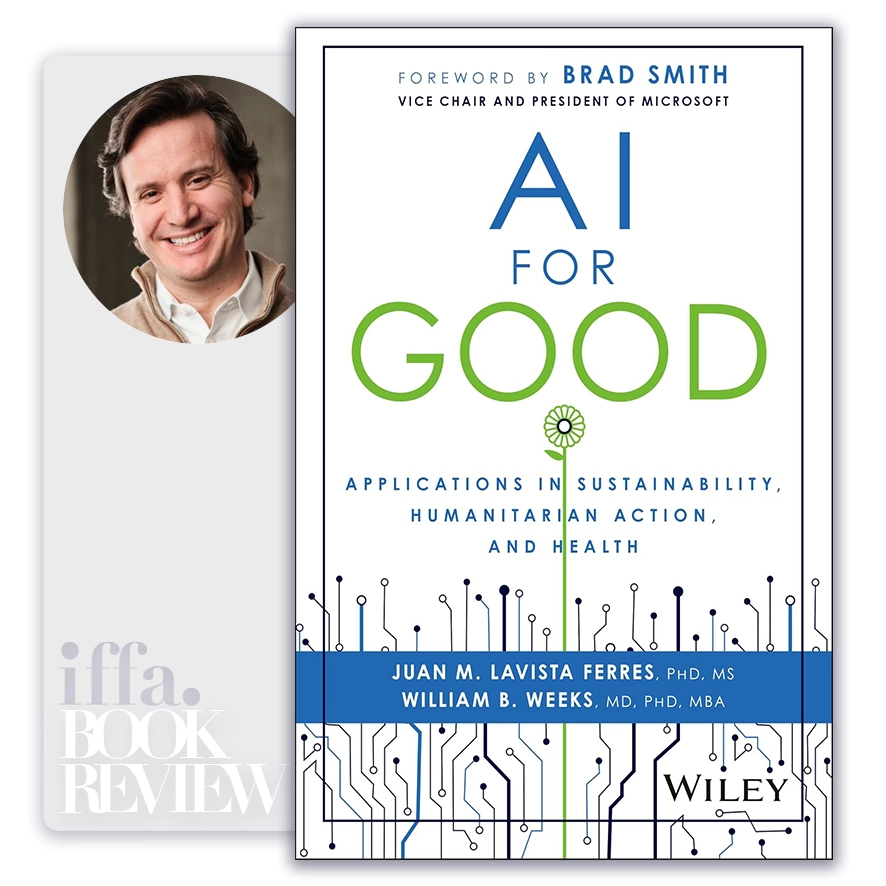
by Juan M. Lavista Ferres
Summary Overview:
AI for Good arrives at a pivotal moment when artificial intelligence is scaling faster than the institutions meant to guide it. Juan M. Lavista Ferres reframes AI not as an abstract technological leap, but as a practical instrument for solving real, systemic problems—from health and climate to inclusion and disaster response. The book matters because it shifts the conversation away from speculative risk and toward responsible application grounded in outcomes.
For CEOs, board members, policymakers, and long-term investors, the relevance is immediate. AI is already reshaping decision-making, productivity, and competitive dynamics. Yet without purpose and governance, its deployment risks amplifying inequality, bias, and short-termism. AI for Good addresses a deeper leadership challenge: how to align powerful technologies with human values, institutional accountability, and long-term societal benefit. It argues that the most enduring advantage will accrue to organizations that design AI with intent, ethics, and impact at the core.
About The Author
Juan M. Lavista Ferres is a technology executive and data scientist best known for leading global initiatives that apply AI to social and environmental challenges. His work bridges advanced analytics with public-interest outcomes.
Lavista Ferres’ perspective is distinctive because it is execution-oriented and impact-driven. He focuses on how AI systems are built, governed, and deployed in the real world—where trade-offs, constraints, and accountability matter.
Core Idea:
The central thesis of AI for Good is that AI delivers its greatest value when it is purposefully directed at human and planetary challenges, not merely optimized for efficiency or profit. Lavista Ferres argues that intent, data stewardship, and governance determine whether AI becomes a catalyst for progress or a source of unintended harm.
At a deeper level, the book presents a worldview in which technology is inseparable from responsibility. Algorithms encode priorities; datasets reflect values. Leaders therefore shape outcomes not only through what AI can do, but through what they choose to apply it to, how they measure success, and how they govern risk.
AI becomes a force for good only when purpose precedes performance.
Key Concepts:
- Purpose-Driven AI Outperforms Opportunistic AI
Impact follows intention.
- Clear social objectives guide model design.
- Vague goals invite misuse and drift.
- Data Is a Moral Asset
Data quality and provenance shape outcomes.
- Bias enters through data, not code alone.
- Stewardship determines trust.
- Measurement Must Reflect Impact
Success metrics shape behavior.
- Efficiency metrics miss societal outcomes.
- Impact metrics align incentives.
- Partnerships Enable Scale
Complex problems require collaboration.
- Public–private ecosystems accelerate adoption.
- Isolation limits reach.
- Ethics Must Be Operationalized
Principles require mechanisms.
- Governance embeds values into workflows.
- Intent without controls is insufficient.
- Inclusion Improves Performance
Diverse teams and stakeholders matter.
- Inclusion reduces blind spots.
- Equity strengthens system robustness.
- AI Can Enhance Resilience
Predictive insights support preparedness.
- Early signals improve response.
- Prevention outperforms reaction.
- Transparency Builds Legitimacy
Explainability sustains confidence.
- Opacity undermines adoption.
- Trust enables scale.
- Human Oversight Is Non-Negotiable
Judgment remains essential.
- Automation without accountability is risk.
- Humans anchor responsibility.
- Leadership Determines Direction
Technology follows governance.
- Leadership intent shapes deployment.
- Values guide prioritization.
Technology amplifies intent faster than it creates wisdom.
Executive Insights:
AI for Good reframes AI strategy as a governance and leadership question, not merely a technical one. Organizations that deploy AI without clarity of purpose risk reputational harm, regulatory exposure, and strategic fragility. Those that integrate ethics, impact metrics, and cross-sector collaboration build durable advantage and legitimacy.
For boards and senior leaders, the implication is clear: AI strategy must be evaluated alongside risk, culture, and long-term value creation. Competitive differentiation will increasingly favor institutions that can demonstrate not just capability, but responsible impact at scale.
- Purpose alignment reduces AI risk.
- Governance converts principles into practice.
- Impact metrics strengthen credibility.
- Transparency accelerates adoption.
- Leadership intent determines outcomes.
Actionable Takeaways:
Responsible AI leadership requires intentional design.
- Define societal objectives before deploying AI.
- Treat data governance as a strategic priority.
- Measure success by impact, not efficiency alone.
- Embed ethical oversight into AI lifecycles.
- Maintain human accountability at decision points.
Final Thoughts:
AI for Good is a pragmatic call for technological stewardship. Juan M. Lavista Ferres shows that AI’s promise is not realized by scale or sophistication alone, but by alignment with human goals and institutional responsibility. The future of AI will be judged less by what it can do, and more by what leaders choose to do with it.
For executives shaping long-term trajectories, the book offers a durable insight: AI is a multiplier of values already present. When guided by purpose, it accelerates progress; when guided by neglect, it amplifies harm.
In the long run, the question is not whether AI will shape society—but whether leadership will shape AI.
The ideas in this book go beyond theory, offering practical insights that shape real careers, leadership paths, and professional decisions. At IFFA, these principles are translated into executive courses, professional certifications, and curated learning events aligned with today’s industries and tomorrow’s demands. Discover more in our Courses.
Applied Programs

- Course Code : SBM-409
- Delivery : In-class / Virtual / Workshop
- Duration : 2-4 Days
- Venue: DUBAI HUB

- Course Code : PMA-613
- Delivery : In-class / Virtual / Workshop
- Duration : 3-5 Days
- Venue: DUBAI HUB

- Course Code : CIF-505
- Delivery : In-class / Virtual / Workshop
- Duration : 3-5 Days
- Venue: DUBAI HUB

- Course Code : CIF-512
- Delivery : In-class / Virtual / Workshop
- Duration : 2-4 Days
- Venue: DUBAI HUB
Related Books