
The Executive Summary of
Good to Great
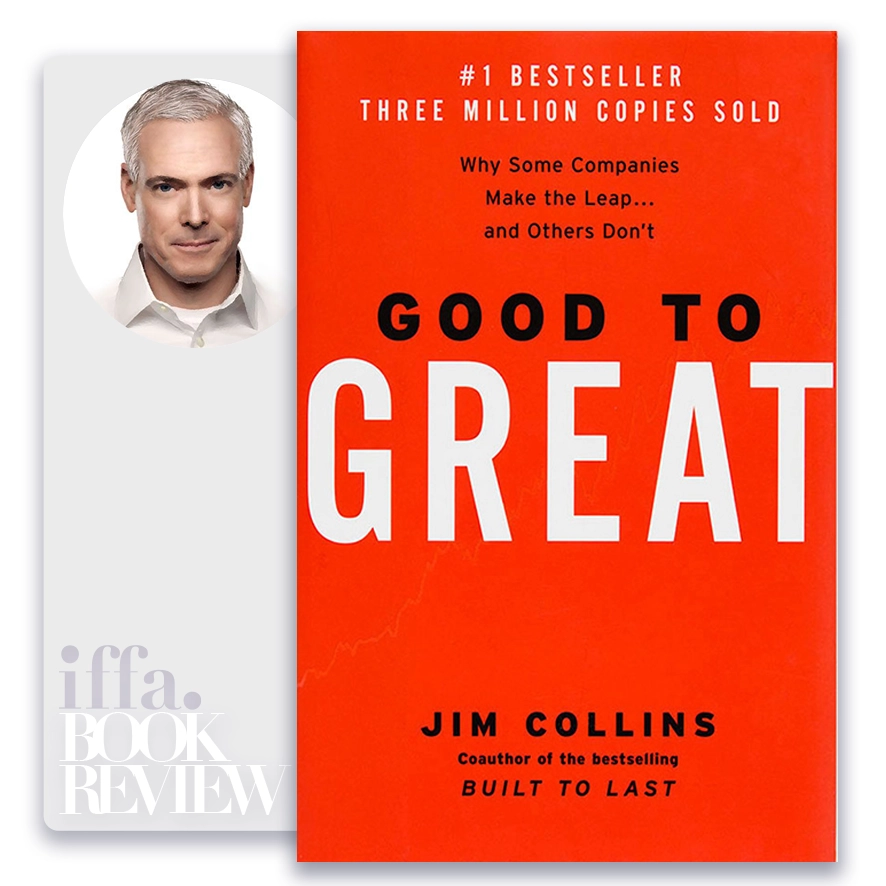
by Jim Collins
Executive Summary:
In a business world obsessed with fast growth, charismatic leadership, and breakthrough strategies, Good to Great delivers a counterintuitive insight: sustained excellence is not driven by hype, hero leaders, or bold transformations—but by disciplined thinking and consistent execution over time. Jim Collins’ research-driven approach dismantles many popular management myths and replaces them with evidence-based principles that endure across industries and cycles.
Good to Great matters because most organizations do not fail from lack of ambition—they fail from undisciplined growth, premature scaling, and leadership ego. Collins shows why only a small fraction of companies make the leap from good performance to sustained greatness—and why most attempts stall or collapse. For executives, board members, and senior leaders, this book offers a practical blueprint for building organizations that outperform not briefly, but durably.
About The Author
Jim Collins is a renowned management researcher, educator, and author known for combining rigorous empirical research with practical leadership insights. His work is widely respected because it is data-driven, longitudinal, and grounded in real organizational outcomes.
Collins’ perspective is unique in that he focuses less on trends and personalities and more on what consistently works over decades, making his conclusions highly relevant for long-term enterprise leadership.
Core Idea:
The central thesis of Good to Great is clear and evidence-backed:
Greatness is not a function of circumstance, charisma, or luck—it is the result of disciplined people, disciplined thought, and disciplined action.
Collins’ research examined companies that made the leap from average or good performance to sustained market-beating results, outperforming peers for at least 15 years. He found that greatness does not happen overnight and rarely begins with a dramatic moment. Instead, it emerges through quiet, methodical buildup followed by visible momentum.
The book reframes success as a process, not an event, and leadership as a system-building discipline rather than individual brilliance.
Great leaders look out the window for success and in the mirror for failure.
Key Concepts:
- Level 5 Leadership
The highest-performing companies were led by Level 5 Leaders—individuals who combined personal humility with intense professional will.
These leaders:
- Credit success to others
- Take responsibility for failure
- Focus on long-term organizational health
- Avoid personal celebrity or ego-driven leadership
- First Who, Then What
Great companies prioritize getting the right people on the bus before deciding where to drive it.
This principle emphasizes:
- Hiring for character and capability
- Removing wrong-fit people early
- Trusting strong teams to adapt strategy
Strategy changes, markets evolve—but the right people make the organization resilient.
- Confront the Brutal Facts (The Stockdale Paradox)
Organizations that go from good to great maintain absolute faith in long-term success while simultaneously confronting harsh realities without denial.
This balance prevents:
- Blind optimism
- Data manipulation
- Strategic delusion
- The Hedgehog Concept
Great companies simplify complexity into a single, powerful organizing idea—the Hedgehog Concept, formed at the intersection of:
- What you can be the best in the world at
- What drives your economic engine
- What you are deeply passionate about
This is not a mission statement—it is a strategic filter for decision-making.
- Culture of Discipline
Greatness emerges when disciplined people engage in disciplined thought and take disciplined action—without excessive bureaucracy.
Key characteristics include:
- Freedom within a clear framework
- Accountability without micromanagement
- Consistency without rigidity
Discipline replaces control.
- Technology as an Accelerator, Not a Driver
Technology does not cause greatness—it accelerates momentum already in motion. Great companies adopt technology selectively, aligned with their Hedgehog Concept.
Technology amplifies discipline; it does not create it.
- The Flywheel Effect
Transformation is not revolutionary—it is cumulative. Progress builds through consistent, reinforcing actions until momentum becomes self-sustaining.
There is no single defining moment—only persistent execution.
You must never confuse faith that you will prevail with the discipline to confront brutal facts.
Executive Insights:
Good to Great reframes leadership away from quick wins and toward institutional durability. It highlights that sustained success is built through people, culture, and disciplined systems, not dramatic change programs.
Strategic Implications for Leaders:
- Leadership humility outperforms charisma
- Talent decisions precede strategy decisions
- Clarity beats complexity
- Discipline reduces the need for control
- Momentum is built, not announced
Actionable Takeaways:
The principles in Good to Great can be directly applied across corporate strategy, governance, talent management, and operational execution.
Practical Actions for Executives:
- Assess leadership behavior against Level 5 criteria
- Upgrade talent before redefining strategy
- Create mechanisms for confronting reality
- Define and enforce your Hedgehog Concept
- Build discipline into culture, not bureaucracy
- Focus on consistent execution over dramatic initiatives
Final Thoughts:
Good to Great is a quietly powerful guide to building enduring organizations. Its message is both humbling and empowering: greatness is a choice, sustained through discipline, clarity, and patience.
In a world chasing rapid transformation, the companies that endure are those that master consistency.
To conclude, the ideas explored in this book go far beyond theory; they offer practical insight that can shape real careers, leadership paths, and professional decisions.
At IFFA, these same principles are transformed into structured executive training courses, professional certifications, and curated learning events designed to align with today’s industries and tomorrow’s demands. Find out more on Courses.
Applied Programs

- Course Code : SBM-409
- Delivery : In-class / Virtual / Workshop
- Duration : 2-4 Days
- Venue: DUBAI HUB

- Course Code : PMA-613
- Delivery : In-class / Virtual / Workshop
- Duration : 3-5 Days
- Venue: DUBAI HUB

- Course Code : CIF-505
- Delivery : In-class / Virtual / Workshop
- Duration : 3-5 Days
- Venue: DUBAI HUB

- Course Code : CIF-512
- Delivery : In-class / Virtual / Workshop
- Duration : 2-4 Days
- Venue: DUBAI HUB
Related Books