
The Executive Summary of
Toyota Production System: Beyond Large-Scale Production
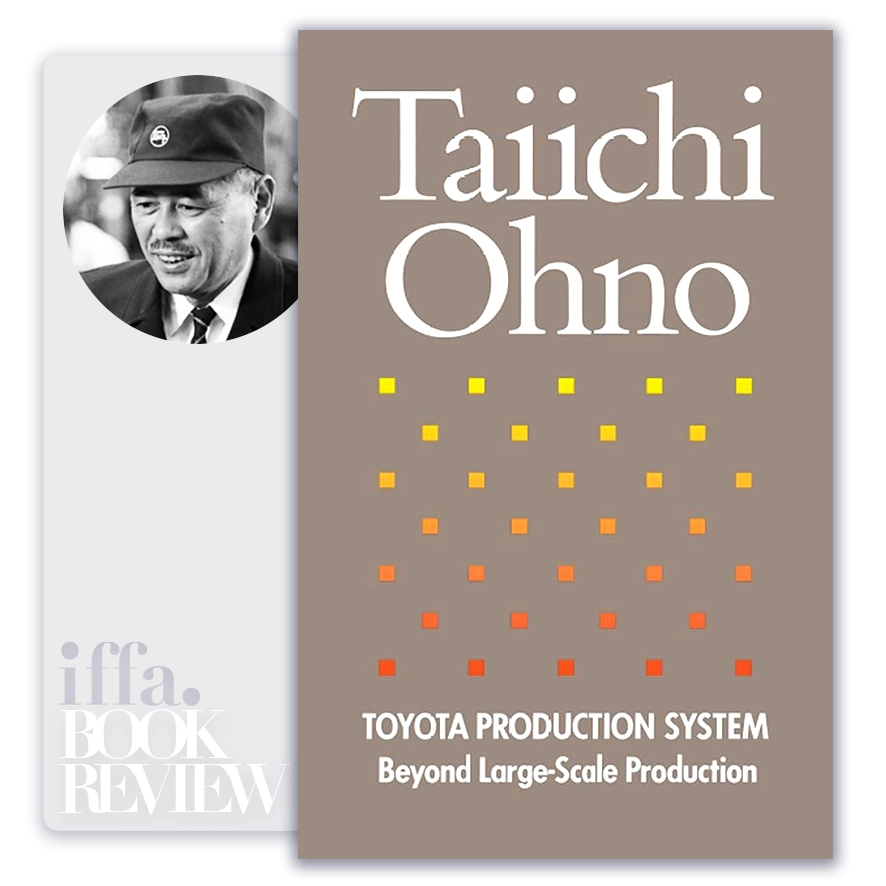
by Taiichi Ohno
Summary Overview:
Toyota Production System: Beyond Large-Scale Production is one of the most consequential management works of the modern era, not because it offers techniques, but because it redefines how organizations should think about work, efficiency, and value creation. Taiichi Ohno wrote in response to a dominant industrial logic that equated scale with success and utilization with efficiency. His argument remains deeply relevant as organizations today confront complexity, volatility, sustainability pressures, and fragile global supply chains.
For CEOs, board members, COOs, and long-term investors, this book matters because it exposes a critical truth: many operational problems are self-inflicted by management systems that reward activity instead of value. Ohno demonstrates that real productivity does not come from producing more, faster, or bigger—but from producing only what is needed, when it is needed, with minimal waste and maximum learning. In an age of constrained resources and rising uncertainty, the Toyota Production System (TPS) is not an efficiency model; it is a governance philosophy for operations.
About The Author
Taiichi Ohno was an industrial engineer and executive at Toyota, widely regarded as the architect of the Toyota Production System. His work fundamentally reshaped manufacturing and later influenced global management thinking through what became known as Lean.
Ohno’s authority comes from building systems under constraint. Operating in post-war Japan with limited capital, space, and demand, he developed a production philosophy grounded in necessity, observation, and relentless questioning, rather than theory or abundance.
Core Idea:
The central thesis of Toyota Production System: Beyond Large-Scale Production is that efficiency is achieved by eliminating waste, not by maximizing output. Ohno challenges the logic of mass production, arguing that overproduction, excess inventory, waiting, and rework are symptoms of poor system design rather than unavoidable costs of scale.
At a deeper level, the book presents a worldview in which management’s primary responsibility is to design systems that expose problems rather than hide them. TPS treats instability, defects, and delays as signals for learning. By aligning flow, pull, and human judgment, organizations can achieve both high quality and flexibility without relying on buffers or heroic effort.
Waste is anything that does not add value from the customer’s point of view.
Key Concepts:
- Overproduction Is the Root Waste
Ohno identifies overproduction as the most dangerous form of waste.
- It hides defects, delays, and imbalance.
- Producing ahead of demand creates systemic blindness.
- Just-in-Time as a Thinking System
JIT is not a scheduling trick but a discipline of alignment.
- Produce only what is needed, when it is needed.
- Timing replaces volume as the control mechanism.
- Inventory Conceals Problems
Excess inventory masks poor quality and weak processes.
- Inventory delays learning.
- Reducing buffers exposes reality.
- Flow Reveals System Health
Smooth flow is a diagnostic tool.
- Interruptions signal design flaws.
- Stability must be engineered, not demanded.
- Pull Replaces Forecast-Driven Push
Demand should trigger production, not forecasts alone.
- Pull systems reduce distortion.
- Forecast error is absorbed, not amplified.
- Standard Work Enables Improvement
Standards are not constraints but baselines for learning.
- Without standards, improvement is impossible.
- Consistency precedes innovation.
- People Are Problem-Solvers, Not Costs
Ohno rejects the idea of labor as a variable expense.
- Human judgment is central to system improvement.
- Respect enables responsibility.
- Visual Control Creates Transparency
Problems should be visible at a glance.
- Hidden problems persist.
- Visibility accelerates response.
- Management Must Go to the Source
Decisions cannot be made from reports alone.
- Direct observation sharpens judgment.
- Distance weakens accountability.
- Improvement Is Endless
There is no final state of efficiency.
- Kaizen is a mindset, not a project.
- Complacency is the ultimate waste.
True efficiency appears only after unnecessary work has been eliminated.
Executive Insights:
The Toyota Production System reframes operations as a leadership responsibility rooted in system design, not worker performance. Ohno shows that many inefficiencies blamed on people are in fact consequences of management choices—batching policies, utilization targets, incentive structures, and information delays.
For boards and senior executives, the implication is profound: operational excellence cannot be delegated or automated into existence. It requires leaders who understand flow, respect frontline insight, and are willing to remove comfort buffers that obscure reality. TPS is not about cost-cutting; it is about building organizations that learn faster than their competitors.
- Waste reduction improves quality and resilience simultaneously.
- Transparency strengthens accountability.
- Human judgment outperforms rigid automation.
- Stability enables strategic flexibility.
- Long-term advantage comes from learning speed, not scale.
Actionable Takeaways:
Enduring operational excellence begins with disciplined design.
- Eliminate overproduction before optimizing anything else.
- Design systems that expose problems early.
- Treat inventory as a warning signal, not a solution.
- Align production with real demand, not internal targets.
- Invest in people as system improvers, not cost centers.
Final Thoughts:
Toyota Production System: Beyond Large-Scale Production is not a manufacturing manual; it is a philosophy of restraint, respect, and realism. Taiichi Ohno teaches that strength comes not from doing more, but from doing only what matters—and doing it well. His ideas endure because they confront human and organizational tendencies toward excess, comfort, and illusion.
For leaders responsible for long-term performance, the book offers a timeless insight: organizations do not fail because work is hard, but because systems are poorly designed. When waste is removed and learning is continuous, efficiency follows naturally.
In the long run, the most competitive organizations are not the biggest producers—but the best thinkers about work itself.
The ideas in this book go beyond theory, offering practical insights that shape real careers, leadership paths, and professional decisions. At IFFA, these principles are translated into executive courses, professional certifications, and curated learning events aligned with today’s industries and tomorrow’s demands. Discover more in our Courses.
Applied Programs

- Course Code : SBM-409
- Delivery : In-class / Virtual / Workshop
- Duration : 2-4 Days
- Venue: DUBAI HUB
- Course Code : PMA-613
- Delivery : In-class / Virtual / Workshop
- Duration : 3-5 Days
- Venue: DUBAI HUB

- Course Code : CIF-505
- Delivery : In-class / Virtual / Workshop
- Duration : 3-5 Days
- Venue: DUBAI HUB

- Course Code : CIF-512
- Delivery : In-class / Virtual / Workshop
- Duration : 2-4 Days
- Venue: DUBAI HUB
Related Books