
The Executive Summary of
The Wisdom of Finance
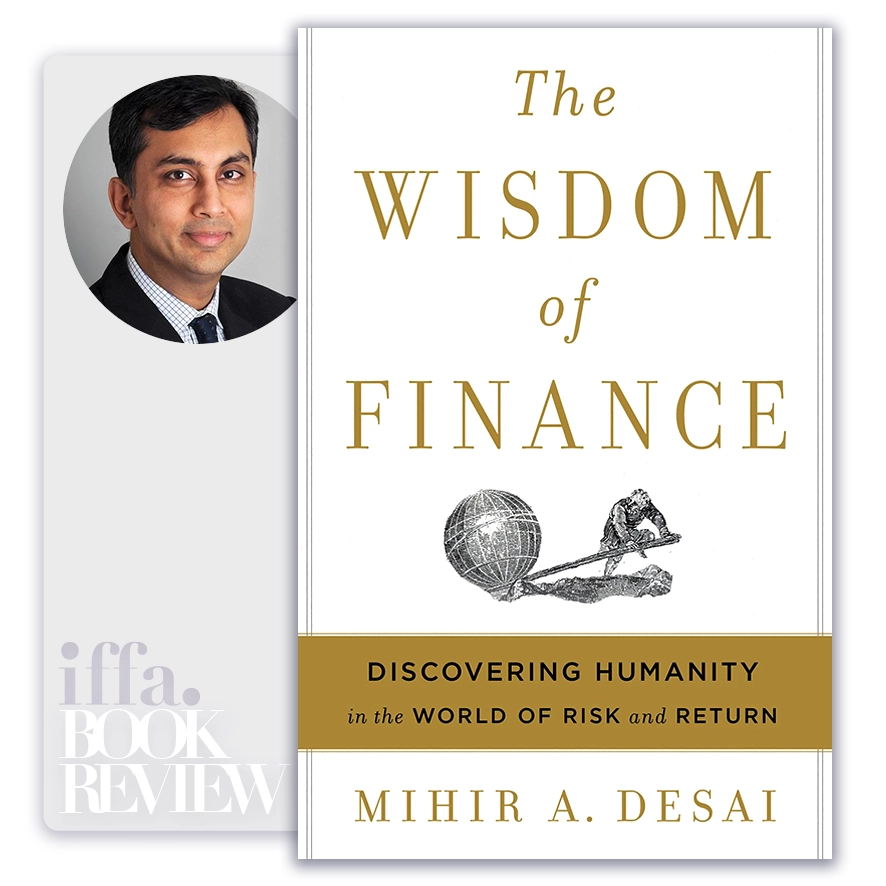
by Mihir A. Desai
Summary Overview:
Finance is often perceived as cold, mathematical, and morally neutral—a domain of spreadsheets, valuation models, and abstract risk calculations detached from everyday human experience. The Wisdom of Finance matters because it challenges this narrow view and reclaims finance as a deeply human discipline, one that reflects our fears, hopes, ethical struggles, and aspirations. Mihir A. Desai argues that finance is not merely about money; it is about how we choose under uncertainty, how we balance risk and security, and how we define success and failure in life as well as in business.
For executives, board members, investors, policymakers, and leaders, this book offers a rare perspective. Rather than teaching finance as technique, Desai reframes it as applied wisdom—a way of thinking that draws equally from economics, literature, philosophy, and lived experience. In an era of market volatility, financial crises, inequality debates, and ethical scrutiny, The Wisdom of Finance helps leaders reconnect financial decision-making with judgment, responsibility, and meaning.
About The Author
Mihir A. Desai is a professor of finance at Harvard Business School and Harvard Law School, with extensive expertise in corporate finance, taxation, and international economics. He has advised governments, global corporations, and institutional investors, and is widely respected for his ability to bridge theory and practice.
What distinguishes Desai is his unusual intellectual range. Rather than isolating finance from the humanities, he integrates insights from Shakespeare, Greek tragedy, modern novels, and moral philosophy to illuminate financial behavior. This interdisciplinary lens gives the book its originality and depth, making it especially valuable for senior leaders who already understand finance technically but seek greater perspective and wisdom.
Core Idea:
At the heart of The Wisdom of Finance lies a profound and disarming idea:
Finance is a way of understanding life’s fundamental trade-offs—between risk and safety, present and future, ambition and humility.
Desai argues that finance, when properly understood, is not amoral or dehumanizing. Instead, it is a language for grappling with uncertainty, helping individuals and institutions make choices when outcomes are unknown and stakes are high. By connecting financial concepts to timeless stories and human dilemmas, the book shows that finance mirrors the same questions explored by great literature: What do we value? What are we willing to risk? How do we live with the consequences of our choices?
Finance is not just about maximizing returns, it is about making thoughtful choices under uncertainty that reflect our values and priorities.
Key Concepts:
- Finance as a Human Narrative, Not Just a Technical Discipline
Desai reframes finance as storytelling. Balance sheets, valuations, and forecasts are narratives about the future—attempts to make sense of uncertainty. Like literature, finance relies on assumptions, interpretation, and belief. This perspective encourages leaders to recognize that financial models do not reveal truth; they express a point of view about risk and possibility.
- Risk Is Inescapable—and Avoiding It Is Also a Choice
A central theme of the book is that risk cannot be eliminated, only redistributed. Choosing safety, diversification, or insurance does not remove risk; it merely shifts it across time, people, or institutions. Desai emphasizes that risk avoidance can be as consequential as risk-taking, often leading to missed opportunity, stagnation, or hidden fragility.
- Time Is the Most Underestimated Variable in Finance
Finance is fundamentally about time—discounting the future, valuing patience, and managing delayed consequences. Desai links financial discounting to human impatience and short-termism, showing how excessive focus on immediate results undermines long-term value creation. Leaders who understand time as a strategic variable make more resilient decisions.
- Leverage Amplifies Both Strength and Fragility
Leverage is not merely a financial tool; it is a metaphor for ambition. Desai explains how leverage magnifies outcomes, turning small errors into existential threats. The book connects financial leverage to personal and organizational behavior, highlighting how overconfidence and moral hazard often accompany leveraged strategies.
- Diversification as a Life Principle, Not Just an Investment Strategy
Beyond portfolio theory, diversification reflects a broader philosophy: do not tie your entire identity, security, or future to a single outcome. Desai uses this concept to explore careers, relationships, and institutions, arguing that concentration increases vulnerability, while diversification fosters resilience.
- Optionality and the Value of Keeping Doors Open
Optionality—the ability to choose among alternatives as uncertainty resolves—is a recurring theme. Desai shows that financial flexibility has moral and strategic dimensions. Leaders who preserve options maintain freedom, adaptability, and dignity in the face of change. Optionality, in this sense, becomes a form of wisdom.
- Failure Is an Integral Part of Intelligent Risk-Taking
Drawing on both finance and literature, the book treats failure not as deviation, but as an expected companion to ambition. Avoiding all failure often means avoiding meaningful action. The challenge for leaders is not to prevent failure entirely, but to fail in ways that are survivable and instructive.
- Incentives Shape Behavior More Than Intentions
Desai emphasizes that well-meaning individuals can produce harmful outcomes when incentives are misaligned. This insight, central to finance, applies equally to governance, leadership, and public policy. Understanding incentives is essential for designing systems that promote long-term value rather than short-term exploitation.
- Ethics Cannot Be Outsourced to Models or Markets
One of the book’s strongest arguments is that financial systems do not absolve individuals of moral responsibility. Models can inform decisions, but they cannot determine what is right. Desai insists that ethical judgment remains a human obligation, especially when decisions affect others’ livelihoods, savings, and futures.
- Wisdom Lies in Balancing Ambition with Humility
Ultimately, The Wisdom of Finance calls for humility—recognition of uncertainty, limits of knowledge, and the fallibility of judgment. Ambition without humility leads to recklessness; caution without ambition leads to inertia. The art of finance, like the art of living, lies in balancing these opposing forces.
The greatest failures in finance occur not when calculations are wrong, but when judgment, humility, and ethical awareness are absent.
Executive Insights:
The Wisdom of Finance reframes financial leadership as judgment under uncertainty infused with ethical awareness. It suggests that technical mastery, while necessary, is insufficient without perspective, humility, and moral clarity.
For executives and boards, the book implies that:
- Financial decisions are always value-laden
- Risk management is as much cultural as technical
- Short-term optimization often undermines long-term purpose
- Leadership requires comfort with ambiguity
- Ethical failures often masquerade as technical successes
Organizations that treat finance as purely mechanical risk becoming efficient—but unwise.
Actionable Takeaways:
For senior leaders, the book encourages integrating financial reasoning with broader reflection on values and consequences. Boards are reminded to evaluate not only outcomes, but decision logic and ethical context. Investors are urged to consider time horizons, resilience, and optionality alongside returns.
Practical reflections include:
- Designing incentives that reward long-term judgment
- Stress-testing decisions for ethical and social impact
- Preserving flexibility rather than maximizing leverage
- Encouraging financial literacy that includes moral reasoning
Final Thoughts:
The Wisdom of Finance is not a traditional finance book—and that is its greatest strength. Mihir A. Desai restores depth, humanity, and perspective to a field too often reduced to technique. By weaving finance together with literature and philosophy, he shows that financial decisions are ultimately decisions about how we live, lead, and take responsibility under uncertainty.
For leaders who already know the formulas, this book offers something rarer and more valuable:
Not more knowledge—but better judgment.
In finance, as in life, wisdom is not about eliminating risk.
It is about choosing well, with eyes open, values intact, and humility intact.
The ideas in this book go beyond theory, offering practical insights that shape real careers, leadership paths, and professional decisions. At IFFA, these principles are translated into executive courses, professional certifications, and curated learning events aligned with today’s industries and tomorrow’s demands. Discover more in our Courses.
Applied Programs

- Course Code : SBM-409
- Delivery : In-class / Virtual / Workshop
- Duration : 2-4 Days
- Venue: DUBAI HUB

- Course Code : PMA-613
- Delivery : In-class / Virtual / Workshop
- Duration : 3-5 Days
- Venue: DUBAI HUB

- Course Code : CIF-505
- Delivery : In-class / Virtual / Workshop
- Duration : 3-5 Days
- Venue: DUBAI HUB

- Course Code : CIF-512
- Delivery : In-class / Virtual / Workshop
- Duration : 2-4 Days
- Venue: DUBAI HUB
Related Books