
The Executive Summary of
Risk Management and Financial Institutions
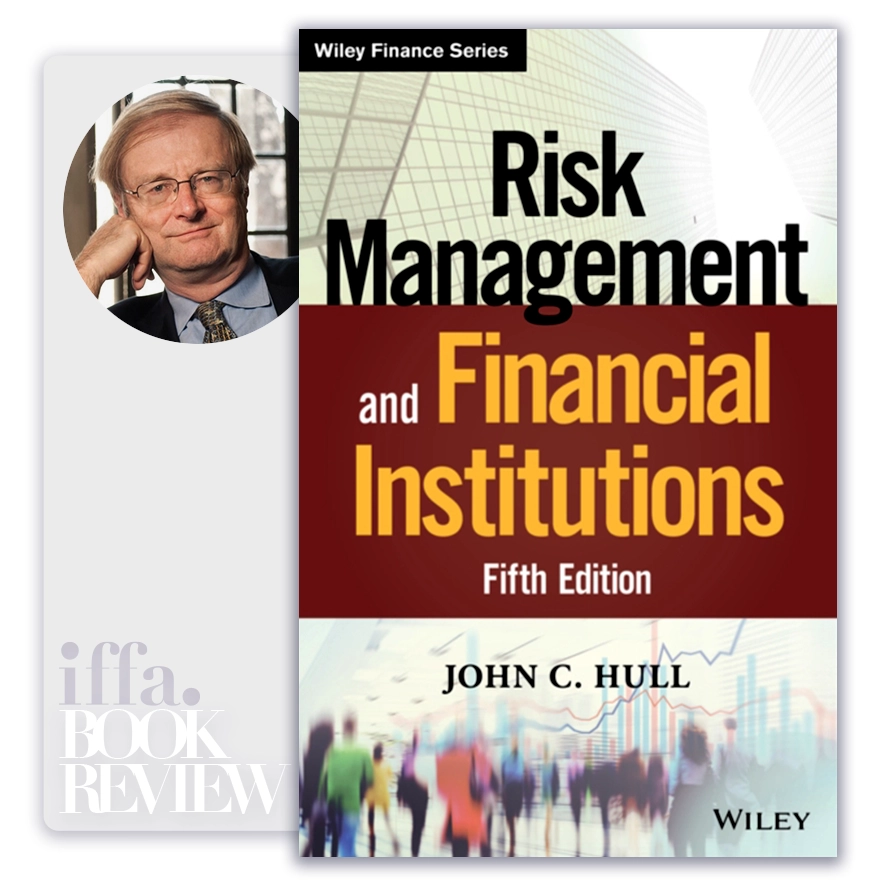
by John C. Hull
Summary Overview:
Modern financial institutions do not fail because they lack intelligence, capital, or sophisticated models—they fail because risk is misunderstood, mispriced, or poorly governed. Risk Management and Financial Institutions is one of the most authoritative works explaining how risk actually propagates through financial systems, and why even well-capitalized institutions can collapse when risk management becomes fragmented, mechanical, or complacent.
This book matters because today’s financial environment is defined by leverage, interconnectedness, speed, and complexity. Banks, insurers, asset managers, and regulators operate inside systems where small shocks can escalate into systemic crises. John C. Hull provides not just technical tools, but a conceptual framework for understanding credit risk, market risk, liquidity risk, operational risk, and systemic risk—showing how they interact, amplify one another, and ultimately threaten institutional survival. For executives and board members, this book is a core reference for risk governance, not just quantitative modeling.
About The Author
John C. Hull is a professor of finance and one of the world’s leading authorities on derivatives, risk management, and financial engineering. His textbooks are widely used by practitioners, regulators, and academic institutions globally.
Hull’s credibility comes from his ability to bridge theory and practice. He does not present risk management as an abstract mathematical exercise, but as a discipline shaped by incentives, regulation, institutional structure, and human behavior.
Core Idea:
The central thesis of Risk Management and Financial Institutions is rigorous and unambiguous:
Risk cannot be eliminated—only identified, measured, allocated, and governed. Institutions fail when they treat risk management as a technical function rather than a strategic one.
Hull emphasizes that risk management is not about predicting the future perfectly, but about:
- Understanding exposure
- Building resilience
- Ensuring survival under stress
- Aligning incentives with long-term stability
Risk is not a side issue—it is the defining constraint of financial strategy.
Risk categories do not operate in isolation, crises occur when they converge.
Key Concepts:
- The Fundamental Categories of Financial Risk
Hull systematically categorizes the main risks faced by financial institutions:
- Market Risk – losses from movements in prices, interest rates, FX, and commodities
- Credit Risk – counterparty default or deterioration in credit quality
- Liquidity Risk – inability to meet obligations when due
- Operational Risk – failures of systems, processes, or people
- Systemic Risk – risk of collapse due to interconnections
Risk categories do not operate in isolation—crises occur when they converge. Effective risk management requires integration, not silos.
- Value at Risk (VaR): Usefulness and Limitations
One of the book’s central tools is Value at Risk (VaR)—a statistical estimate of potential losses over a given horizon and confidence level.
Hull explains:
- Why VaR became widely adopted
- How it standardizes risk measurement
- How it enables capital allocation
But he also highlights its critical limitations:
- Poor performance in extreme events
- Dependence on historical data
- False sense of precision
VaR measures typical losses—not catastrophic ones. Institutions that rely on VaR alone optimize for normality and fail under stress.
- Stress Testing and Scenario Analysis
Hull strongly emphasizes stress testing as a corrective to model blindness.
Stress testing asks:
- What happens if correlations spike?
- What if liquidity disappears?
- What if counterparties fail simultaneously?
Unlike VaR, stress tests:
- Embrace tail risk
- Explore structural failure
- Challenge assumptions
The most important risks are those models assume away. Stress testing is a governance tool, not just a quantitative one.
- Credit Risk and Default Modeling
Hull explains how credit risk is assessed using:
- Probability of default (PD)
- Loss given default (LGD)
- Exposure at default (EAD)
He shows how:
- Credit risk concentrates invisibly
- Correlations rise during downturns
- Rating-based systems fail under stress
The 2008 crisis demonstrated that credit risk is often systemic, not idiosyncratic.
- Liquidity Risk: The Silent Killer
One of the book’s most important lessons is that liquidity risk often matters more than solvency risk.
Institutions can fail even when:
- Assets exceed liabilities
- Capital ratios appear strong
Liquidity risk emerges when:
- Funding markets freeze
- Confidence collapses
- Assets cannot be sold
In crises, liquidity matters more than valuation. Liquidity planning is therefore existential, not technical.
- Risk Transfer Through Derivatives
Hull examines how derivatives:
- Hedge risk
- Transfer risk
- Concentrate risk
While derivatives can reduce exposure for individual firms, they can increase systemic fragility when:
- Counterparties are opaque
- Positions are leveraged
- Clearing is inadequate
Risk is never destroyed—only redistributed. Understanding where risk ends up is more important than reducing it locally.
- Capital Adequacy and Regulatory Frameworks
Hull reviews regulatory approaches such as:
- Basel I, II, III
- Capital buffers
- Leverage ratios
While regulation improves stability, Hull notes:
- Regulatory arbitrage is inevitable
- Capital rules lag innovation
- Compliance does not equal safety
Regulation reduces risk—but never replaces judgment.
- Model Risk and Overconfidence
A recurring theme is model risk—the danger of trusting models beyond their valid range.
Models fail when:
- Market structure changes
- Human behavior shifts
- Rare events occur
Hull stresses that models should inform decisions, not dictate them.
- Incentives and Risk-Taking Behavior
Risk management breaks down when:
- Bonuses reward short-term gains
- Losses are socialized
- Risk ownership is unclear
Hull implicitly reinforces a core governance truth:
bad incentives overwhelm good models.
- Systemic Risk and Interconnectedness
The book underscores how financial institutions are:
- Tightly coupled
- Highly correlated
- Vulnerable to contagion
What is safe for one institution may be dangerous for the system.
Systemic thinking is therefore essential at board and regulatory levels.
Risk is never destroyed, only redistributed.
Executive Insights:
Risk Management and Financial Institutions reframes risk management as institutional design and leadership responsibility, not a back-office function.
Strategic Implications for Leaders and Boards:
- Risk governance is strategic governance
- Liquidity outranks profitability in crises
- Models create blind spots as well as insight
- Stress beats precision
- Incentives shape risk far more than policies
- Systemic exposure matters more than standalone metrics
- Survival is the first objective of strategy
Actionable Takeaways:
Hull’s framework can be directly applied across banking, asset management, insurance, fintech, and regulation.
Practical Actions for Executives and Boards:
- Integrate risk across silos
- Treat stress testing as a decision tool
- Challenge VaR with tail-focused metrics
- Monitor liquidity daily, not quarterly
- Align compensation with long-term risk
- Map counterparty and systemic exposure
- Assume models will fail—plan accordingly
- Design governance for crisis conditions
Final Thoughts:
Risk Management and Financial Institutions is not a warning against risk-taking—it is a warning against misunderstood risk. John C. Hull shows that financial progress depends on intelligent risk-taking—but survival depends on respecting uncertainty, complexity, and human behavior.
The book’s ultimate lesson is clear:
Institutions do not collapse because risk exists—they collapse because they believe it is under control.
For leaders operating in an era of rapid innovation and systemic fragility, this book provides a foundational truth:
The most important risk management decision is not how much risk to take—but whether the institution can survive being wrong.
The ideas in this book go beyond theory, offering practical insights that shape real careers, leadership paths, and professional decisions. At IFFA, these principles are translated into executive courses, professional certifications, and curated learning events aligned with today’s industries and tomorrow’s demands. Discover more in our Courses.
Applied Programs

- Course Code : SBM-409
- Delivery : In-class / Virtual / Workshop
- Duration : 2-4 Days
- Venue: DUBAI HUB

- Course Code : PMA-613
- Delivery : In-class / Virtual / Workshop
- Duration : 3-5 Days
- Venue: DUBAI HUB

- Course Code : CIF-505
- Delivery : In-class / Virtual / Workshop
- Duration : 3-5 Days
- Venue: DUBAI HUB

- Course Code : CIF-512
- Delivery : In-class / Virtual / Workshop
- Duration : 2-4 Days
- Venue: DUBAI HUB
Related Books