

The Executive Summary of
Narrative Economics
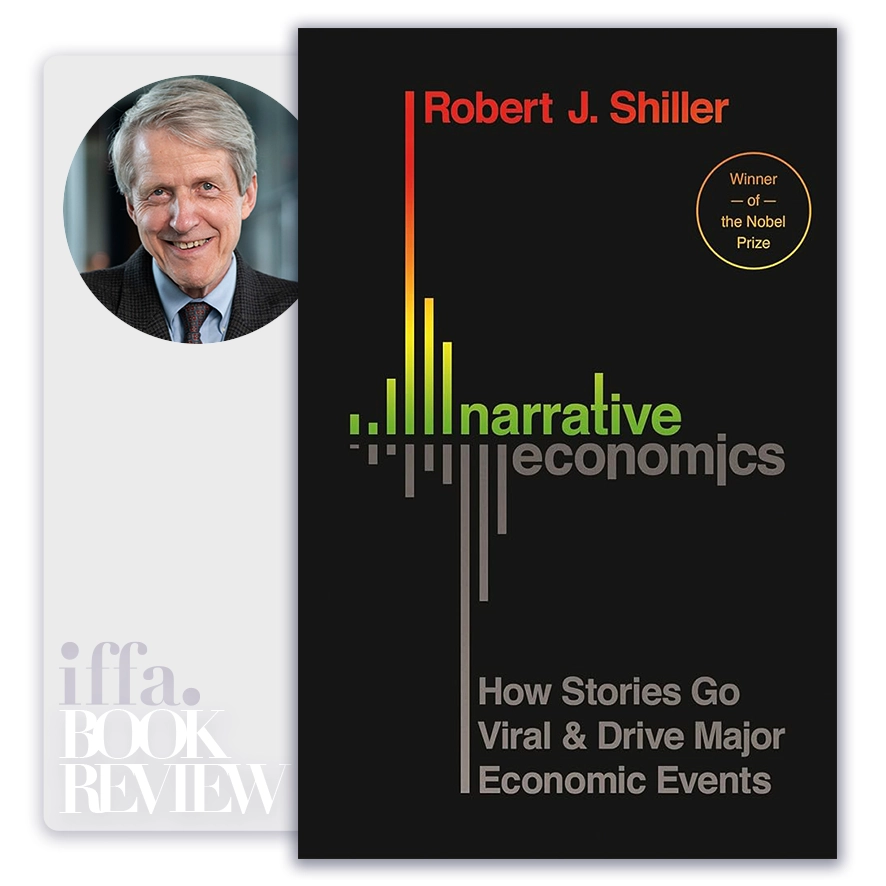
by Robert J. Shiller
Summary Overview:
Robert J. Shiller is a Nobel Prize–winning economist, professor at Yale University, and one of the world’s leading thinkers on financial markets, behavioral finance, and asset bubbles. He is widely known for identifying irrational exuberance in markets long before crises materialized.
Shiller’s credibility lies in his ability to blend rigorous economic analysis with psychological and sociological insight. Long before narrative economics was fashionable, he warned that markets are driven as much by human emotion and collective belief as by rational calculation. Narrative Economics is the culmination of decades of research into how ideas shape economic reality.
About The Author
John McMillan was a distinguished economist and professor at Stanford University, known for his work on market design, institutional economics, and comparative economic systems. He advised governments, international organizations, and policymakers on privatization, regulation, and economic reform.
McMillan’s authority stems from his pragmatic, non-ideological approach. He does not argue for markets as dogma, nor against government as principle. Instead, he asks a more powerful question: what conditions make markets work well—and what causes them to fail? His work bridges theory, history, and real-world policy design.
Core Idea:
At the heart of Narrative Economics lies a powerful and unsettling insight:
Economic outcomes are strongly influenced by popular narratives that spread contagiously and shape collective behavior.
Shiller defines economic narratives as:
- Stories or explanations about economic events
- Easily repeatable and emotionally engaging
- Widely shared through conversation, media, and culture
These narratives influence:
- Consumer spending
- Investment decisions
- Policy support
- Risk tolerance
- Market bubbles and crashes
Crucially, narratives are not always true—but they are effective. Once widely believed, they can drive behavior at scale, regardless of underlying fundamentals.
Economic ideas go viral, and when they do, they change behavior before data catches up.
Key Concepts:
- Narratives Spread Like Viruses
Shiller borrows from epidemiology to explain how narratives propagate.
Narratives:
- Emerge suddenly
- Spread through social networks
- Peak in influence
- Eventually fade or mutate
Economic ideas go viral—and when they do, they change behavior before data catches up. This viral dynamic explains why markets often overshoot—both upward and downward.
- Why Some Stories Go Viral
Not all ideas spread. Successful narratives tend to be:
- Simple
- Emotional
- Moralized
- Personalized
- Aligned with existing fears or hopes
Examples include:
- “This time is different”
- “Housing prices never fall”
- “AI will take all jobs”
- “Crypto will replace money”
The most influential economic narratives are rarely the most accurate—they are the most repeatable.
- Narratives Precede Economic Turning Points
Shiller shows that major economic events are often preceded by narrative shifts, not data shifts.
Before crashes:
- Stories of easy wealth dominate
- Skepticism is mocked
- Risk is reframed as opportunity
Before recessions:
- Fear-based narratives spread
- Uncertainty becomes contagious
- Spending slows preemptively
By the time data confirms a trend, the narrative has already moved markets.
- The Role of Media and Technology
Modern media accelerates narrative spread dramatically.
Key accelerants include:
- Social media platforms
- Financial news cycles
- Influencers and opinion leaders
- Algorithmic amplification
Narratives now:
- Spread globally in minutes
- Bypass expert filters
- Reinforce echo chambers
This increases volatility and shortens the time between belief formation and mass action.
- Narratives Shape Policy and Regulation
Economic policy is not made in a vacuum. Policymakers respond to:
- Public sentiment
- Media pressure
- Moral framing
Shiller shows how narratives influence:
- Tax policy
- Trade agreements
- Financial regulation
- Stimulus measures
Policies often respond to stories about the economy, not the economy itself.
Understanding narratives is therefore essential for public leadership and governance.
- Rationality Does Not Cancel Narrative Power
A key misconception is that narratives only affect the uninformed. Shiller argues that:
- Experts are not immune
- Intelligence does not neutralize emotion
- Social reinforcement amplifies belief
Even highly educated investors and policymakers absorb and transmit narratives unconsciously.
Narratives operate beneath awareness—especially among experts.
- The Feedback Loop Between Narratives and Markets
Narratives and economic outcomes reinforce each other.
Cycle:
- Narrative spreads
- Behavior changes
- Market moves
- Narrative gains credibility
This feedback loop explains why bubbles grow self-justifying—until they collapse.
- Measuring Narratives Is Now Possible
One of the book’s most forward-looking contributions is the argument that narratives can be tracked and measured.
Using:
- Text analysis
- Search trends
- Media frequency
- Social data
Economists can now study narrative prevalence and predict potential economic impact.
Narratives are no longer anecdotal—they are data.
This opens a new frontier for economic forecasting.
- Narratives Compete and Mutate
Narratives do not exist in isolation. They:
- Compete for attention
- Merge with others
- Evolve over time
For example:
- “Globalization creates prosperity” → “Globalization destroys jobs”
- “Innovation drives growth” → “Technology increases inequality”
Understanding narrative evolution helps leaders anticipate sentiment shifts.
- Economics Needs a Narrative Lens
Shiller does not argue against traditional economics—but for its expansion.
He proposes:
- Integrating narrative analysis into macroeconomics
- Studying storytelling alongside statistics
- Training economists to understand psychology and culture
Ignoring narratives does not make economics more scientific—it makes it incomplete.
The most influential economic narratives are rarely the most accurate, they are the most repeatable.
Executive Insights:
Narrative Economics reframes leadership, investing, and policy as belief-management challenges, not just analytical ones.
Strategic Implications for Leaders and Executives:
- Markets move on sentiment before fundamentals
- Corporate narratives affect valuation and trust
- Reputation is an economic asset
- Crisis management is narrative management
- Ignoring public stories invites strategic blind spots
Organizations that fail to understand narratives often react too late—after belief-driven behavior has already reshaped reality.
Actionable Takeaways:
For Executives and Business Leaders
- Monitor dominant narratives in your industry
- Treat storytelling as a strategic function
- Align corporate communication with economic sentiment
- Prepare counter-narratives before crises
- Understand how fear and optimism affect demand
Final Thoughts:
Narrative Economics is a foundational shift in how we understand economic reality. Robert Shiller makes a compelling case that markets are not just machines—they are conversations. Prices, policies, and cycles are shaped not only by supply and demand, but by the stories societies tell themselves about opportunity, risk, and the future.
Those who understand narratives gain a rare strategic advantage: the ability to anticipate not just what might happen—but what people will believe is happening.
The ideas in this book go beyond theory, offering practical insights that shape real careers, leadership paths, and professional decisions. At IFFA, these principles are translated into executive courses, professional certifications, and curated learning events aligned with today’s industries and tomorrow’s demands. Discover more in our Courses.
Applied Programs

- Course Code : SBM-409
- Delivery : In-class / Virtual / Workshop
- Duration : 2-4 Days
- Venue: DUBAI HUB

- Course Code : PMA-613
- Delivery : In-class / Virtual / Workshop
- Duration : 3-5 Days
- Venue: DUBAI HUB

- Course Code : CIF-505
- Delivery : In-class / Virtual / Workshop
- Duration : 3-5 Days
- Venue: DUBAI HUB

- Course Code : CIF-512
- Delivery : In-class / Virtual / Workshop
- Duration : 2-4 Days
- Venue: DUBAI HUB
Related Books