
The Executive Summary of
A Random Walk Down Wall Street
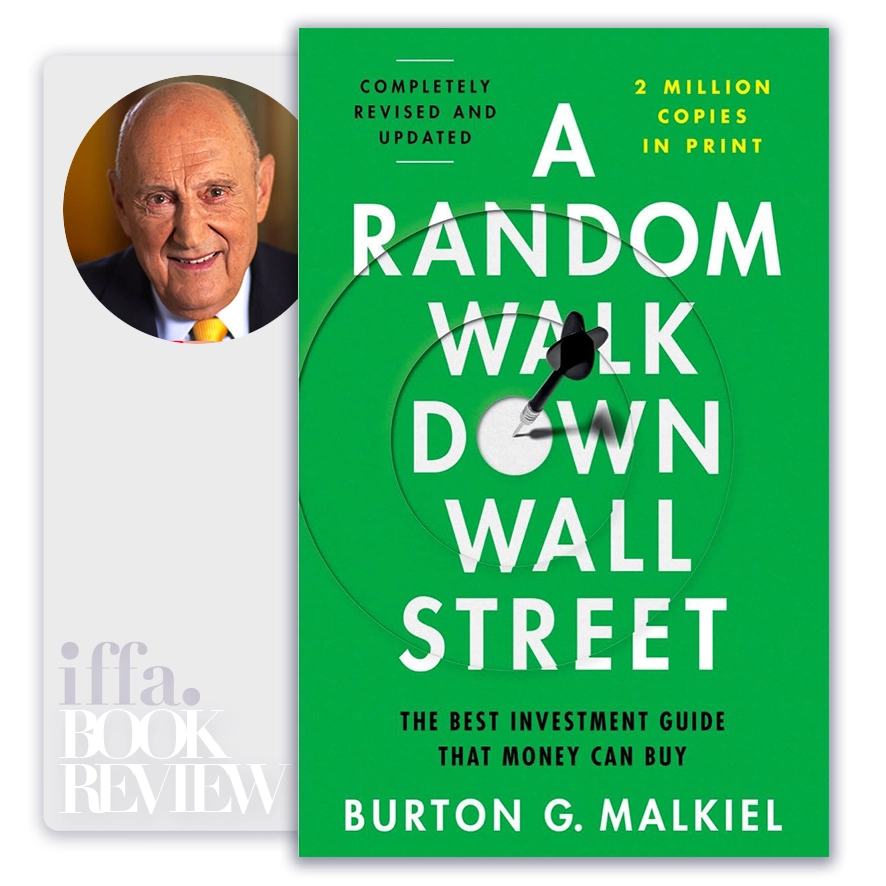
by Burton G. Malkiel
Summary Overview:
Few books have shaped modern investment thinking as profoundly—or as persistently—as A Random Walk Down Wall Street. First published in the early 1970s and continuously updated across decades of market cycles, bubbles, crashes, and technological shifts, the book remains one of the most influential works ever written on investing. Its relevance endures because it challenges a deeply ingrained belief that dominates financial markets: that superior intelligence, forecasting, or professional expertise can reliably beat the market.
For executives, board members, institutional investors, family offices, and high-net-worth individuals, this book matters because it reframes investing from a speculative pursuit into a discipline of humility, probability, and long-term thinking. In an environment flooded with financial news, algorithmic trading, influencer commentary, and short-term performance pressure, Malkiel provides a clear, evidence-based argument for why simplicity, diversification, and patience outperform complexity and prediction over time. This is not an anti-finance book; it is a pro-discipline book—one that exposes how easily intelligence and effort can be misdirected in markets dominated by uncertainty.
About The Author
Burton G. Malkiel is an economist, professor emeritus at Princeton University, and a long-time practitioner in investment management. He has served on investment committees, advised financial institutions, and contributed extensively to the academic literature on capital markets.
What makes Malkiel’s perspective unique is the combination of rigorous academic research and real-world market experience. He does not argue from ideology or theory alone; his conclusions are grounded in decades of empirical data on stock prices, mutual funds, professional managers, and market behavior across geographies and time periods.
Core Idea:
At the heart of A Random Walk Down Wall Street lies a simple but disruptive proposition:
Financial markets are highly efficient, and consistently beating them through stock selection or market timing is extraordinarily unlikely.
Malkiel introduces the concept of the “random walk”, arguing that stock price movements are largely unpredictable because new information arrives randomly—and is rapidly incorporated into prices. As a result, past price movements, technical patterns, expert forecasts, and even much fundamental analysis offer little reliable advantage in predicting future returns.
Rather than attempting to outsmart the market, Malkiel advocates an alternative philosophy: accept uncertainty, minimize costs, diversify broadly, and focus on long-term asset allocation rather than short-term prediction. This approach does not promise excitement or prestige—but it offers a far higher probability of achieving durable investment success.
Most professional investors fail to outperform the market after costs, making low-cost diversified investing the most reliable strategy for long-term wealth creation.
Key Concepts:
- The Efficient Market Hypothesis (EMH)
A central pillar of the book is the Efficient Market Hypothesis, which holds that market prices already reflect all available information.
Malkiel distinguishes between:
- Weak form efficiency (past prices offer no predictive power)
- Semi-strong efficiency (public information is quickly reflected)
- Strong form efficiency (even insider information offers limited advantage over time)
If information is widely available, it is already priced in—making consistent outperformance extraordinarily difficult.
- Why Technical Analysis Fails
The book systematically dismantles technical analysis—the practice of predicting prices using charts and patterns.
Malkiel shows that:
- Patterns often appear meaningful only in hindsight
- Apparent signals disappear once transaction costs are included
- Consistent success cannot be replicated empirically
Pattern recognition without predictive power is storytelling, not strategy.
- The Limits of Fundamental Analysis
While more credible than technical trading, even fundamental stock picking struggles to outperform the market.
Malkiel explains that:
- Analysts compete against equally informed professionals
- Errors in forecasts cancel out advantages
- Valuation models depend on uncertain assumptions
When everyone has access to the same data, insight becomes consensus—not advantage.
- Professional Managers Rarely Justify Their Fees
One of the book’s most controversial findings is that most actively managed funds underperform their benchmarks over time.
Key reasons include:
- High management fees
- Transaction costs
- Style drift
- Market impact
Costs are certain; excess returns are not—and costs compound relentlessly.
- Index Funds as a Rational Solution
Malkiel was one of the earliest and most vocal advocates of index investing.
Index funds:
- Capture market returns
- Minimize fees and turnover
- Reduce behavioral mistakes
- Outperform most active strategies over time
The market return is a generous prize—there is no need to gamble for more.
- Asset Allocation Matters More Than Security Selection
The book emphasizes that long-term investment outcomes are driven primarily by:
- Asset class mix (equities, bonds, real assets)
- Risk tolerance
- Time horizon
Choosing the right mix of assets matters far more than choosing the “right” stocks.
- Risk and Return Are Inseparable
Malkiel reinforces a foundational investment principle: higher expected returns require accepting higher volatility.
He cautions against:
- Chasing yield
- Ignoring downside risk
- Assuming past performance guarantees future safety
There is no return without risk—only risk that is hidden or misunderstood.
- Behavioral Errors Undermine Investors
Although written before behavioral finance became mainstream, the book anticipates many of its insights.
Common errors include:
- Overconfidence
- Herd behavior
- Panic selling
- Performance chasing
Investors harm themselves more through behavior than through market structure.
- Market Bubbles Are Recognizable—But Not Tradable
Malkiel acknowledges that bubbles exist but warns against assuming they can be exploited profitably.
Knowing a market is irrational does not tell you when it will become rational again.
Timing bubbles is far harder than identifying them.
- Long-Term Discipline Beats Short-Term Brilliance
The book consistently returns to one theme: investing success is cumulative and slow.
Time, patience, and discipline are the most underappreciated assets in investing.
The greatest enemy of investment success is not lack of intelligence, but overconfidence in one’s ability to predict an inherently uncertain market.
Executive Insights:
A Random Walk Down Wall Street reframes investing as risk management under uncertainty, not prediction under confidence.
Strategic Implications for Executives and Boards:
- Markets reward discipline more than intelligence
- Cost control is a strategic advantage
- Diversification is protection against ignorance
- Complexity often signals overconfidence
- Governance should emphasize long-term allocation, not short-term results
- Investment policy matters more than manager selection
Organizations and individuals that chase outperformance often accept hidden risk without realizing it.
Actionable Takeaways:
For Executives & Investors
- Adopt low-cost, diversified investment vehicles
- Focus on asset allocation aligned with risk tolerance
- Avoid frequent trading and market timing
- Ignore short-term noise and performance rankings
- Scrutinize fees and turnover
- Evaluate managers over full cycles, not quarters
- Reward discipline, not short-term luck
- Design policies that prevent emotional decision-making
Final Thoughts:
A Random Walk Down Wall Street endures because it delivers a message that is both uncomfortable and liberating: you do not need to outsmart the market to succeed—you need to avoid outsmarting yourself. Burton G. Malkiel shows that humility, diversification, and patience outperform brilliance, prediction, and activity over time.
In a world obsessed with forecasting, this book offers clarity:
Markets are uncertain.
Costs are real.
Time is powerful.
Those who internalize these truths do not just become better investors—they become better stewards of capital.
The ideas in this book go beyond theory, offering practical insights that shape real careers, leadership paths, and professional decisions. At IFFA, these principles are translated into executive courses, professional certifications, and curated learning events aligned with today’s industries and tomorrow’s demands. Discover more in our Courses.
Applied Programs

- Course Code : SBM-409
- Delivery : In-class / Virtual / Workshop
- Duration : 2-4 Days
- Venue: DUBAI HUB

- Course Code : PMA-613
- Delivery : In-class / Virtual / Workshop
- Duration : 3-5 Days
- Venue: DUBAI HUB

- Course Code : CIF-505
- Delivery : In-class / Virtual / Workshop
- Duration : 3-5 Days
- Venue: DUBAI HUB

- Course Code : CIF-512
- Delivery : In-class / Virtual / Workshop
- Duration : 2-4 Days
- Venue: DUBAI HUB
Related Books